When Will We See Real Change?

by Chris Bodenner

Scott Lucas takes stock of the situation in Egypt:

[There is] uncertainty surrounding political talks between the regime, led by Vice President Omar Suleiman, and the opposition. Government outlets were soon announcing that agreement had been reached on joint committees, including one for 5412410519_168450fd49_z Constitutional reform, free media, and an end to the military emergency. Other signals cames from the opposition side: the Muslim Brotherhood, now acknowledged by the Government for the first time in more than 50 years, said it was not negotiating but only ensuring that the regime heard the opposition point of view; representatives of the Tahrir Square protesters insisted that the immediate departure of President Mubarak remained an essential precondition; and Mohamed ElBaradei, who has been named by opposition parties to present their position, said he had not even invited to the discussions, even though his representative was there. 

Opposition sources later told media, including the BBC's Jon Leyne, that the talks had been limited to two points: constitutional changes and the procedure to implement them. That would fit the regime narrative that President Mubarak has to be replaced in an "orderly" process, involving Parliamentary approval of a replacement and a procedure for elections, rather than stepping down immediately. Given that the Parliament was dissolved last week by Mubarak, the time involved in even these limited steps would let the President enjoying his office desk for more months.

This is the process that the US, for all the confusion surrounding its position, is backing. President Obama used the occasion of American football's Super Bowl for a pre-game interview in which he got back to his Administration's mantra of "orderly transition".

Image created by Nick Bygon, who writes:

The main image is from Reuters photojournalist Amr Abdallah Dalsh and the second one is from Reuters photojournalist Goran Tomasevic. If any thanks are due, I would appreciate a message to both of them for their hard work and dedication. They have been laying their lives on the line to help document these historical moments, and it is with that same enthusiasm for memorializing those vital turning points towards total liberation that I have used their photographs, to create this illustration.

Here are links to their photos
totallycoolpix.com/wp-content/uploads/2011/28012011_egypt…
totallycoolpix.com/wp-content/uploads/2011/30012011_egypt…

I hope Reuters and Mr. Dalsh and Mr. Tomasevic will understand and allow for the free distribution of this graphic. I am not seeking any profits from this image, as all of my artwork (as seen on my flickr) is all licensed under Creative Commons, share and share alike.

They’ve Got Arianna

by Conor Friedersdorf

The Huffington Post is being acquired by AOL for $315 million.

The detail I found most interesting:

Arianna Huffington, the cable talk show pundit, author and doyenne of the political left, will take control of all of AOL’s editorial content as president and editor in chief of a newly created Huffington Post Media Group. The arrangement will give her oversight not only of AOL’s national, local and financial news operations, but also of the company’s other media enterprises like MapQuest and Moviefone.

(Obligatory Moviephone link.)

Here's Arianna Huffington's thoughts on the deal – and a video interview the heads of both companies did with Kara Swisher.

What's my opinion? I suppose that I am agnostic. I'm not that familiar with the whole of AOL's media empire. But I'm very curious to see how this plays out, and hopeful that it will be a success. The same goes for The Daily and the merger between The Daily Beast and Newsweek (full disclosure: I've written for every enterprise named in this post save The Daily.) Everybody is trying to figure out what model is going to make money on the Web – it's an exciting time to be in media, and every venture is another data point. The most interesting part of Huffington's vision is being a player in local news. There are a lot of places that could use that.

Where Cameras Can’t Go

WalkingToTahrirGetty

by Patrick Appel

Sheila Carapico considers what the news networks miss:

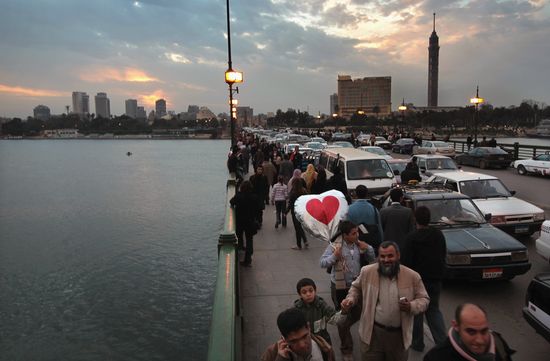
The wide-angle aerial view from television cameras trained down on Tahrir Square in central Cairo is unprecedented in the history of world revolutions. … But what television has brought to the world is only a partial reality. There is only Tahrir; the huge metropolitan expanse of Cairo and the families at home in neighborhoods are beyond the frame, oddly irrelevant. The participants in the revolution are the hundreds of thousands of demonstrators, not the equal numbers standing unpicturesque guard by night to ensure the safety of neighborhoods. TV shows a mass, not a massive group of individuals. This televised reality has become hugely controversial. 

(Photo: Traffic and pedestrians move along a bridge leading to Tahrir Square February 6, 2011 in Cairo, Egypt.)

How To Plunder The Lottery

by Zoe Pollock

Jonah Lehrer reports on Mohan Srivastava, the man who cracked the code on scratch lottery tickets:

“The lottery corporations all insist that their games are safe because they are vetted by outside companies,” Srivastava says. “Well, they had an outside auditor approve the tic-tac-toe game. They said it couldn’t be broken. But it could.” Fundamentally, he believes that creating impregnable tickets is extremely difficult, if not impossible. “There is nothing random about the lottery,” he says. “In reality, everything about the game has been carefully designed to control payouts and entice the consumer.” Of course, these elaborate design elements mean that the ticket can be undesigned, that the algorithm can be reverse-engineered. The veneer of chance can be peeled away.

The best part is Srivastava did the math and realized he could make more money consulting than gaming the system.

Palin, Inc.

PalinEmptyChair_EricThayer_Getty

by Chris Bodenner

Real American Sarah Palin is trying to trademark her name:

Politicians seldom trademark their name but they might do so to prevent others from using it, for example, to sell shoddy, unapproved merchandise or "official" candidate memorabilia. A search for other political figures such as President Barack Obama and potential 2012 GOP presidential candidates Mike Huckabee, Tim Pawlenty and Mitt Romney do not show any pending trademark applications. It is a rarity, say trademark attorneys, for political figures to file such forms.

The Palins are facing a long road in the effort to trademark their names. "Generally one can trademark one's name," said Jeffrey S. Kravitz, a Los Angeles-based intellectual property attorney. "But, it is not easy."

It becomes even more difficult when you forget to sign the application:

It seems like signing your name is not something you would forget when your name is what you're trying to trademark, but she's a busy woman.

The application also says that the mark's "first use in commerce" was on January 1, 1996. That's the year she was elected to be mayor of Wasilla, and it seems a little odd to call the start of a political career (especially as a small-town mayor) a "first use in commerce," but this is Sarah Palin we're talking about.

This is actually the second Palin registration effort – the first one, in September of last year, was filed by Bristol. She, too, says she provides "motivational speaking services," but hers are "in the field of life choices." (More specifically, choices that might lead to becoming an unwed teenage mother right when your mom is running for office.)

Bristol didn't sign, either.

Did Someone Try To Kill Suleiman?

by Chris Bodenner

Robert Gibbs was asked in a press conference about the shaky report of an assassination attempt on the Egyptian vice president. Marcy Wheeler finds Gibbs' response "fascinating":

You would think if Gibbs knew the allegation was false, he’d say so in no uncertain terms. If he didn’t know about it, he’d tell reporters he’d get back to them on it. But instead, “I’m not going to get into that question.”

Which is not dissimilar from the way Hillary used this alleged assassination attempt in Munich. In spite of the fact that only Fox has reported it in the US, the German diplomat who at one point seemed to confirm subsequently retracted it, and an Egyptian official has denied it, Hillary used the alleged assassination to support her case that stability is key in the transition to Egyptian “democracy.”

Lee Smith speculates over political intrigue on the Egypt side:

If Fox’s report is accurate, then Cairo’s denials are cause for serious concern. After all, had the Mubarak regime staged the operation as a pretext for a crackdown on opposition protesters, then it would be eager to get the news out to as many sources as possible. That they are hushing up the incident may suggest that the plot originated in the government’s security and military apparatus.

“Do Not Be Afraid”

by Chris Bodenner

In a video shot on January 18, a defiant young Egyptian, Asmaa Mahfouz, praises the self-immolating protesters and challenges men to join her and others turning out to Tahrir Square:

Xeni Jardan provides more context:

The video is popularly credited with helping inspire fellow Egyptians by the thousands to participate in protests in Cairo's Tahrir Square, calling for an end of the 30-year authoritarian rule of Hosni Mubarak. The video is also credited with helping to inspire the Egyptian government to block Facebook. Whether it's accurate to credit this one video, and this one young woman, with all of that, I'll leave to activists in Egypt who know the history better than I. But at the very least, her powerful video captures the spirit of an important moment in history.

Physical Health Break Update

Breathe

This is already the longest sick leave I've taken in ten years of blogging so it pains me to say I'm not quite 100 percent yet. My docs don't want me back in the thick of things until I regain my full energy levels, and although I really, really hoped to be fine by now, I can't force my body to rebound so quickly from something that turned pretty serious. And when you've had HIV for 17 years, you learn not to push your immune system too hard. Aaron has also put his foot down, which settles it.

Still, the worst is clearly over and I can't express how exhilarating it is to breathe freely and deeply again. This morning, after a session on the nebulizer, I opened the bathroom window and drew the cold damp air deep into my lungs. No drug beats oxygen.

My favorite poem about breathing, by the way, is very, very Catholic and some of you may find it a bit much, but Gerard Manley Hopkins' classic here is a linguistic treasure. Money quote:

Wild air, world-mothering air,
Nestling me everywhere,
That each eyelash or hair
Girdles; goes home betwixt
The fleeciest, frailest-flixed
Snowflake; that’s fairly mixed
With, riddles, and is rife
In every least thing’s life;
This needful, never spent,
And nursing element;
My more than meat and drink,
My meal at every wink …

For Hopkins, this was like the ubiquitous presence of the Blessed Virgin. For me right now, it's just a reminder of how blessed we are … to breathe.

— Andrew

Marriage, Best Served With Mutual Misunderstanding

by Zoe Pollock

George Wilkinson examines a new study. People were paired up and asked to repeat ambiguous phrases and to switch up their intonations to impart different meanings. The good news? People are good at guessing what you mean by how you say it. The bad news? Your spouse doesn't understand you any better than a stranger:

They thought their spouses “got it” for 6 out of 10 phrases, when in fact the spouses averaged the same as strangers, at around 4 out of 10.

The scientists who designed this study chose the conditions to illustrate the flip side of a developed intimacy. The habits of ellipsis and allusion can become counterproductive when the topic falls outside of the shared sphere, or, as in this experiment, context is removed to the point of real ambiguity  (in real life, think of emails or text  messages; or, speaking near a running faucet).  Speakers presume that they’re being clear; and a listener, may use their own take on the shared relationship to mistakenly believe they don’t need clarification. Preventing this sort of miscue is the basis for an entire cottage industry of counselors and marriage therapists.

A Short History Of Egypt And The Bomb

by Zoe Pollock

Jeremy Bernstein examines ElBaradei's history as the former head of the International Atomic Energy Agency:

If [ElBaradei] is part of a new government that emerges, one hopes that his attitude towards nuclear proliferation will not change, though the Muslim Brotherhood—which is known to be hostile to Israel and which has in recent years called for Egypt to acquire a nuclear deterrent—could put new pressure on the government to pursue a bomb. No one knows how this will turn out but of one thing we can be grateful: unlike in Pakistan, which faces instability of its own and has apparently doubled the number of its nuclear weapons to about a hundred, there aren’t any nuclear weapons in Egypt that might fall into the wrong hands.