The Odds Of A Civil War

Erik Voeten applies a study on civil wars and foreign intervention to Libya:

Stephen Walt points us to this working paper (ungated) by Duke University's Alexander Downes, who examines whether foreign imposed regime changes increase the likelihood of civil war. Downes finds that the answer is a clear "yes" if the purpose of the foreign intervention is to install a new leader in power as opposed to restoring a recently overthrown leader.

The likelihood of civil war is especially strong in poor and/or ethnically heterogeneous countries and if the regime change occurs in conjunction with defeat in an interstate war. Downes uses matching to deal with the obvious problem that foreign countries are most likely to intervene in cases that are violent to begin with (matching tries to create balance between a "treatment" group and a "control" group based on observed characteristics such as geographic location, democracy, and development. Matching does not control for unobserved differences that may make civil war more likely in countries where foreigners intervene).
Creepy Ad Watch

In keeping with the Dish's refusal to graduate to watching Glee, a reader writes:

This is an ad for Flygresor, a Swedish discount air-fare site.  The tag line is "Sjukt billiga flygresor", which roughly translates to "sickening cheap flights".  In the ad, a guy tells his friend how much cheaper his flight is, and the friend reacts – presumably with envy.

Are Boys Any Less Fragile?

Lux Alptraum highlights a double standard:

I think that, by worrying about young women while assuming that–no matter what trouble they get up to–-boys will, in the end, be all right, we are doing boys a tremendous disservice. To wit: like Miranda Cosgrove, Angus T. Jones (of "Two and a Half Men" fame) turns eighteen this year. Unlike Miranda Cosgrove, he hasn't spent the decade sheltered in the bosom of Disney–he's spent it at the side of a womanizing, drug abusing, violent, emotionally disturbed man (yes, that would be Charlie Sheen).

Given the two situations, I'm vastly more concerned about the long term mental wellness of Jones–yet I've yet to see any columnists agonizing about his future, or how he'll successfully navigate to adulthood given the trauma of being exposed to someone so unhinged at such a young, impressionable age. Are boys really as resilient as we give them credit for–-or are we just fundamentally less concerned when they do drugs, go to rehab, shoplift, abuse women, and have sex (or any of the number of activities that cause us to fear for the futures of young women)? And, regardless of what the answer to that question is: why is it so?

Alyssa Rosenberg searches for the root of this bias.

Can We Walk Away?

110992280

Greg Scoblete asks the Big Question:

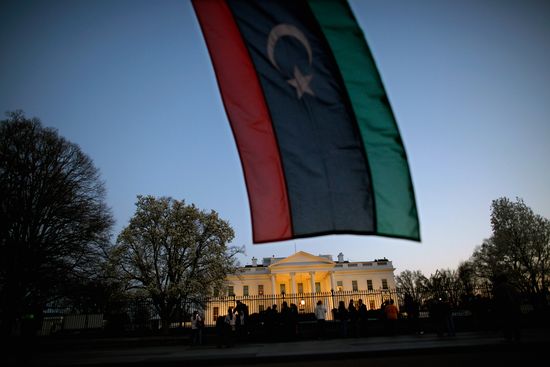
[T]he question with respect to Libya is whether we're facing a situation akin to Somalia in 1993 (minus, let's hope, any U.S. casualties), where the U.S. can walk away following a military intervention and not get dragged back in, or whether the U.S. has set itself up for a second Iraq, where we are left policing and containing Gaddafi until regime change by military force becomes American policy. It may take a subsequent administration or two to reap what this administration has sown.

(Photo: Fadi Tarapolsi holds up a pre-Gaddafi Libyan flag while standing vigil in front of the White House on March 28, 2011. Tarapolsi and his parents have been living in exile in the United States from Libya more than 30 years ago. He said he has held vigil at the White House every night for the past five weeks and will continue to do so until Libyan leader Muammar Gaddafi is out of power. By Chip Somodevilla/Getty Images)

The Pareto Principle

David Brooks lists "concepts worth using in everyday life":

Clay Shirkey nominates the Pareto Principle. We have the idea in our heads that most distributions fall along a bell curve (most people are in the middle). But this is not how the world is organized in sphere after sphere. The top 1 percent of the population control 35 percent of the wealth. The top two percent of Twitter users send 60 percent of the messages. The top 20 percent of workers in any company will produce a disproportionate share of the value. Shirkey points out that these distributions are regarded as anomalies. They are not.

Will The Coalition Arm The Rebels?

The Guardian spots the signs:

The British foreign secretary, William Hague, said after the London conference today that it was not one of the subjects of discussion. He said the issue "was not raised at the conference… and is not part of any agreement today". 

But the US Secretary of State Hillary Clinton suggested that it would be legal to arm the rebels. She told a press conference at the Foreign Office: "It is our interpretation that [UN Security Council resolution] 1973 amended or overrode the absolute prohibition on arms to anyone in Libya, so that there could be a legitimate transfer of arms if a country should choose to do that." …

The US ambassador to the UN refuses to rule out arming Libyan rebels. In an interview with ABC television, Susan Rice said: "We have not made that decision, but we've not certainly ruled that out."

Ackerman is keeping tabs on the "transatlantic tensions". Uri Friedman rounds up early opinions for and against the arming of rebels.

The Daily Wrap

Today on the Dish, Andrew asked conservativism to consider raising income tax rates, and bemoaned the slim pickings for 2012 since the GOP has gone fringe. Newt feared a secular socialist Islamist America, Romney's phoniness trumped all, and the Tea Party still tilted towards unbearably white. Andrew and Dan Savage gave the Obamaites credit for changing course on gay rights, TNC considered Ferraro's white populism, and Philip Greenspun questioned a $40 million paywall. Herman Cain played the black conservative victim card, Ezra Klein wanted to tweak Social Security to save them, and Alexis tracked the death of the first electric car (in 1900).

Rebel forces hadn't quite overtaken Qaddafi's hometown, bodies piled up, and recents victories were reversed. Douthat didn't think Obama owned up to his real choice in Libya, but the American public approved of the Goldilocks war. Exum and feared a stalemate, Marc Lynch put Arab opinion with Obama, Roger Cohen urged ruthlessness, and Andrew wondered if our intervention would ruin nascent rebellions in other countries. Freddie dismantled the metaphor of Libya as an old woman, Israel yawned, and Palin named the war a squirmish. Nick Kimbrell compiled a soundtrack the the Arab revolutions, Crowley stood by his disapproval of Manning's treatment, and the US challenged authoritarian regimes for who could kill the most prisoners. Matt Alt contrasted the Japanese coverage of the crisis, and Goldman Sachs ordered its employees to stay in Japan.

Andrew filtered his belief in God through his Catholicism, Linton Weeks assessed our kibbles and bits society, and readers got blasted by the Dish firehose. South Park seeped into Andrew's subconscious, a reader re-invented the Kinsey Gaffe, and beardage was still trending. Social networking could end bullying, love could save architecture, and sometimes incentives corrupt. Top teenage dirty words here, ultimate spoiler here, quotes for the day here, here and here, MHB here, FOTD here, VFYW here, and VFYW contest winner #43 here.

–Z.P.

Not Another Iraq, Yet

111057946

Marc Lynch defends Obama's attacks on Libya but isn't blind to the risks:

[M]y conversations with Arab activists and intellectuals, and my monitoring of Arab media and internet traffic, have convinced me that the intervention was both important and desirable.  The administration understood, better than their critics, that Libya had become a litmus test for American credibility and intentions, with an Arab public riveted to al-Jazeera.  From what I can see, many people broadly sympathetic to Arab interests and concerns are out of step with Arab opinion this time.   

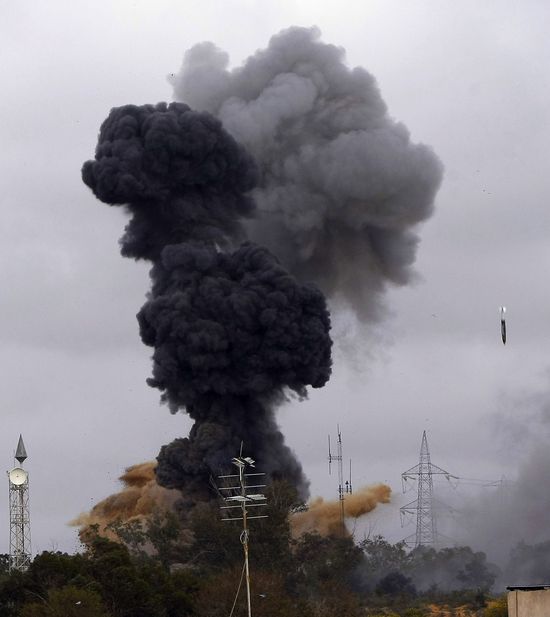
In the Arab public sphere, this is not another Iraq — though, as I've warned repeatedly, it could become one if American troops get involved on the ground and there is an extended, bloody quagmire.  This administration is all too aware of the dangers of mission creep, escalation, and the ticking clock on Arab and international support which so many of us have warned against.  They don't want another Iraq, as Obama made clear…. even if it is not obvious that they can avoid one.  

(Photo: Smoke billows and a missile drops (R) in the vicinity on the tightly-guarded residence of leader Moamer Kadhafi and military targets in the suburb of Tajura, as two loud explosions rocked the Libyan capital Tripoli on March 29, 2011. NATO-led coalition aircraft had been seen in the skies over the capital earlier in the afternoon. By Mahmud Turkia/AFP/Getty Images)