Not About The Deficit

Ezra Klein watches John Boehner fight "the Democrats' offer to put entitlements and taxes on the table":

[W]hat this debate is really about: not cutting spending or reducing the deficit, but cutting spending Republicans don't like while avoiding any and all tax increases — even if that means the country has higher deficits and the middle- and working-class bear more of the burden. The difficulty for Republicans is they've not wanted to clearly explain that philosophy to the American people, and so now they're in the odd position of arguing against Democratic efforts to do more for the deficit and do more to cut spending but not really being able to say why they oppose those efforts.

Any deficit cutting plan that tackles neither entitlements nor tax increases is utterly unserious. You cannot repeat this often enough. The mix is eminently debatable. The math isn't.

In The Shadow Of The Valley Of Death

Lilies

David Kuo is a dear friend and a true Christian. A refugee from the Bush administration, and author of Tempting Faith, David has been battling a brain tumor for years. This week brought bad news, and his many friends have asked those of us who believe in such things to pray for him and his wonderful family. Please do. We hear a lot about Christians failing to reach their ideals. This is inevitable. But in David's and Kim's case, the way they live their lives is one of the greatest advertisements for faith in Jesus I know, and to see them struggling to keep it in the face of mortality is heart-wrenching and also inspiring:

Yesterday was one of the three worst days of our lives. We had such absolute faith and confidence that the scan would be fine… it wasn't even a big deal. It was to just be a "baseline" scan. And then the horrid words from a doctor's smiling lips, "The scan is bad."

By the time we left our dear friend Jamie Tworkowski was almost literally holding us up. All the chemo and all those days in the radiation machine strapped down by the Hannibal Lecter mask, all the certain promises that radiation would buy us years, gone, poof. Then there was our lives and our kids and our marriage. It felt like our every dream for our lives together had been obliterated. Kim could barely walk to the car. I sunk to my knees when I walked a dozen wobbly steps into the house. Jamie held us both and prayed for us, tears streaming from his eyes. We felt like we were stuck in the valley of the shadow of death. The grief and fear and horror relented only for brief moments.

Today often felt worse than yesterday.

It began with Kim and me huddled in bed, bawling, talking, asking God and each other for forgiveness for our failures of commission and omission. We had a powerful, powerful time of prayer in the early afternoon – again, just a true, abject crying out to God for his mercy that this cup may pass from us. We thought of the woman in the crowd who pushed through to just to touch the hem of Jesus' garment. But almost as soon as the prayers ended the darkness descended.

Being around the kids was torture. Aidan's been stepping into his own personality more and more. Its an interesting one… he's becoming a bit of a showman. It was excruciating for both Kim and me to watch him pose/dance/hop with gleeful innocence with the heaviness of time's uncertainty crushing us. Livvy found us crying in the bedroom and asked what was wrong. We told her Daddy's head was sick and we were sad. She then did a dance performance for us. It's easy to replay these hours and hear the enemy's voice telling us we lacked faith and courage. We know that our father isn't wagging his finger at us. We know he is with us.

Can we answer every question? Uh, no. Many questions? No. But we cling to some basic truths – God is good. We know He delights in those who fear him and put their hope in his unfailing love. That we do. Even (especially?), when it is through grief. He's never going to forget us. He knows us and has always known us.

Pray for them.
Are There More Major Earthquakes Nowadays?

Not really:

Earthquakes with a magnitude 7.0 or greater have remained fairly constant in numbers throughout the last century.

However, Dave Santek (CIMSS/SSEC) at the University of Wisconsin-Madison points out that there have been stronger earthquakes recently. There were no quakes of 8.5 or stronger in the 1970's, 80's or 90's, but already 4 in the 2000's. Quakes 8.0 and greater also register more since 2000, with 6 in the 1970s, 4 in the 1980s and 6 in the 1990s, yet already 13 in the 2000s.

According to the [United State Geological Survey], it may seem there are more earthquakes today because of more and better communication, and better technology.

But also, says Steve Dutch at the University of Wisconsin, growing population bases in at-risk areas cause more damage and bring more media attention. There is no question that scientific and technological advances lead to better monitoring and study – and more awareness. In 1931 there were about 350 seismograph monitoring stations in the world. Today, says USGS, there are more than 4,000 stations, with more rapid and comprehensive data reporting by satellite and computer.

Why Does Teacher Pay Peak Late?

Payovertime

Adam Ozimek wonders

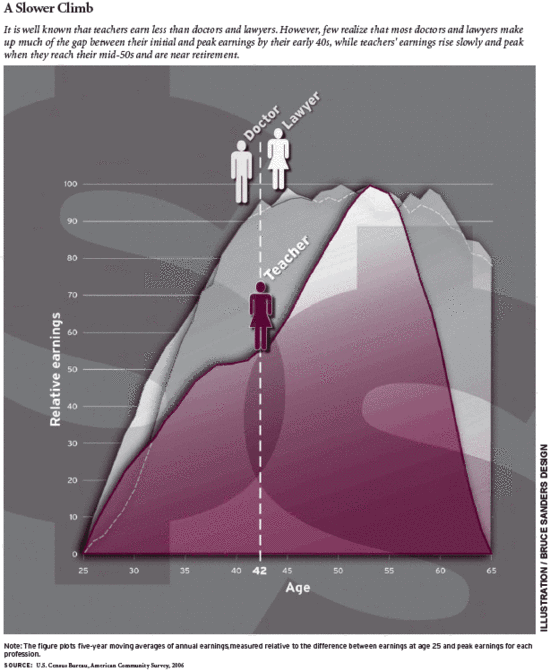
As Michael Petrilli points out in Education Next, teacher pay scales continually rise with experience even though studies show that only the first few years of experience increases teacher effectiveness. So for example, even though a teacher with 25 years experience is no worse than a teacher with 10 years experience, he or she gets paid a lot more. Consider the [above] chart from economist Jacob Vigdor, which shows how average teacher pay grades compare to doctors and lawyers.

In these other jobs pay rises rapidly with experience, whereas teacher pay rises much more slowly and don’t peak until age 55, even though the benefits of experience all occur within the first five years. As Petrilli points out, if teacher pay rose in a commensurate fashion with quality enhancing experience, then it would increase quickly in the first five years, and then flatten out, which by making pay proportional to quality would remove all of the incentive to lay off older teachers. This is not to make the case for lower pay for teachers overall, in fact you could do this whole thing in a revenue neutral way.

The View From Rush Limbaugh’s Recession, Ctd

A reader writes:

As it happens, I'm actually an expert on "drunks on disability" – a lawyer who's concentrated on Social Security disability claims for the past 14 years.

(a) You can't get Social Security or SSI for being addicted to drugs or alcohol. Not since a change in the law in 1996. Yes, there are some disabled people who are addicts; but you find addicts in every slice of life. No reason the disabled should be exempt.

(b) As a practical matter, use of alcohol or drugs makes it MUCH harder to get on disability.

Disability judges are inclined to think that if you stopped drinking or using drugs, your condition would improve and you'd be able to work again. And they're inclined to think that if there's a single mention of drugs or alcohol in your medical records, then you must be an addict.

(c) The biggest problem with Social Security and SSI disability is not the frauds in the system. There are few of these, for the simple reason that most people can get a higher income from a minimum-wage part-time job than they're going to get from a disability check. A much bigger problem is the paranoid overreaction of the system to the possibility of fraud.

This means many honest claims are denied or delayed, causing genuinely disabled people to lose their life savings, their cars, their homes, their health (in most states you can't get Medicare or Medicaid without getting approved for disability), and sometimes their lives – about once or twice a year, one of my clients dies before we can win his or her claim.

I have many clients who have been fighting their disability appeals for upwards of five years. Meanwhile, in Washington, they're considering chopping personnel funding for Social Security. So I'm telling my clients that the waiting time will probably get longer.

Shocking, I know, to think Rush might be promoting an inaccurate view.

Another writes:

I don't know if another reader has mentioned this yet, but according to Al Franken's "Rush Limbaugh is a Big Fat Idiot," Limbaugh has admitted on his radio show that he once took unemployment checks when he was between jobs.

Daydreaming About Balancing The Budget

Andrew Sprung lists the reforms he would implement if he could "make policy by fiat":

First, I would find a way to give the government (probably federal but possibly state, or some hybrid) the sole power to set uniform prices for all medical procedures.  Every other wealthy nation on earth provides universal healthcare to its citizens, and virtually all of them accord sole pricing power to the government (provincial governments in Canada's case), whether or not they strain those payments through some form of private insurance. In the U.S., we pay far more per procedure than any other country, primarily because the government lacks this pricing power.  Our doctors — specialists, in any case — are overpaid, an advantage (to them) partly offset by the ridiculous administrative costs of dealing with multiple insurers, the outsized cost of malpractice insurance, and the huge financial burden of unsubsidized medical school. I would seek to ease those burdens while also reducing most specialists' profit margins.

Trapped In The Past

Leon Wieseltier mounts his enormously high horse and pontificates:

If Muammar Qaddafi takes Benghazi, it will be Barack Obama’s responsibility.

That is what it means to be the American president. The American president cannot but affect the outcome. That is his burden and his privilege. He has the power to stop such an atrocity, so if the atrocity is not stopped it will be because he chose not to use his power. Perhaps that is why Obama has been telling people, rather tastelessly, that it would be easier to be the president of China. Obama will not be rushed. He is a man of the long game. But the Libyan struggle for freedom, and the mission of rescue, is a short game. That is the temporality of such circumstances. If you do not act swiftly, you have misunderstood the situation. Delay means disaster. Does Obama have any idea of what Qaddafi’s victory will mean for the region and its awakening?

Not much, actually. Wieseltier suffers from the notion that we are still living in the 1990s. The American president is emphatically not responsible for all the horrors that go on in the world, even if he has the power to stop them. Notice one word missing from the piece: Iraq.

Marriage In Maryland: “It’s all about the word of God.”

Today is the crucial one as the state House debates the question. It has already passed the Senate and the governor has said he'll sign a marriage equality bill. From the debate unfolding:

Del. Cheryl Glenn (D-Baltimore City), presented an amendment to change the name of the bill to include "Civil Unions" not "marriage." Glenn said she has promised activists supporting same-sex marriage she would be lead sponsor of legislation providing protections, but as long as that is called "civil unions" not "marriage." "It's all about the word of God," she said. "It truly is."

Del. Kathleen Dumais (D-Montgomery County), co-sponsor of the marriage bill, countered that by saying, "Creating something separate is not equal, and I respectfully request rejection of amendment." Glenn's amendment was rejected by a voice vote.

Penis As Weapon

Mary Knudson adds to the chorus of voices angry at the way an 11-year-old gang rape victim was portrayed in a NYT story:

What seems to be missing in the understanding of the reporter and the paper’s editors is that when a penis is used for violence, it is no different from a gun or a knife or a club. In rape, the penis is a weapon. Would the newspaper have written the story in the same way if the 11-year-old child were stabbed or clubbed by 18 men? I think not.