Who Are The Rebels?

Andrew Exum digs up a study finding that on "a per capita basis …  twice as many foreign fighters came to Iraq from Libya — and specifically eastern Libya – than from any other country in the Arabic-speaking world":

This might explain why those rebels from Libya's eastern provinces are not too excited about U.S. military intervention. It might also give some pause to those in the United States so eager to arm Libya's rebels.

Remember how we armed the anti-Soviet rebels in Afghanistan? We're still fighting some of them.

Yglesias Award Nominee

"Scott Walker's attempt to de-unionize the public sector in Wisconsin was a nasty piece of business. Walker sprung a far-reaching bill he didn't campaign on that was designed in large part to hamper the opposition party from winning future elections. It was not, however, a coup d'etat, as Robert Reich calls it. Walker duly passed a law through a duly-elected legislature. It's a highly unpopular law, but his opponents have democratic recourse: first a recall procedure, and then the next election. If Walker's law does not grow more popular, Democrats will overturn it when they next attain a majority, which will itself become easier due to the unpopularity of Walker's actions," – Jon Chait.

How Does A No-Fly Zone Work?

Ackerman explains the mechanics:

All the debate over a no-fly zone hasn’t resolved just what the goal of the mission would be. Buying time for the rebels on the ground? Eventually taking out Gadhafi’s ground forces — which, after all, do the majority of the fighting? Staying until Gadhafi is overthrown? Also, what would the rules of engagement be? Anything that flies during the day dies? Just fighter aircraft, or would Libyan troop transport copters be fair game? And remember, as Irving reminds, “anything you use for this, you are choosing not to use them for something else.”

[Retired Gen. Pete Piotrowski] says the no-fly zone should only be imposed if NATO is planning to do other things to tip the military balance to Gadhafi’s enemies. 

Live-Blogging The Earthquake-Tsunami

The Dish was up last night tracking developments. The horror as it unfolded transcribed here. One resource-rich paragraph:

BBC World has footage of a huge ocean whirlpool. Here's what it looked like inside a Japanese supermarket. And a home as the occupants evacuated. Other videos: a sea of floating cars; an airport runway is quickly overrun by water; a view from the air; the scene in an office; inside a department store; an explosion at an industrial facility.

Thanks to the Dish's West Coast bureau (that would be Conor in his jammies) for working through the night.

“Katrina And The Haiti Earthquake Rolled Into One”

109946712

Global Voices is translating tweets. From the Guardian's live-blog, a quote from Richard Gordon, director of Bournemouth University Disaster Management Center:

One of the key things is that there is going to require a lot of work on casualty tracking since many families will have been divided. People are now making hundreds of telephone calls to find out if members of their family are alive. The mobile phone network will be at capacity and it will be interesting to see if it can handle the pressure or will invoke procedures limiting access to public calls to emergency services. The quake struck at around 2pm in Japan, which means schools will have been still working, so many people evacuating will have the added stress of trying to reach their children. Hospitals are also going to be overwhelmed. It is a major humanitarian disaster — like Hurricane Katrina and the Haiti earthquake rolled into one.

From the BBC's live-blog:

Another five powerful aftershocks measuring around 5.5 magnitude have just rattled the eastern coast of Japan in quick succession, the US Geological Survey reports.

The WSJ's live-blog:

Twitter user _mego tweeted that she was stranded in her house in Miyagi prefecture— Japan’s worst-hit city—Friday. Her first tweet approximately an hour ago said the first floor of her seaside house was flooded due to an earlier tsunami and she is being forced to take refuge on the second floor. She tweets, “A tsunami just hit. I am taking pictures from the second floor of my house. The flooding continues and I am afraid of being left behind. Please come to my rescue!!” The tweet was followed by her address and a grizzly picture.

The Lede:

Friday's 8.9 magnitude earthquake is the fifth largest recorded by the United States Geological Survey since 1900. The U.S.G.S. has a list of the fifteen biggest on its Web site, including:

1. 1960 — 9.5 — Chile
2. 1964 — 9.2 — Prince William Sound, Alaska
3. 2004 — 9.1 — Sumatra
4. 1952 — 9.0 — Kamchatka, Russia
5. 2011 — 8.9 — Friday in Japan
6. 2010 — 8.8 — Offshore Maule, Chile

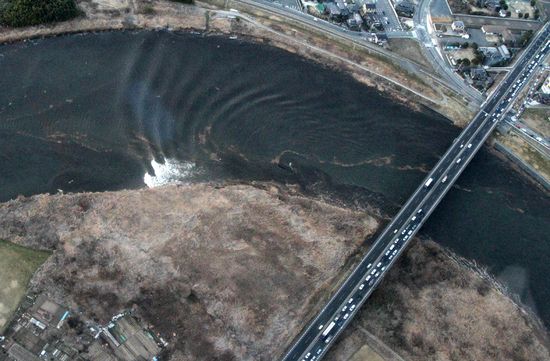
(Photo: This aerial shot shows the tsunami tidal waves moving upstream in the Naka river at Hitachinaka city in Ibaraki prefecture on March 11, 2011. A massive 8.9-magnitude earthquake shook Japan, unleashing a powerful tsunami that sent ships crashing into the shore and carried cars through the streets of coastal towns. By STR/AFP/Getty Images)
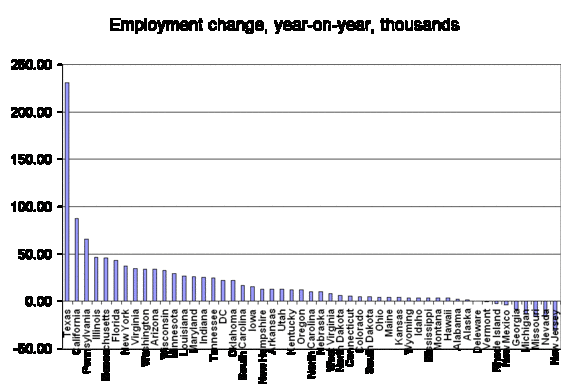
Chart Of The Day

JobCreation

Avent passes along a chart (click to enlarge) showing where jobs were created in 2010:

As you can (hopefully) see, Texas leads the pack. About a fifth of all new jobs were created there last year. About half of net new jobs were produced by the top 6 states, and about 80% were produced in the top 15. New Jersey had the biggest job loss, followed by Nevada. New Jersey's job losses were almost entirely due to cuts in government employment.

Embracing The Bias, Ctd

Jay Rosen provides a prescription for NPR's woes:

* Abandon viewlessness as the official ideology at NPR. Replace it with pluralism. Meaning: NPR acknowledges that the people who work for it have a diverse mix of views and starting points. It is unreasonable to expect that these won’t factor into their work, but it is perfectly reasonable to hold everyone at NPR to basic standards: accuracy, fairness, intellectual honesty and transparency. That means you can click on the name of any editorial staffer and find out where they’re coming from. … Not only is this more honest, not only would it force NPR to diversify its staff even more than the network already has, but it would eliminate the power of dirty tricks meant to expose the fact the people at NPR have political lives and opinions. …

* Renounce the two percent or so of its budget that it gets directly from the Corporation for Public Broadcasting or other federal agencies, eliminating that as an hot button issue.

The advantages of going off the federal dollar entirely are obvious. It would eliminate the incentive to institutional timidity that is such a striking feature of NPR’s operating style whenever it is faced with politicized attacks or merely anticipates them. (Jason Linkins makes that case here.) Eliminate the federal subsidy to local stations or force a showdown on it and mobilize your supporters: Either way NPR has to emerge from its defensive crouch.

A “Volkswagen With Wings”?

Annie Lowrey finds a flying car:

[Carl] Dietrich and his cofounders came up with a design for a standard light aircraft with wings that fold up, tucking themselves close to the body of the plane for driving or extending to full wingspan for flying in just 20 seconds. This is not George Jetson's magically hovering bug: The Transition needs to take off and land at an airport. But once it is on solid land, it drives on regular paved road.