Jaybird tosses tokens into the discussion and argues that the profitability of one-on-one, fight-based arcade games helped drive other types of games into the home:
The industry (quickly!) learned that the most money to be made was not in side-scrolling storyline games (which, if you were lucky, had 2-3 obsessed folks playing until Magneto was beaten) but in a new token being dropped every 90 seconds. Let’s face it… in theory, two really skilled players could beat X-Men by themselves (in theory). But Street Fighter II? You’d have a token every minute and a half if there were two players there.
The focus ceased to be on games intended to make you keep playing, but games that made you want to (FINALLY) beat the sonova that kept killing you with Dhalsim. And every piece of real estate being taken up by Captain America and the Avengers is a piece of real estate that you cannot dedicate to yet another Street Fighter II SE … Meanwhile, at the same time, home consoles were providing the side-scrolling, and Tetrisy, and shooter, and jumper, and storyline games that we all fell in love with in the arcade but had since been relocationed due to the popularity of Street Fighter II (and pretenders).
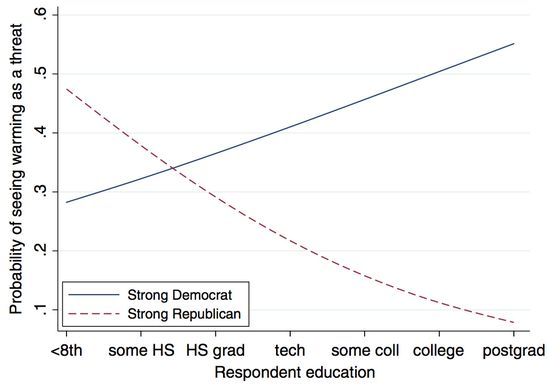
A study from a few years ago found that the "probability of perceiving global warming as a threat increases with education among Democrats, but decreases with education among Republicans."
The probability of perceiving global warming as a threat increases with education among Democrats, but decreases with education among Republicans. Only two respondents out of a thousand described themselves as "strong Democrats" or "strong Republicans" with less than an 8th grade education, so the crossover at far left in [the above figure] should not be over-interpreted.
The study's authors theorize that partisan echo chambers on the Internet are partially to blame. Henry Farrell is skeptical:
If Gentzkow and Shapiro are right, then there is less ideological segregation in consumption of Internet information sources than one might imagine e.g. from looking at blogs alone. It is possible, for example, that highly educated strong Republicans may be exposed to both contrarian and conventional sources of information on climate change, but trust the former much more than the latter because of partisan cues.
Arash Aramesh interviews a political operative with close ties to Rafsanjani, who is "down but not out":
What Rafsanjani did was that he convinced Mahdavi-Kani to run. This man is a very conservative but a moderate cleric. Rafsanjani and Mahdavi-Kani have been political allies for many years. This [Mahdavi-Kani’s nomination and subsequent victory] was a team effort led by Rafsanjani. … Rafsanjani’s political astuteness led him to convince Mahdavi-Kani to run and deny a hardliner such as Jannati, Yazdi, or Mesbah-Yazdi the highest position in the Assembly.
The operative notes that Rafsanjani "is still the Chairman of the Expediency Council and has enormous economic influence."
It's devastating coastal areas. The Wall Street Journal reports the quake is a magnitude 8.9:
That makes it the fifth largest recorded world-wide since 1900, according to the U.S. Geological Service, larger than the 7.9-magnitude Great Kanto Earthquake that devastated Tokyo in 1923 or the 6.8 magnitude quake that hit Kobe in 1995.
If you're anywhere in the Pacific Ocean, go here and check local tsunami warnings. For Dish readers in Hawaii:
Hawaii Civil Defense is advising all residents in tsunami inundation zones to evacuate immediately.The alert, issued at 10:38, reads "Leave all coastal evacuation zones immediately. Refer to Hawaiian Telcom or Paradise Pages for evacuation maps."
The earliest that hazardous waves could hit Hawaii is 2:59 a.m., said the agency, according to Pacific Tsunami Warning Center, based in Ewa Beach.
Russia and Indonesia, Central American countries like Guatemala, El Salvador and Costa Rica…In the Philippines, the government issued a warning for 19 provinces along the coast, possibly affecting hundreds of thousands of people. A tsunami could could hit by 6 p.m. (5 a.m. ET), it said.
The LA Timesreports on the potential impact on the West Coast:
A tsunami warning has been issued for the central and northern California coast and Oregon, the National Weather Service announced early Friday. In the San Francisco Bay Area, an emergency warning system announcement for a tsunami warning was braodcast just after 1 a.m. Waves could begin arriving in Crescent City, Calif., at 7:23 a.m. and the Bay Area shortly after 8 a.m.
A lower-level tsunami advisory was issued for the Southern California coast south of Point Concepcion, which includes southern San Luis Obispo County and the counties of Ventura, Los Angeles, Orange and San Diego.
A map showing tsunami travel times is here. Google victim finder for Japanese victims and their families here.
National Geographic has the best general primer on tsunamis I've found so far.
UPDATES:
– 2:30 PST. BBC World has footage of a huge ocean whirlpool. Here's what it looked like inside a Japanese supermarket. And a home as the occupants evacuated. Other videos: a sea of floating cars; an airport runway is quickly overrun by water; a view from the air; the scene in an office; inside a department store; an explosion at an industrial facility.
Al Jazeera English puts confirmed death toll at 29 people, a figure expected to rise.
– 2:48 PST. Updated times for when waves will hit West Coast of United States:
PORT SAN LUIS HARBOR 8:09 a.m. SANTA BARBARA HARBOR 8:17 a.m. SANTA MONICA: 8:32 a.m. SAN PEDRO 8:32 a.m. NEWPORT BEACH 8:45 a.m. LA JOLLA 8:48 a.m.
Officials don't expect the waves to cause damage. But as a precaution, officials are likely to urge people to avoid beach areas. Officials said people living in low-lying coastal areas should seek higher ground as a precaution and listen for special instructions from emergency agencies. Unusual wave action from the quake might last for several hours.
One bit of good news: "The four Japanese nuclear power plants closest to Friday's major earthquake in Japan have been safely shut down, the International Atomic Energy Agency said."
– 3:19 PST. Obama's statement:
Michelle and I send our deepest condolences to the people of Japan, particularly those who have lost loved ones in the earthquake and tsunamis. The United States stands ready to help the Japanese people in this time of great trial. The friendship and alliance between our two nations is unshakeable, and only strengthens our resolve to stand with the people of Japan as they overcome this tragedy. We will continue to closely monitor tsunamis around Japan and the Pacific going forward and we are asking all our citizens in the affected region to listen to their state and local officials as I have instructed FEMA to be ready to assist Hawaii and the rest of the U.S. states and territories that could be affected.
– 3:25 PST. Kenneth Maxwell is blogging at the Wall Street Journal:
The aftershocks rocking Tokyo on a regular basis are unpleasant enough. But one of the most unwelcome things in a major earthquake in Japan, it turns out, is the special audible electronic alert that sounds across TV networks when Japan’s sophisticated network of earthquake detection machinery picks up on a big shake coming.
The alert is a 10-second warning, accompanied by an on-screen map that pinpoints the epicenter of the quake with the indication that a major shake is on the way. And what follows is one of the most unwelcome 10-second periods a Tokyoite might encounter.
– 3:28 PST. From a friend of The Dish:
We have been experiencing smaller tremors sporadically over the past few months, so when I first felt the earthquake, I assumed it would be just a small five second movement. But it just kept getting bigger and bigger and bigger. I was alone in my apartment on the top floor of our complex, and I had no idea what to do since I had never experienced anything like this. As I could feel the whole building shaking violently, I tried calling my roommates (originally California residents- I assumed they'd know what to do) amidst the sounds of miscellaneous things in my apartment crashing to the floor. After a few minutes the shaking subsided, but it felt like an eternity.
Even three hours later we are still feeling the aftershocks. Tokyo city is in chaos, as 3 of the 4 major power plants are down, and all trains have been shut down until tomorrow morning. Right now I can hear the winds from the tsunami outside my window, and even though I know the waters will not reach this far inland, it is a frightening thing to be a part of one of the worst natural disasters to hit Japan in recent history.
The Japanese government issued a state of emergency at a nuclear power plant Friday after a cooling system failure in the wake of the giant earthquake and tsunami off the east coast of the Pacific nation.
An administrator at the Tohoku Electric Power Co's Onagawa facility said the process for the cooling reactor is "not going as planned," adding that "nuclear emergency situation" has been declared. The company asked people nearby to stay calm, the official TV news channel NHK reported.
– 3:51 PST. It's as good a time as any to revisit this guide to earthquake preparation. Also, a staffer at Time Out Tokyo rounds up information for residents and offers a live blog of the afternoon.
– 4:15 PST. Twitter hashtag #HItsunami to monitor what folks in Hawaii are saying:
"These fucking sirens are making my heart stop."
"If you haven't started yet, now is the time to put down the phone/iPad/laptop and PLUG IT IN. You may need it if power goes out."
"Hard to describe feelings knowing a tsunami coming and NOTHING you can do about it."
" No going back to sleep with those sirens. I'm up. About to eat & load the car just in case."
– 4:25 PST.(The BBCWorld Twitter feed is streaming on the left margin of that page.)
BBC's Kate McGeown in Indonesia says a tsunami has been detected in the north east of the country, but it's only half-a-metre high. Too early to say if damage has been caused.
– 4:30 PST. The 15 biggest earthquakes ever recorded. Also, the WSJ reports:
TOKYO—Some people in Tokyo were warned that a major earthquake was about to hit before they felt a tremor.
As an 8.9-magnitude earthquake struck Japan's northeastern coast Friday, the world's first early warning system—developed by the country's meteorological agency—detected the quake's shockwave near the seismic center and sent off the warning message, which appeared on national television and radio as well as mobile phone screens.
– 4:36 PST. AP reports official death toll is now at 60, still expected to rise significantly. Fox News has more from California:
Orange County, California is closing its beaches starting at 8 a.m. ET – and will station lifeguards and sheriffs to discourage anyone from using the beaches. At roughly 8 a.m. ET – automated calls will be going into the homes along the beach communities where officials anticipate some impact from the tsunami. Officials tell Fox News, they anticipate a surge in Orange County of about two feet.
While they don’t expect damage – the problem they anticipate has to do with tidal issues and rough surf. Large fishing boats are being encouraged to head out to sea – small boats are being urged to stay in port.
– 4:43 PST. Japanese Prime Minister Naoto Kan:
My fellow citizens, as you are already aware from reports on TV and on the radio, today at 2:46 p.m. an enormously powerful earthquake of Magnitude 8.4 struck, with its seismic center off the Sanriku coast. This has resulted in tremendous damage across a wide area, centered on the Tohoku district. I extend my heartfelt sympathy to those who have suffered.
As for our nuclear power facilities, a portion of them stopped their operations automatically. At present we have no reports of any radioactive materials or otherwise affecting the surrounding areas. In light of these circumstances, I immediately established an emergency headquarters for response to disaster, with myself as the head. The government will make every possible effort to ensure the safety of the public and keep damage to the minimum possible extent. I ask the public to continue to stay fully vigilant and to keep abreast of TV and radio reports, and I ask everyone to act calmly.
– 4:45 PST. The US National Weather Service Honolulu & Central Pacific Hurricane Center is updating its Facebook page.
– 4:48 PST. A friend passes along these recommendations for japan folks to follow on Twitter: @tokyoreporter, @TomokoHosaka, @yurikageyama, @sandrajapandra, @DailyYomiuri, @daiwaka, @HirokoTabuchi
– 5:03 PST. Waves expected to hit Hawaii in the next few minutes:
Some refuge centers at schools were already filling up in the overnight hours, and lines were forming in front of convenience stores. Police combed shoreline neighborhoods, ordering evacuations and closing roads.
Officials warned that tsunami can last for hours, and attract multiple destructive waves. They also said that people were showing up at hospitals seeking shelter, and authorities urged them to go elsewhere to keep the medical facilities available for any injured people. "Anyone in the shoreline areas should get out now," he said. The evacuation area included the tourist hub of Waikiki, where thousands of people are packed into a string of beachfront hotels. Hotel guests staying in concrete or steel-reinforced buildings were being moved to the third floor for safety, Cummings said.
– 5:09 PST. An NBC affiliate in Hawaii reports that "Surf 'beginning to pick up' at Kauai, waves up to 3 feet. Water receded up to 150ft." Live coverage here. And here.
– 5:23 PST. So far so good in Hawaii on the beach cams I'm watching.
– 5:33 PST. Still no reports of serious damage as first wave recedes. Let's hope that continues.
– 5:39 PST. The Pacific Fleet reports: "At Pearl Harbor a half-meter surge was detected. Initial reports show no damage to ships and piers."
Today on the Dish, Andrew clarified his position on indefinite detention and torture to Greenwald, a reader gave the military their due, and a new paper revealed the conditions that make states stop torturing. Andrew countered Fareed on supplying arms to Libya, Graeme Wood humbled the US, Steven Cook urged us to have a light touch in Egypt, and we parsed Khamenei's continuing purge. Andrew backed Bagehot in treasuring others' right to offend, we tracked King's crusade, Tyler Cowen glimpsed the fiscal endgame, and the US was slowly becoming Greece. We rounded up Wisconsin reax, and Nate Silver predicted a backlash.
Massie prodded Romney's robot exterior, we poked his plastic veneer, and wondered if Limbaugh could back him. John Phillips ordered the Palin Caramel Macchiato, Bernstein un-victimized her, and Eminem could challenge her. Ezra Klein made the case for bike lanes as pro-car, Republicans prevented ex-felon votes based on partisanship, and Andrew wondered whether James O'Keefe was a journalist or a prankster with a knack for entrapment. Wilkinson brutalized Brooks, Limbaugh discovered unemployment benefits and didn't approve, and even bloggers on the right don't read many right-leaning voices. Steve Cheney rebelled against Facebook comments, industrial agriculture danced with nature American Beauty style, and Arnold Kling advised economists.
Brigham Young professors had to remind students to shave, beards don't mix well with fire-breathing, and lost and found is fun. A reader confessed his own marriage infidelities, another wanted NPR to embrace their bias, and we remembered David Broder. Eve Conant updated us on the final death throes of DADT, Andrew picked American Idol favorites, Goldblog made love to America, James Franco's brother gay-dueled, and straight men made out for celery. Yglesias award here, creepy ad watch here, hand-drawn New York here, chart of the day here, yesterday's chart reconfigured here, history of science fiction here, VFYW here, FOTD here, and MHB here.
Back in January, Todd Bieber found a roll of film in Brooklyn’s Prospect Park and made a YouTube video to find its owners. He finally tracked them down:
What he learned:
“Basically I made a simple silly choice and it led to one of the most amazing/crazy experiences in my life,” Bieber says. “So I’m going to keep doing stuff like that.”
It's important to note than in addition to being callous and out of touch, Rush Limbaugh's comments on unemployment benefits and welfare are based on an utterly bogus CNBC study, thoroughly debunked by Ryan Chittum at the Columbia Journalism Review.
Another writes:
Reading this post reminds me of my father-in-law and his wife.
You stated that, "One way to look at this is that when Rush Limbaugh really thinks the "sloth and laziness" of Americans mostly consists of jailed drunks on disability and equivalent cases." This is completely the way these two, both tea partiers and Limbaugh fans, see our welfare system. He receives social security and disability checks, both are Medicare recipients, but otherwise they feel that all other welfare is almost completely used by people who are abusing the system (and they sympathized with the protestor with the sign "Keep socialism away from my Medicare").
If I complain about insurance costs, I'm asked if it bothers me as much as it does them that because of some "drunks" who are covered by the government, my insurance costs are so high. Another big complaint is that food stamps are being used by people to make a profit. I normally respond that the amount of people who abuse the welfare system is pretty small, and that if the doctors at hospitals don't treat every person who really needs it (i.e. "those damn illegals"), it could become a medical crisis for everyone. But sane arguments are generally ignored.
Contra Kristof, Larison argues the case for a no-fly zone is weak:
[I]t is relatively easy to enforce a no-fly zone, but it won’t have that much of an effect on the civil war. It should tell us everything we need to know about how unwise intervening in Libya is that even the most hawkish interventionists aren’t proposing more significant military action right now. It may be that some hawks are trying to get the administration to accept a half-measure in the hope that committing to the half-measure will force the administration into taking additional military action later.
Along the same lines, another poll shows that Americans have no appetite for intervention in Libya.
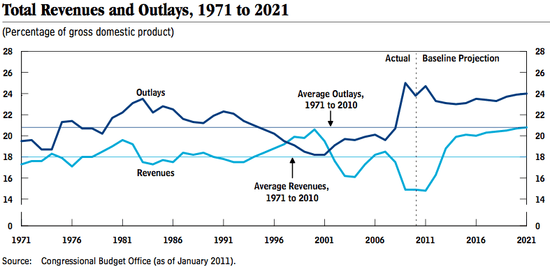
The path toward long-run fiscal balance involves recalibrating Medicare, Medicaid, and Social Security to lower rates of indexation, reimbursement, benefit increase, and so on. We need to start that process now. It cannot be done overnight or even over a few years' time. It takes a long time for those gains to come in, cumulatively. No one is going to vote for a "thirty percent cut to Medicare, today," although they might vote for changes in rates, which over time would amount to large reductions.
The CBO put out a report today with more than a 100 ways to cut spending or raise revenue:
If federal debt continued to grow relative to the nation’s output and income, investors would require the government to pay higher interest rates on its securities to compensate for the risk that they might not be repaid or that the value of the securities might be eroded by inflation. Interest rates might rise only gradually to reflect such growing uncertainty—but other countries’ experiences suggest that a loss of investors’ confidence can occur abruptly and might well come during an economic downturn. To resolve the resulting fiscal crisis, lawmakers would need to make fiscal policy choices that would be much more drastic and painful than if policies had been adjusted sooner.
 The Dish