Journalism Or Entrapment?

In a post titled "Entrapping NPR", Ira Stoll writes:

As fascinating as it is to see what NPR executives are saying privately about Tea Party members, Zionists, and Jewish owners of newspapers… it seems to me that the techniques used to obtain the video are also troubling. The self-described "citizen journalists" lied. They intentionally falsified their own identities… For a group called "Project Veritas" to go around lying about who it is for the purpose of catching people saying silly things or getting reaction shots of the people sitting there laughing or eating while the Project Veritas members said silly things obscures the purpose of the organization, whose name, after all, means "truth." What is Project Veritas about, anyway? Lying? Or truth-telling?

In the age of Fox, that distinction has become blurred. To his credit, former BJ editor Michael Walsh acknowledges the point:

There ought to be a sharp line between ethical professional journalism and activist citizen-journalism, because the professionals generally have the technical experience to extract answers to questions without resorting to subterfuge.

But Chait takes a different view:

… unlike the vast bulk of O'Keefe's career, this is a legitimate act of journalism. Executives at NPR are public figures, and I don't have a problem with journalists using false pretenses to get public figures to reveal their true beliefs. As long as NPR gets federal funding, people have a legitimate interest in the political views of its staff, even if those political beliefs color the news coverage far less than conservatives believe.

But is O'Keefe a journalist rather than a page-view-prankster? Yes, we can learn a lot by such pranks – Scott Walker was a revealing victim. But there is a danger of what we'd call in other circumstances "entrapment." Especially given the rewards these stunts get in terms of attention and pageviews.

Wisconsin Reax

WisconsinGetty

Yglesias:

Not to draw an equivalence between a bad bill and a good one, but what it reminds me of is congressional Democrats after Scott Brown’s election. The early CW was that somehow Democrats “had to” back down in the face of their unpopularity. But they didn’t have to do anything. They believed as strongly in universal health care as the Wisconsin GOP believes in crushing labor unions. So they passed the damn bill.

Pejman Yousefzadeh:

I have no problem whatsoever endorsing the actions of the Wisconsin Senate Republicans. Just because Democrats didn’t feel like showing up to vote on the issues of the day does not mean that Republicans ought to indulge the other side in their desire to shut down the government. The standoff has gone on long enough, and barring the implementation of extraordinary measures, it would not have ended anytime soon.

Chait:

Obviously, Republicans think that crippling the Democratic Party in the long-term is part of what they need to do to control state-level budgets. But I think the more likely result is simply that Democrats will pass a ball allowing collective bargaining among public employees as soon as they return to power. The ramifications of parties using their political power in order to try to cripple the opposing party are a lot deeper and more dangerous than Walker seems to be reckoning.

Ben Smith:

[I]f Walker is down politically right now, it may not really matter. Smart executives do the hard stuff in their first months and years in office. An economic recovery – and Wisconsin's already in better shape than most states — will allow governors around the country to, as is traditional, claim mostly undeserved personal credit for national economic trends, to use new revenues to simultaneously spend freely and cut taxes. Walker's success in cutting spending and longer-term obligations to the state's workforce now will give him more room to please everyone as his re-election (or even his own, more distant, recall fight) approaches.

Ezra Klein:

It seems to me that the system worked. Democrats were able to slow the process down and convince both voters in Wisconsin and the national media that there was something beyond business as usual happening in Madison. National and state polls show they were successful in that effort. Walker and the Senate Republicans ignored the Democrats’ attempts at compromise and ignored the public turning against them and decided to pass the legislation anyway.

Bainbridge:

I honestly didn't think they'd have the stones to do it. For my take on why this is good public policy go to my posts The case against public sector unionism and More on public sector unions.

E.D. Kain:

In Wisconsin, Democrats are already promising to step-up recall efforts. But the recalls are only a small part of what is likely going to be a huge anti-Republican backlash across the nation, as working Americans finally realize what that party actually stands for: an playing field heavily tilted toward the rich and powerful, toward corporate power, and against worker rights.

Josh Barro:

Democrats will take power in Wisconsin again, and when they do I think they are likely to restore the “dues checkoff” — automatic deductions from public payrolls to pay union dues, eliminated in the just-passed bill. But I think they are likely to find the federal model of limited collective bargaining pretty useful, just as Barack Obama has. Under pressure from municipal officials, Wisconsin Democrats will be more likely to “reform” this law while retaining significant constraints on bargaining than to repeal it entirely.

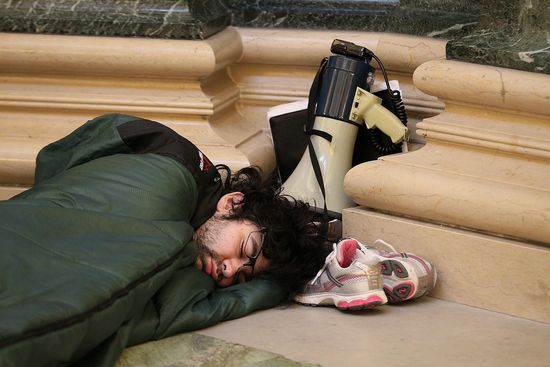
(Photo: A protestor sleeps on the floor of the Wisconsin State Capitol on March 10, 2011 in Madison, Wisconsin. Thousands of demonstrators took over the the Wisconsin State Capitol late Wednesday after the Wisconsin Republican Senators voted to curb collective bargaining rights for public union workers in a surprise vote with no Democrats present. By Justin Sullivan/Getty Images)

Just Supply Them

Fareed suggests a half-way position on aid to the Libyan uprising:

Over the past five decades, the U.S. has had very mixed results when it has intervened, by air or land, in other people's wars. But it has done pretty well when it has helped one side of the struggle. Arming rebels in Afghanistan, Central America and Africa has proved to be a relatively low-cost policy with high rates of success. Giving arms, food, logistical help, intelligence and other such tools to the Libyan opposition would boost its strength and give it staying power. Once Gaddafi realizes that he is up against an endless supply of arms and ammunition, he will surely recalibrate his decisions.

The news that Qaddafi is raiding his rainy day massacre fund and has huge resources to pay mercenaries, propagandists and his paramilitary renders this kind of limited intervention more palatable. I'm still queasy. If we arm those rebels, where do those arms eventually end up? Does the future of Egyptian democracy really hinge on the outcome in Libya? I don't see why or how.

From The Annals Of Patriotic Passion

Palin-in-runners-world-450x491

A Goldblog exclusive:

On that perilous night, when I first lifted my lamp by her golden door, she was dressed in broad stripes and bright stars. I was always a sucker for broad stripes and bright stars. It happened after a long day of exceedingly hard work. Boy, was I tired from all that hard work! She knew I wanted her. And I knew she wanted me.

In a flash, our clothes fell to the floor, and she whispered huskily in my ear, "Give me your huddled masses, yearning to breathe free," and before I knew it, I saw that golden valley. Oh, the rockets' red glare! The bombs bursting in air!  In that moment of indivisible union, I screamed out, "America, America! God shed His grace on thee!"

I was hopelessly, irretrievably in love. I guess that makes me a sinner. But it also makes me a patriot.

(Photo: Sarah Palin in Runners World.)

CDs Declined, Music Didn’t, Ctd

Music-industry

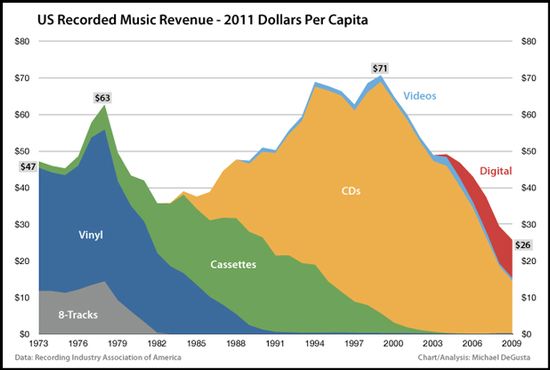
Michael DeGusta says the previous chart "sucks" and makes his own:

The above chart is adjusted for inflation & population…. So let’s correct the inaccurate conclusions one might reasonably draw from the misleading Bain chart:

Wrong: The music industry is down around 40% from its peak in 1999
Correct: The music industry is down 64% from its peak.

Wrong: At least the music industry is almost 4 times better off than in 1973.
Correct: The music industry is actually down 45% from where it was in 1973.

Wrong: The CD era was the aberration. (Mr. Gruber’s reasonable take)
Correct: The CD peak was only 13% better than the vinyl peak, not over 250% better as the Bain chart implies.

The overall conclusion is that the music industry is actually doing much worse than the Bain chart implies:

10 years ago the average American spent almost 3 times as much on recorded music products as they do today.

26 years ago they spent almost twice as much as they do today.

A Light Touch In Egypt

Steven Cook says Egyptians "need a lot less help than we think":

Even if Washington pledges its total neutrality in Egyptian politics, a bold and public democracy-promotion effort could quickly lapse into support for one party, group, or movement. U.S. officials will be sorely tempted to gravitate toward liberal elements within the revolutionary movement, such as Ayman Nour's al-Ghad party, the newly licensed al-Wasat party, Nobel Peace Prize laureate Mohamed ElBaradei, and a host of independent figures. Furthermore, it is hard to believe that Congress will remain neutral should the Obama administration choose to work with the Nasserists and the Muslim Brotherhood, both of which maintain views on Egyptian foreign policy, especially when it comes to the Arab-Israeli conflict, that are inimical to American interests.

King’s Crusade, Ctd

Josh Gerstein puts today's hearings in context:

In the last five years, House and Senate committees have held at least 22 hearings focusing on the problem of radicalized American Muslims plotting terrorist acts or joining Al-Qaeda and similar groups, according to congressional staffers. 

Weigel adds:

The point is that the controversy over the hearings is mostly about King, who commands media attention like some lost member of the Kardashian family …

The Ex-Felon Vote

Adam Serwer looks at voter disenfrancisement. He notes that Florida's GOP is "prepared to roll back former Gov. Charlie Crist's efforts to re-enfranchise ex-felons." A disproportionate number of former prisoners are African-American, a demographic group that votes strongly for Democrats:

The obvious historical irony is that Reconstruction-era felony disenfranchisement laws were once passed by Democrats to disenfranchise blacks because they voted Republican. Now, Republicans support such laws because they make it more difficult for Democratic-leaning constituencies to cast ballots. To say that such laws are motivated by partisanship rather than racism doesn't really redeem them all that much.