Left, Right And Time, Ctd

A reader writes:

I think the rhetorical chutzpah that drives me the most crazy is when I hear right-wingers accuse people of class warfare when they dare point out something like the ever widening gap between the rich and everyone else. I mean, the stats are mind boggling and it's not like anyone's disputing them. How can they? And yet the cries of socialism and class warfare continue, and nobody but a blogger or two will call them on it. I've been pretty disappointed in Obama, and this is one area in particular that's just pathetic.

He could take Greenwald's column, or one of Krugman's, and just decimate these idiots who are calling him a socialist/Maoiest whatever. But he doesn't. No Democrat bothers. Of course they don't, because then they would just feed the claims of those crazy "progressives" that both Parties are owned by Wall Street. Seriously, if Obama's supposed to be the grown-up, isn't it his job to tell the whining children who have no reason to cry whatsoever to shut the hell up and be grateful for what they have? The only time he does this is when he comes down on the progressives for being too critical of him. What a country …
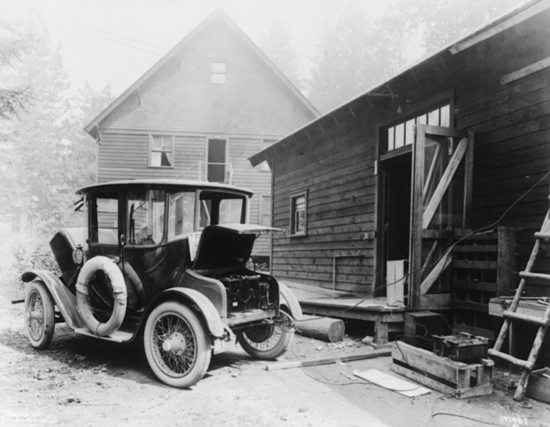

The Original Death Of The Electric Car

773px-Detroit_Electric_car_charging

Dave Roberts interviews Alexis Madrigal about his new book, Powering the Dream: The History and Promise of Green Technology. Alexis reflects on a failed turn-of-the-century electric car company:

To succeed, the electric cars of those days would have had to succeed as part of a greater all-electric transportation system. In fact it was attempted by the Electric Vehicle Company, which was run by a bunch of robber baron types, and failed. Not because the cars didn't work; not because they couldn't get you across Manhattan in an electric cab in 1900. The technology was the part that worked. The business is what failed. Unfortunately, that was a pretty high-profile failure. Like in the internet space, when something really high-profile fails, people say, oh, that'll never work. Until it does.

His bigger point:

There is this concept in technology history of technological momentum: once you get going down a path, once money starts flowing, all sorts of new innovations come about and all sorts of new businesses are built. The American innovation machine gets cranking down particular pathways.

It makes it really difficult to see: What kind of advances would we have seen around electric vehicles if that company had succeeded wildly? Which technologies win seems more inevitable in retrospect than it does to anyone at the time. That's a consistent lesson through all of the research I've done. Everyone has been convinced that their technology was going to win. 

(Photo: "Detroit Electric car charging")

Campbell’s Law

USA Today found test score irregularities at a DC school. Dana Goldstein uses the story to argue that "we measure student academic growth in nuanced ways that encourage deep learning, not in over-simplified ways that create perverse incentives to dumb-down the curriculum and cheat":

In the social sciences, there is an oft-repeated maxim called Campbell’s Law, named after Donald Campbell, a psychologist who studied human creativity. Campbell’s Law states that incentives corrupt. In other words, the more punishments and rewards—such as merit pay—are associated with the results of any given test, the more likely it is that the test’s results will be rendered meaningless, either through outright cheating or through teaching to the test in a way that narrows the curriculum and renders real learning obsolete.

In the era of No Child Left Behind, Campbell’s Law has proved true again and again.

When the federal government began threatening to restructure or shut-down schools that did not achieve across-the-board student “proficiency” on state reading and math exams, states responded by creating standardized tests that were easier and easier to pass. Alabama, for example, reported that 85 percent of its fourth-graders were proficient in reading in 2005, even though only 22 percent of the state’s students demonstrated proficiency on the National Assessment of Educational Progress, the gold standard, no-stakes exam administered by the federal government.

Michelle Rhee has defended herself and the school in question, saying USA Today's investigation "absolutely lacked credibility." 

A Frank Lloyd Wright Home, Ctd

A reader writes:

Andrew, did you read the article you linked to? The Detroit house is NOT abandoned; it's been painstakingly (and expensively) restored by Norm Silk and Dale Morgan.  They now open their house and garden for summer jazz concerts organized by Barbara and Spencer Barefield, the couple with whom Ta-Nehisi recently toured Palmer Woods. I have just visited Taliesin West, Wright's architecture school and home in Scottsdale. 

As with most Wright houses, it is charming and hard to live in.  FLW liked small tunnel-like entrances to large spaces, small bedrooms made to feel larger by looking out on landscapes, and tiny bathroom spaces.  His houses are scaled to fit himself and his clients, none of them tall.  

It takes wealthy and/or dedicated people to restore and preserve these places, and sometimes it takes a corporation.  The Meyer May house, one of Wright's most liveable, is a museum owned by Steelcase for the benefit of the company's hometown and is part of the renaissance of Heritage Hill in Grand Rapids.

The point was that it had been abandoned. The link tells the rest of the story. Another writes:

I remember reading about this poor house in Dwell Magazine a few years back. And this one, the Tracy House, looks similar to, but much smaller than, the Turkel House, is for sale in Normandy Park, a community south of Seattle proper. It's waterfront property, the same owners helped to build it and are the only owners until now. 

By The Book

PJ Crowley stands by what he said of Bradley Manning's treatment:

The Pentagon has said that it is playing the Manning case by the book. The book tells us what actions we can take, but not always what we should do. Actions can be legal and still not smart. With the Manning case unfolding in a fishbowl-like environment, going strictly by the book is not good enough. Private Manning's overly restrictive and even petty treatment undermines what is otherwise a strong legal and ethical position.

Tweaking Entitlements To Save Them

Ezra Klein outlines the "pro-Social Security case for Social Security reform":

[Too often] the folks most resistant to reforming Social Security are also those most committed to its mission. Many of the program’s defenders are so concerned that conservatives will slash benefits — now or down the road — that they are afraid to open the pension plan to any reforms at all. I think they’re wrong.

Austin Frakt applies this line of argument to Medicare:

[E]very time someone suggests changes to either program it isn’t long before someone else trashes it in the name of protecting it from benefits cuts. It’s not necessarily an incorrect argument, not always. But if one is serious about preserving either program it can’t be an argument always and forever about every possible reform. If it is, it is essentially an argument for no reform. And no reform itself guarantees benefits cuts (see Don’s graphs).

Face Of The Day

111044394

A protestor is led away by police while taking part in a pro-Kadhafi demonstration in London, on March 29, 2011. International powers met in London on Tuesday to map out a future for Libya, vowing to continue military action until Kadhafi stops his 'murderous attacks' on civilians. More than 35 countries, including seven Arab states plus the heads of the United Nations and NATO, gathered as Kadhafi urged Western nations to end their UN-backed offensive against his country. By Carl Court/AFP/Getty Images.

Beardage Trending …

Scientists may recuse themselves:

Unsurprisingly, when a live chicken is rubbed across an unwashed beard containing a lethal titer of avian viral particles, then ground up in a blender and injected into fertilized eggs, the rates of survival are not good. Beard-wearing scientists must take care to ensure that they do not repeat this extremely precise and odd sequence of events, lest they ruin dozens of perfectly good eggs.