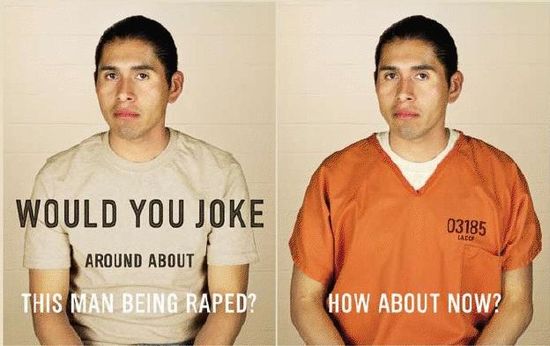
How To Stop Prison Rape

PrisonRapeAd

David Kaiser and Lovisa Stannow advocate for more safeguards:

The notion that rape is inevitable in our prisons is, as the Justice Department says, “not only incorrect but incompatible with American values.” After all, the government has extraordinary control over the lives of people whom it locks up and keeps under surveillance every hour of every day. Preventing sexual abuse in detention is primarily a matter of management. The policies needed are, for the most part, straightforward: for example, considering characteristics that make an inmate especially vulnerable when deciding where to house him, such as homosexuality or a history of prior abuse. Well-run prisons have adopted such policies already, and their rates of sexual assault are dramatically lower than the national average. But for too long, too many facilities have failed to take these basic measures.

Frum nods.

(Photos from a Just Detention International campaign against prison rape)

Pakistan As Nuclear Powder Keg

J. Dana Stuster warns that the conflict between Pakistian and India is the "greatest risk for nuclear war in our time":

The bad news is that Pakistan's nuclear program is expanding – it's set to become the fourth largest nuclear power, it is developing smaller, more mobile bombs, and it is building more nuclear reactors to churn out bulk supplies of weapons-grade uranium. The good news, though, is that (as far as we can tell) Pakistan has an effective security program in place. The bombs are under the purview of the military, the most stable and competent institution in the country. They are kept disassembled with the components kept in separate buildings, at secret facilities that both India and the United States would be hard-pressed to find. The sites are guarded by thousands of troops being watched by a meticulous internal affairs bureau to screen out extremists. It might be sufficient if Pakistan were not one of the most threatening and most threatened countries in the world.

Free Labor Or Bundles Of Joy?

The Dish has already debated the connection between parenting and happiness at length. But a new paper goes further and argues that parents exaggerate the emotional rewards of parenting because children are no longer economically beneficial: 

In an earlier time, kids actually had economic value; they worked on farms or brought home paychecks, and they didn’t cost that much. Not coincidentally, emotional relationships between parents and children were less affectionate back then. As the value of children has diminished, and the costs have escalated, the belief that parenthood is emotionally rewarding has gained currency. In that sense, the myth of parental joy is a modern psychological phenomenon.

Wilkinson adds:

This is testable. We could ask people in poorer places, where kids are still a productive asset to their parents, about the emotional rewards of parenthood. I bet Eibach and Mock are right. 

CDs Declined, Music Didn’t

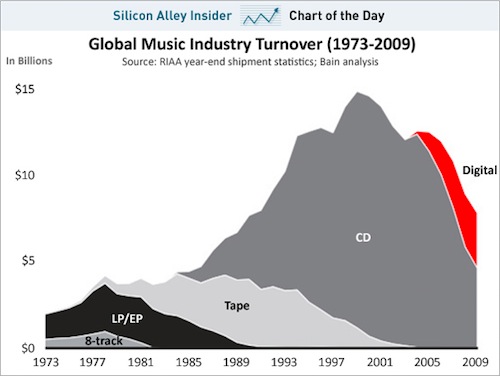
Musicindustry

Annie Lowrey wonders how we should measure "the value people derive from Wikipedia or Pandora" or other online products:

MIT professor Erik Brynjolfsson explains the idea using the example of the music industry. "Because you and I stopped buying CDs, the music industry has shrunk, according to revenues and GDP. But we're not listening to less music. There's more music consumed than before." The improved choice and variety and availability of music must be worth something to us—even if it is not easy to put into numbers. "On paper, the way GDP is calculated, the music industry is disappearing, but in reality it's not disappearing. It is disappearing in revenue. It is not disappearing in terms of what you should care about, which is music."

As more of our lives are lived online, he wonders whether this might become a bigger problem. "If everybody focuses on the part of the economy that produces dollars, they would be increasingly missing what people actually consume and enjoy. The disconnect becomes bigger and bigger." 

Chart via Yglesias.

Inequality And The Right, Ctd

A reader writes:

Great charts you posted on household income, 1979-present, before and after taxes. But consider how many more two-earner households there are now than in 1979 and the decline in after-tax household income for most people is even more distressing.

Another writes:

Your charts on income distribution from 1979-2007 leave out a major aspect of the story that should not be ignored: the buying power of people in the lowest 10% is exponentially greater today than it was back then. 

I know this because I was a kid back then living in a bottom 10% household.  A McDonald's meal was a once or twice per year luxury.  Today fast food meals are cheaper in actual nominal terms than they were back then.  In 1979, gasoline prices nearly bankrupted us, particularly when being forced to drive cars that sucked gas and spewed oil and fumes at criminal levels.  Gas prices may be "high" today, but it's nothing in terms of % of people's incomes like it was in 1979.  Moreover, cars back then required much more maintenance and lasted barely more than 3-4 years before rusting out and needing to be replaced.  Today a person can buy a cheap fuel efficient compact car with as many electronic gizmos as most high end luxury cars and it will easily run 100,000 miles on simple oil changes alone. 

Clothing: I had about six outfits in 1979, enough for a week of school and a nice set for church on Sunday.  Shoes were worn until they literally had holes in them, and even then duct tape had to make due until enough money was available to buy new ones.  Today, clothes are as cheap as food.  One trip to WalMart and a person in the bottom 10% of wage earners has as many clothes as it took me three years to accumulate back then.  In 1979 we had no computer, no cell phone bill, no Internet bill, no cable TV bill (unless you were "rich"), and only one 17-inch black and white TV.  Today: totally different story.  Even the poorest the of households has at least one of those luxury items.

My point is: If I had to choose between living in the bottom 10% in 1979 or 2011, I'd take 2011 in a heartbeat.  To a person in the bottom 10%, it does not matter – AT ALL – that a person in the top 1% can afford six more vacation homes than he could in 1979.  If anything, the rich being SO rich has actually raised the bar on standard of living for everyone.

Another:

Funny you should mention Winter's Bone in the discussion, because my father and I, who spent a good deal of time in Arkansas living or on vacation, watched the movie on the recommendation of a small-government, hard-core liberatarian.  He said he thought the movie was one of the most depressing he'd ever seen.  We, much more liberal economically, found the movie somewhat bleak but uplifting.  Discussing the movie later, we thought that this friend found the movie depressing because he simply didn't understand that there were people living like that in America.  Or that he "knew" but had never really thought what life was like for the poor.

Another:

While I completely concur with your analysis about the destabilizing dangers of inequality, I feel the need to explain why I find such inequality troubling even apart from a consequentialist perspective. 

Consider that the basis of an economy is the production and voluntary exchange of wealth, i.e. goods and services.  But if an economy is wealth production is increasing, as one might expect by looking at those graphs, why do the benefits of that increasing wealth not accrue to the workers?  Even if we grant that CEOs and hedge fund managers worker harder and longer hours than the average worker, are we really supposed to believe that the difference in how much they work can really account for such a huge gap?  Has the increase in that disparity been a reflection of these business moguls working harder and harder?

The fact is that there are subtle ways by which wealth is siphoned away by speculators, and even by honest business people who don't realize where their surplus comes from.  One of these ways was pointed out by the 19th century economist Henry George, who observed that the benefits of development and production accrue to the most valuable land.  Businesses operating on such areas gain a surplus over other businesses known as rent.  This surplus is by definition unearned, as it is the surplus of apply the same amount of labor in one area versus another.  Land rents also absorb the wealth from public infrastructure, effectively serving as a sort of "wealth sink." 

I could go into the margin of production and how it affects wages and unemployment, but that would get a bit too wonkish for your readers to follow along.  Suffice to say that the profits reported by the wealthiest corporations are only partly due to production, while another part comes from rent, and when you see wealth disparities grow like that, you can pretty much count on the growing accumulation of rent as a major culprit.

Another related factor, particularly in the recent crash, is debt.  After movies like Inside Job and all the talk about derivatives, I don't think I need to explain too much about how Wall Street made billions by leveraging debt.  Was there any wealth produced in this process?  No.  It's just shuffling around a bunch of claims on existing wealth, and making new claims on those existing claims.  Now, what happens when the amount of real wealth stays the same but a small number of people increase the number of claims they have on it?  Sounds to me like a pretty sneaky form of robbery.
Newt’s Chances, Ctd

Even if Huckabee and Palin don't run, Gingrich doesn't have a path to the nomination:

Palin and Huckabee voters really don't like him all that much more than they like Romney. With Republicans who currently list Huckabee as their top choice for the nomination Gingrich's favorability is a 58/24 spread and Romney's is actually better at 59/19. With Republicans who say Palin's their top choice right now Gingrich's numbers are slightly better than Romney's, but just by a small margin- 53/29 for the former Speaker as opposed to 50/29 for the former Governor.

The Seattle Model

Seattle-library

Edward Glaeser says the city could have shared Detroit's fate:

A great paradox of our age is that despite the declining cost of connecting across space, more people are clustering together in cities. The explanation of that strange fact is that globalization and technological change have increased the returns on being smart, and humans get smart by being around other smart people. Dense, smart cities like Seattle succeed by attracting smart people who educate and employ one another.

Zach Klein, who shot the above photo, captions:

The Seattle Central Library is marvelous. I left inspired, and incredulous that such an amazing building could be constructed by the public, not a rich maniac alone. It's so cool.

The Daily Wrap

Today on the Dish, Andrew rebutted a reader on military intervention in Libya, while others assessed what's in it for the U.S. Qaddafi attempted to starve rebel strongholds, threatened the Guardian's Peter Beaumont with death, and ramped up attacks. Roger Cohen viewed American intervention with pessimism, a Muslim cleric argued extremism was a reaction to the violence of the state, and Anderson Cooper was on Qaddafi's trail of his lies. Issandr El Amrani laid out press lessons from Tunisia and Egypt, Egyptians stormed the secret police HQ with cell-phone cameras, and Peter Beinart called out homeland security for singling out Muslim Americans for terror. Obama reversed his Guantanamo decision, John Yoo took advantage, and Bradley Manning's torture depressed Alex Knapp.

Andrew reveled in 18 minutes of pure Palin and made her enemy list, while the rest of the blogosphere placed their 2012 bets. Josh Green went with darkhorse Santorum, Romney puzzled everyone, Frum had second thoughts on Pawlenty, and Mitch Daniels resembled the President's barber. Drezner downplayed the Tea Party's foreign policy, and a journalist duked it out with a cabinet member on rural interests. Andrew urged Obama to bring back the Reagan era tax rates to make heads explode and Limbaugh's staff laughed at him. Brigham Young outlawed beards for Mormons, mostly because of the hippies and Matt Zwolinski contemplated legal prostitution. Andrew defended the libertarian plan for healthcare reform, and a Republican state senator came out in favor of civil unions. Andrew gave some ground on marital monogamy and those who wait, Andrew Stuttaford cheered Christians for not reading the bible, and a pastor outed Dan Savage as a reality-based conservative. Arcades didn't last even with Canada's loonie, poison squads used to keep America's food safe, and we examined urinal cakes and the economy. Bieber calculated his YouTube persona, no one can mention love at a congressional hearing, and NPR is run by liberals.

Map of the day here, quote for the day here, dissent of the day here, Malkin award here, chart of the day here, parliamentary jamming here, freelancer's invoice here, Sully bait here, Douthat bait here, tatooed story here, MHB here, FOTD here, VFYW here, and contest winner #40 here.

–Z.P.

Wrong But Not Prohibited

Matt Zwolinski contemplates exploitation:

An exchange can be mutually beneficial and yet unfair or degrading.  If you are drowning in a lake, and I row by on the only canoe in sight, it is morally wrong of me to make my rescue of you contingent upon your signing over the deed to your house.  Granted, you would be better off taking my deal than passing it up.

His point:

We can grant that even exploitation of a mutually beneficial sort is a serious moral wrong, but it simply does not necessarily follow from this that it is something that governments ought to prohibit it.  … Perhaps prohibiting exploitative transactions will lead would-be exploiters to offer mutually beneficial deals on fairer terms.  But, as is illustrated in the case of sweatshop labor, there is reason to worry that prohibiting exploitation by, say, mandating safety improvements or a higher minimum wage, will make the package sufficiently unattractive to would-be exploiters that they wind up prefering to make no offer at all.

Hence the case for legal prostitution.