Libya And The Other Dictators

President Obama took it as self-evident that US and NATO intervention would help tip the balance in the Middle East toward reform. Benjamin Friedman's not so sure:

Embroiling ourselves in Libya may do less to frighten other Middle East dictators then keeping our powder dry. Beyond tying up troops and public patience for war, the limited nature of our commitment—manifest in strict limits on the use of force and our stated desire draw back within days whether or not Qaddafi goes—might simply show dictators that they should hang tough, come what may. Whether or not he falls, if leaders like Bashar Assad fear his fate, they may simply heighten repression to prevent the sort of insurgency that brought western bombs to Libya.

Larison, unsurprisingly, agrees:

[I]t occurs to me now that the Libyan intervention is something of a gift for other authoritarian governments. Even more than before, authoritarian governments are going to be able to portray dissenters in their countries as being in league Western powers, and they will be able to point to Libya’s fate as an example of what demands for political reform can cause. While the administration seems to be very keen to align itself with certain popular movements in the region, they are lending credibility to authoritarians’ arguments that internal dissent is intended to weaken a country and that dissent invites outside attack.

Which means to say that outside intervention merely distorts the indigenous forces at large in the region, and may lead to the opposite of what is well intended. But America couldn't help itself, even under Obama. When you have that big a hammer …

(Video: Syrian protesters tearing down the visage of Assad last weekend. Today Assad dismissed his entire cabinet, and tomorrow he's set to deliver "his first speech in two weeks of unprecedented dissent.")
The Flipside To Cyberbullying

Amanda Marcotte thinks social networking has helped in the fight against bullying:

Cyberbullying is no different than regular bullying, with one giant exception: now there's a record.

Now parents, teachers, kids who play like they're oblivious, and other adults can see how vile the things that kids say to each other can be. Now we have a record of how ostracized some kids are, and how the popular kids use cruelty to reinforce their social status.  Now the problem is harder to paper over and ignore, because it's staring us in the face.  Feminists figured this one out a long time ago. The greatest weapon that rapists and domestic abusers have over their victims is the conspiracy of silence, and the greatest weapon to stop the violence has been to expose it to the light of day.  I think the same is true of school bullying. Now that we see bullying for what it is, it's much harder to pretend it's not a problem.

Would You Pay $10 To Attack Libya?

Among Exum's criticisms of the president's speech:

Did anyone else want to know more about the cost of this intervention? Considering this intervention likely wiped out even the most draconian cuts envisioned by the Republicans in the House of Representatives, how the hell are we supposed to both carry out these kinds of military interventions and pay for them? You know what leadership is? Leadership is announcing to every American that their 2011 taxes will go up by $10 per person in order to pay for what we have done. Leadership is making sure people understand that in these times, you cannot have both guns and butter unless you are willing to pay for both.

Slavery Analogies Gone Wild

Herman Cain is playing the victim card:

"I'm an American Black Conservative – an ABC — and I'm proud of it," Cain said. "And because I've been affiliated with the conservative movement, and had the audacity to go on talk radio and do a talk show, and promote conservative principles, I've been called a racist too. Go figure"

Cain then went on to say he thought liberals were upset with him "because I won't stay on the Democrat plantation like I'm supposed to." "It may shock you but some black people can think for themselves," he added.

Oh please. One understands the temptation. Some liberal condescension toward minority members who are conservative can truly get on your nerves. But the victim card is not the answer, especially when your politics is supposed to be against it. It's easy rhetoric, but more useful as therapy than argument.

Stalemate Watch

111052033

Disheartening developments from Libya:

Al Jazeera English is reporting that the oil port Bin Jawad, taken on Sunday by the opposition, has fallen once more into regime hands, with insurgents retreating to Ras Lanuf to the end. Its correspondent says that opposition military commanders are complaining that their fighters "do not want to be" disciplined or act in a structured way and that insurgent supply lines are stretched.

Abdel-Hamid reports:

So certainly what we can say at this stage is that Bin Jawad is not any more in the hands of the rebels, actually the Gaddafi forces now are managing to pound Ras Lanuf and are getting closer and closer to them, pushing the opposition fighters eastwards more and more. I think this is an exact repeat of what happened about three weeks ago.

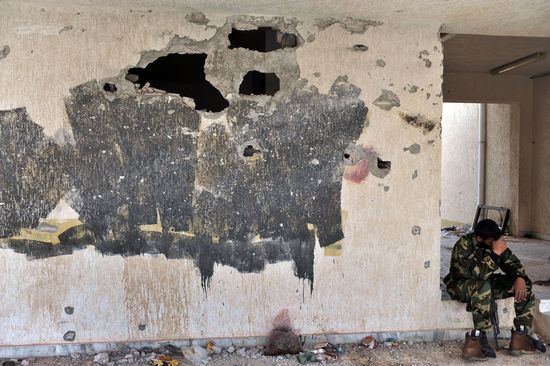
(Photo: A Libyan rebel rests outside a destroyed building before located close to the town of Ras Lanuf, on March 29, 2011. By Aris Messinis/AFP/Getty Images)

Quote For The Day II

"I agree the Arab involvement is not so big or not so concrete. But at least there are some Arab countries participating physically and some Arab countries participating at the conference here in London. I hope it will increase. I hope the Arab League has in the future a mechanism to do these things. This is an internal Arab problem. Unfortunately we could not do it by ourselves,"- Sheikh Hamad bin Jassim bin Jabor al-Thani, the prime minister of Qatar.

The US In Alliance With Hezbollah

As Roger Cohen notes, it's already happened. And Cohen backs ruthlessness in Libya:

People are being born throughout the Middle East. They are discovering their capacity to change things, their inner “Basta!” That’s how the Arab spring began on Dec. 17 in the little town of Sidi Bouzid in Tunisia — with a fruit peddler’s “enough” to humiliation. In my end is my beginning.

Three months later the genie is not only out of the bottle, it’s shattered the bottle. I said of Libya in an earlier column: Be ruthless or stay out. So now the West is in, be ruthless. Arm the resurgent rebels. Incapacitate Qaddafi. Do everything short of putting troops on the ground. Qaddafi, as President Obama has said, “must leave.” So that Libya can be an Arab country that is imperfect but open.

It appears that Clinton has heard him.

And Israel Yawns

Joe Klein reviews Obama's speech from Jerusalem:

After several days of meetings with Israeli officials here, I was not too surprised to find that Libya barely dented the conversation.

In one lengthy meeting with a former Mossad leader, we toured the entire region–and, I realized as I left, he never brought up Gaddafi. He was vehement on the need to provide economic assistance to Egypt, however. And he was still sorting out the impact of the revolutionary tide on Iran's fortunes in the region (always a priority for the Israelis and Saudis)–the jury is out, so long as the situation in Syria is in doubt.  In fact, he was far more concerned about the fate of Iraq, a crucial problem that has gotten lost in the maelstrom and may tip the balance of power in the region, than he was about Libya.

There is another view, however: as I reported a few days ago, most Palestinians seem entirely pleased that Obama has acted against Gaddafi, who is seen as an Arab embarrassment.