"If you go upstairs to take photographs you will be shot and killed immediately," – a Qaddafi spokesman, addressing the Guardian's Peter Beaumont and other journalists.
Month: March 2011
Palin’s Enemies List
Tina Dupuy updates it. I am on the list (yay!) but violate its rule:
The list is made up of people and groups she has personally, by name, gone after in the press. Left out are people who criticize her and she ignores, like Meghan McCain.
Palin has never mentioned my name in public.
A No-Fly Zone Over Libya? Ctd
A reader writes:
When you argue that "democratic revolutions only have a chance if they emerge indigenously," I can't help but think that Libya has done so already. We are past its emergence – the question now is, what end result do we want there and how badly do we want it?
And to your point (which seems to be that a new democracy can only be stable and valid if achieved without reliance on outside help), well, look at the American Revolution. France pitched in quite a bit.
In fact, it was the French navy under the Comte de Grasse that cut off any possible sea escape for the 9,000 Brits dug in at Yorktown, who were besieged not only by Washington's 12,000 Continentals but also by 8,000 French troops under the Comte de Rochambeau. Without France, there wouldn't have been a Cornwallis surrender in 1781, and therefore no Treaty of Paris in 1783, and therefore no victorious United States without a lot more suffering and expense (if at all).
Now, does this mean we need to establish a no-fly zone over Libya? Of course not. France jumped into our revolution because France wanted to hurt Britain, and there is no motive so clear-cut for us to jump into Libya. But let's not reject involvement based on an incomplete read of history, either.
Yes, foreign powers have sometimes intervened in civil wars or uprisings in other countries to advance their own interests. The first question is whether military intervention, with unforeseen consequences, in a third Muslim country advances US interests or not. Maybe tipping the air-war in the rebellion's favor could help stop the massacres. Maybe it would have a trivial effect, given the capacity of Qaddafi to move his paramilitary and mercenaries around on the ground. If it fails, we endure another chorus of criticism from those in the Muslim world who despise us. If it succeeds, the US all but "owns" whatever comes after Qaddafi.
Can we morally stand by and watch so many innocents killed? We did so on a far larger scale in Iraq even as we were responsible for Iraq's internal security. If we can stand by and observe the murder of tens of thousands under US occupation, by what argument do people argue that the US has an obligation to jump back in and protect those hunted down by Qaddafi's thugs?
Two wrongs don't make a right? Sure. But what we learned from Iraq is that once you take the leap into intervention, no one can know what follows. Ten years after 9/11 we are enduring more casualties in Afghanistan than at any point in the last decade, while also killing nine boys by mistake. Imagine a story about Qaddafi hunting down children by helicopter gunship. We are also still in Iraq with numbers of troops no pro-war advocate anticipated in 2003. And yet the very same people who backed the Iraq war are now backing intervention in Libya, including, I might add, Senator John Kerry.
18 Minutes Of Sarah Palin
You know you want it. Okay, so you don't. So don't click. But it's so rare for this politician to be interviewed by a non-FNC journalist that it's worth watching the whole thing. I note that on BBC World News America last night – the primo place on cable for in-depth foreign and domestic news – they removed the exchange in which Palin once again brought up Trig. But this analysis from their reporter rings true to me:
Both the critics and supporters of Palin that I met while in Alaska told me that she should never be underestimated.
Parliamentary Jamming
Well, sometimes listening to a defense minister needs a little jazzing up:
(Hat tip: TDW.)
The Revolutions And The Press
Issandr El Amrani lists lessons from Tunisia's and Egypt's revolutions:
Egypt's [former Prime Minister Ahmed Shafiq] was hurt by his proximity to Mubarak, but what undid him was his defensive appearance on a live television show where, for the first time in Egyptian history, he was forced to debate in public with opposition figures. His resignation the next day was announced on the military's Facebook page, which has become its primary outlet after it was criticized for handing public relations through very abrupt martial communiqués. In these countries were leaders were long used to sycophantic television interviews, they now face combative interviewers out to make a reputation for themselves. It will be a while before the spin doctors come in and teach the politicians to stay on-message — in the meantime, they are walking the tightrope without a net.
A leader communicating by Facebook and unable to answer press questions coherently? Maybe Mr Shafiq could relocate to Alaska.
Chart Of The Day
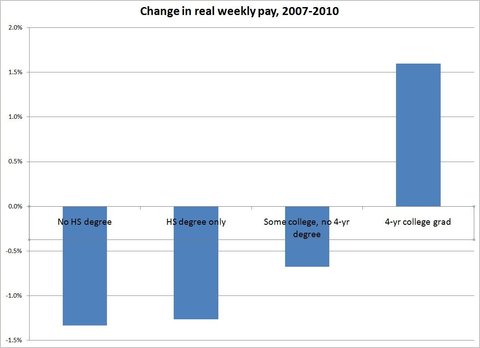
Leonhardt looks at how various social classes have weathered the recession. The above chart stands out:
College graduates have received a raise since the recession began. Every other educational group has taken a pay cut.
Internet Idol, Ctd
A reader writes:
Music journalists for the New York Times discussed Bieber's YouTube strategy on a podcast in April last year. Listen here. Money quote from Jan Hoffman on the show:
It was so canny. Justin first came onto YouTube because of his mom. Justin was trying out at the local version of American Idol, the local town version and his mom taped it. The narrative goes that she wanted it just to show relatives who weren't able to attend. It goes on YouTube and she keeps on taping him, as he sings in the bathroom, he brushes his teeth, he warbles to the mirror. He begins to catch the eye of lots of young girls.
And part of the strategy of Scooter Braun, who later on sort of acknowledges such, is to let the girls think they discover him.
He becomes truly the fans' hero. What really happens though is that Scooter hears about him, Scooter Braun the manager, signs Justin, and decides that because Justin's appeal is through YouTube, he's gonna encourage them to keep producing more product and putting it onto YouTube, and he deliberately tells them: make it look rough, make it look homemade, let's not let it look overproduced so the girls can continue to discover him.
So, yeah, YouTube helped in his success, but it's just as calculated as any industry marketing campaign, and not the rosy, grassroots scenario that James Parker seems to hint at.
Map Of The Day
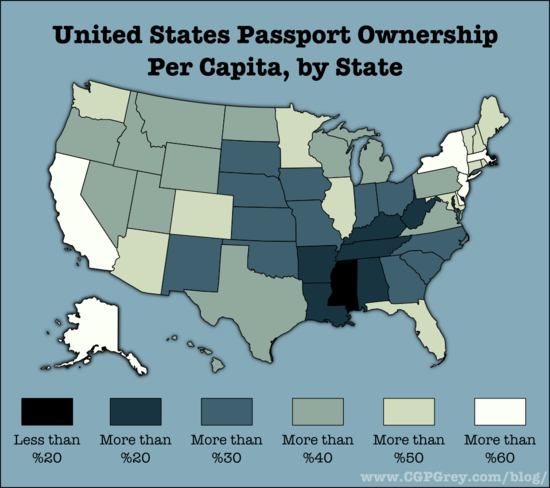
How many Americans have a passport, by state:
Does Peeing On Urinal Cakes Help The Economy?
Answer here.
 The Dish