Marriage Equality And The Black Vote

David Kaufman says black "voters who don't support marriage equality still appear willing to elect politicians who do":

"The truth is, we just don't see blacks voting against a candidate based on [his or her] support of gay marriage," says Patrick Egan, assistant professor of politics and public policy at New York University. "We actually don't see this becoming an important issue for voters of any race."

Poor Karl Rove. Outfoxed by history in 2011. But, hey, he got Bush re-elected in 2004.

(Hat tip: Alvin McEwen)

Dissents Of The Day

8bff3960-0aaf-4abe-949e-ed2389191bfe

A reader writes:

I must disagree strongly about the value of the white angry bird. I admit I felt the same way at first, until I discovered the real fun of this bird – after dropping its bomb, it propels itself with remarkable force at a 45-degree angle. If the bird is low enough, you can send it careening into whatever structure is protecting those damnable pigs to great effect.

Yes, that is its bouncy upside. Another writes:

Whoever made that Angry Birds Likability Scale is obviously an amateur thymo-orthnithologian.

True, the white bird's egg-bombs are pretty dinky, but his real strength is his ability to hit targets from below. He can also hit two targets on different sides of the screen if used just right. He is a multi-tool utility player, the shortstop to the black bird's DH.

The boomerangoucan also has an interesting and underappreciated power: he can go faster than any other bird, even the yellow bird. The thing about the green bird is that he picks up speed the longer you let him boomerang. If you shoot the green bird backwards and then boomerang him into the fray, he is very good. Of course using him requires finesse, but I thought Angry Birds was a thinking man's game!

Another:

The white bird has a hidden gift that many people don't know about; it holds the key to unlocking one of the golden eggs. See this Youtube for a full explanation.

Another:

The talent-less red bird is clearly the crappiest.

(Brandon Ortwein's "Angry Birdsky" mashup via TDW)

David Brooks Has A Blog

This is a promising start:

Tom Wolfe was once asked, What is the most important change of your lifetime? He is purported to have answered, “Oh, that’s easy. Co-ed dorms.”

My own gloss on that answer is that we spend a lot of our time debating political events and the choices leaders make. But the most important changes are the shifts in culture, ideas and mentalities that people usually don’t even notice until after the fact. In 1960, it would have been absurd for most colleges to have co-ed dorms. A short time later, they were unremarkable.

The full blog is here. I wonder if blogs will be part of the looming NYT paywall.

Inequality And The Right

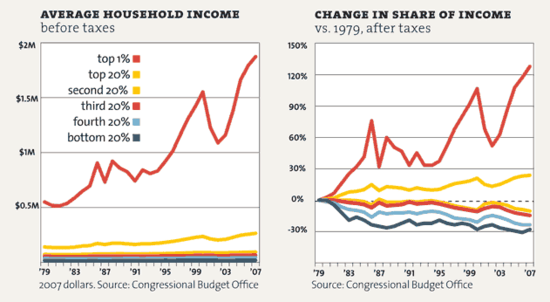
Inequality-p25_averagehouseholdincom

It's a subject that lies behind many of my readers' dissents from my small government, flat, simple taxation kind of conservatism. In Wisconsin, for example, it is impossible, I think, to separate the issues of public sector collective bargaining rights … and the broader context of a country polarized into two camps: the very, very rich, and everyone else. This is expecially true after the bank bailouts. There is a strong argument that bailing out the banks was the right, if distasteful, thing to do because of the threat their collapse would have had on the entire economy. But watching Wall Street rack up bonuses, carry on as normal, while teachers are being asked to take big benefit cuts … well, it's understandable why even level-headed Wisconsinites look a little Jacobin these days.

To many on the right, this inequality is a non-issue, and in an abstract sense, I agree. Penalizing people for their success does not help the less successful. But at a time of real sacrifice, it does seem to me important for conservatives not to ignore the dangers of growing and vast inequality – for political, not economic, reasons. And by political, I don't mean partisan. I mean a genuine concern for the effects of an increasingly unequal society. Last night, we watched "Winter's Bone" about meth-fueled social collapse in the heartland and then clicked over to watch "The Real Housewives Of Orange County." It was a bracing summary of where America increasingly finds itself. If you find this growing gulf unproblematic, I refer you to that leftist radical, Aristotle:

"It is clear then both the best partnership in a state is the one which operates through the middle people, and also that those states in which the middle element is large, and stronger if possible than the other two together, or at any rate stronger than either of them alone, have every chance of having a well-run constitution."

By "middle element," Aristotle means the middle class. The loss of it has destabilizing political consequences. Now, some of this may be unavoidable, given a globalized and increasingly automated economy. But it increasingly seems wrong to me to exempt the very wealthy from sacrifice, in the context of their gains in the last three decades, if we are to ask it of everyone else.

It's not about fairness. It isn't even really about redistribution, as we once understood that from the hard left. It's about political stability and cohesion and coherence. Without a large and strong middle class, we can easily become more divided, more bitter and more unstable. Concern about that is a legitimate conservative issue. And if someone on the right does not find a way to address it, someone on the left may well be empowered to over-reach.

A No-Fly Zone Over Libya, Ctd

 John McCain and John Kerry want one. Joe Klein urges caution:

The biggest problem is that we have no idea whether the rebels in Libya are freedom fighters at all. Some are, especially the English-speaking, western-educated young people who are prime targets for visiting journalists. But how relevant are they to the real power struggle? Who are the non-English-speaking tribal elders? Are they democracy loving freedom fighters…or just Qaddafis-in-waiting? It's a question to be asked not only in Libya, but also in Egypt, Tunisia, Yemen and Bahrain. One hopes for the best–especially in Egypt, where there are signs that the Army is allowing at least a partial transition away from autocracy. But who knows, really? Even Iraq's democracy is looking shaky these days as Nouri al-Maliki seems intent on consolidating his power.

I do not doubt the sincerity and good intentions of those appalled by Qaddafi's brutality. Obviously, I share it. But this is where morality must address prudence if we are to make actual, real-life decisions in a fallen world. And if we haven't learned that these "societies" are beyond our understanding, that military intervention can bring unintended consequences, that democratic revolutions only have a chance if they emerge indigenously … then what have we learned?

Premature Monogamy

Ross Douthat admits that sex outside marriage cannot be avoided. But he emphasizes that there are "different kinds of premarital sex":

There’s sex that’s actually pre-marital, in the sense that it involves monogamous couples on a path that might lead to matrimony one day. Then there’s sex that’s casual and promiscuous, or just premature and ill considered.

Dana Goldstein tweaks Douthat's message:

I agree with Douthat that many young people would be wise to abstain from sex until they are in a monogamous relationship with some lasting power. But I think from there, he goes seriously astray. I don't think it makes sense to teach teenagers that, ideally, they should be marrying the first (or second) person they ever sleep with.  What we should teach young people about marriage is that it's worth waiting for the right person: you know, a loving, committed, emotionally mature and stable partner with whom you share interests, goals, and all that other heart-warming stuff.

What I find unpersuasive is Ross's dichotomy. There's either pre-marital monogamy or everything else: "casual and promiscuous, or just premature and ill considered." In real human lives, isn't this a spectrum rather than a binary choice? Many men especially, to my mind, should be wary of marrying the first person they fall for or have sex with. Experience in relationships, and sex, and the tangled mashups of both, is surely salient for getting the marital choice right. This can end in tears, of course, but so can premature monogamy.

There is nothing lonelier than a bad marriage made for good reasons; and nothing but experience that can help you figure out if you are making a huge mistake.