Obama vs Walker

One has been distant but supportive of the unions in response to the events in Wisconsin; the other is in the news daily. And yet polling in Wisconsin suggests that the distant and relatively quiet one is gaining ground:

Obama’s approval rating sits at a comfortable 53%-42%, above the national average, and a nine-point improvement in the poll from November. (In November – after the Democrats' shellacking in the midterms – the president’s approval in the poll was split at 44%-43%.)

By contrast, Walker’s approval rating is upside down – with 43% approving and 53% disapproving of how he’s handling his job. Walker’s “strongly disapprove” is a sky-high 45%; Obama’s is 26%. Walker’s favorability rating – also 43%-53% — mirrors his approval. His negative rating is up 18 points from November, when his rating was 45%/35%. His “strongly unfavorable” is up to 41% from a “very unfavorable” rating of just 19% in November.

Few seem to know for sure if the WSJ story about the State Senate Dems coming home is true. I rather think their point has been made, however dumb it was to run away. It might not be so easy for a Republican to win Wisconsin in 2012.

When The Mandate Was Libertarian, Ctd

Last week Chait dug up on old Ronald Bailey column which endorsed mandatory health insurance. Bailey fires back and asks Chait to examine the rest of his proposal:

BaileyCare would enable all Americans to purchase health insurance in a national competitive private market. It would completely eliminate Medicaid and S-CHIP (and possibly even Medicare) and use those funds to provide vouchers to poor Americans helping them to buy private insurance in a competitive market. It also would completely delink insurance from employment; it is a consumer-driven plan that combines high-deductible catastrophic insurance with health savings accounts with the aim of using market competition to rein in health care expenses. Vouchers also mean that there would be no need for tax penalties to force people to buy insurance.

Balko piles on. They're right. It's possible to create a system which both has a mandate and is also highly free market in structure and design. In an ideal world, I'd prefer it to Obamacare. But the GOP has never fully endorsed such a plan or tried to propose it when it had control of the Congress. Oddly enough, I think a commitment to universal access to healthcare and the kind of radical free market approach favored by Bailey would have had real political potential – if its vouchers were generous enough for the poor to afford it.

Kristol vs Gates

It's on now. What I find fascinating about Kristol's worldview is that it is unchanging. That's true of those who have doctrines, rather than judgments. Money quote:

Leave aside the facts that our soldiers and Marines are succeeding in Afghanistan, and that history will vindicate Gates’s involvement in the decision to surge. Does Gates really think it appropriate—while he’s still secretary of defense, with troops fighting at his direction—to be undercutting the troops’ mission as though he’s resigned to their failure?

As for the “realism” of his prescription: The United States has sent 100,000 or more troops to Asia and the Middle East five times in the last six decades. Does he really think we may never be called upon to do so again?

The combination of accusing Gates of disloyalty to the troops and a doctrinaire belief that nothing really has changed in the dynamics of global power since the 1950s is classic neoconservatism: cheap shots, faux moralizing and fathomless ignorance.

And, yes, those who learn nothing from history, who devised, egged on and refused to take responsibility for the most disastrous wars since Vietnam – they do indeed need their heads examined.

Indentured Mercenaries

LeavingLibyaGetty

Another disturbing tactic used by Qaddafi's people:

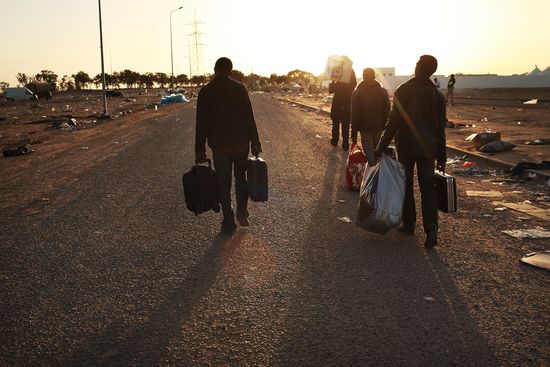
Libyan troops loyal to Muammar Gaddafi are rounding up black African migrants to force them to fight anti-Gaddafi rebels, Reuters is reporting. The news agency said it had spoken to several young African men who have fled to Tunisia. The men told reporters at the Ras Jdir refugee camp near the Tunisia-Libya border that they were raided in their homes by soldiers, beaten and robbed of their savings and identity papers, then detained and finally offered money to take up arms for the state.

Along the same lines, Babak Dehghanpisheh reports that "that the fear of foreign mercenaries has spurred hysteria among Libyans in the east and led to a series of attacks on dark-skinned Africans who had nothing to do with the violence":

Yusuf Suleiman Hassan, a 25-year-old native of Chad, says he came to Benghazi, in eastern Libya, six months ago to find work. He eventually joined dozens of his countrymen in grueling construction work. When the violent uprisings broke out in Libya last month, he knew it was time to go. "There was a lot of fighting," says Hassan, who's wearing a muddy light blue jacket and brown sandals. "I'm a poor man and I just want to go home."

The Kalashnikov-toting Libyan guards who are now holding Hassan captive don't buy any of it. They insist he's a murtazeqa—a mercenary paid by Muammar Gaddafi to attack regime opponents.

The Guardian summaries the latest developments in the war-torn country. Juan Cole lists the "Top Ten Achievements of Mideast Democracy Protests this Weekend".

(Photo: Sudanese men walk to a United Nations displacement camp after crossing into Tunisia from Libya on March 6, 2011 in Ras Jdir, Tunisia. As fighting continues in and around the Libyan capital of Tripoli, tens of thousands of guest workers from Egypt, Tunisia, Bangladesh and other countries are fleeing to the border of Tunisia to escape the violence. By Spencer Platt/Getty Images)

Who Leads The World?

David Rothkopf rages against the idea of a G-Zero world in which "no country or bloc of countries has the political and economic leverage to drive an international agenda":

We have major powers, at least one of which is greater than the others and will be for quite some time, that must work together to get things done. Sometimes that means the solution will be a G-2, sometimes it will be a G-8, sometimes it will be a G-3.5 (depending on how the schizophrenic EU splits). In fact, the reality is we live in a G-X world with x being a variable that is filled in to suit the occasion and the national interests of the major powers involved. The coalitions will change but the fact that a few nations will continue to lead the world as has always been the case will not.

“Bear Chic”

Bear_plaid

Victoria Gannon charts the plaid fad:

In the 1970s, plaid became a site of negotiation, enabling a partial collapse of a false dichotomy. It was during this period that many gay men adopted a hyper-masculine look, claiming traditionally heterosexual symbols and asserting their own manliness. “[G]ay men looked towards traditional images of rugged masculinity, such as the cowboy or lumberjack,” writes Shaun Cole in Don We Now Our Gay Apparel, his history of gay men’s dress in the twentieth century. “All these clothes had a clear meaning in the wider American culture: toughness, virility, aggression, strength, potency.” Two supposed polarities—homosexuality and heteronormative masculinity—unite in one fashion statement; both identities are destabilized in the process. Plaid continues to be prominent in gay male culture, having been coined “bear chic” in a 2009 article in the Advocate.

Either that or we got it from the lesbians. I was wearing plaid back when I was a twink. At the very least, it's practical.

(Image by Eat Sleep Draw, via Fuck Yeah Plaid!)

When Do You Trust An Avatar?

David Zax reports on a upcoming study on virtual assistants:

On the whole, people reported higher engagement with avatars that looked like them, in terms of race and gender. They also learned better from the avatars when the helpers appeared to hold similar opinions about success. Learners who preferred striving for a a personal best (measured against prior performance), rather than an absolute best (measured against others' performance), learned more when their avatars measured success the same way.

The End Of Cheap Food?

AP110228027386

John Parker reports:

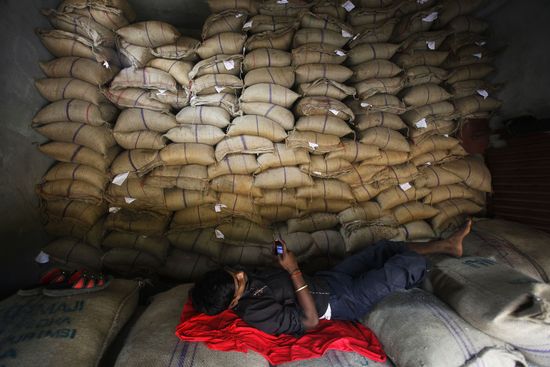
A combination of factors—rising demand in India and China, a dietary shift away from cereals towards meat and vegetables, the increasing use of maize as a fuel, and developments outside agriculture, such as the fall in the dollar—have brought to a close a period starting in the early 1970s in which the real price of staple crops (rice, wheat and maize) fell year after year.

This has come as a shock. By the 1990s most agricultural problems seemed to have been solved. Yields were rising, pests appeared under control and fertilisers were replenishing tired soil. The exciting areas of research in life sciences were no longer plants but things like HIV/AIDS.

(Photo: An Indian worker sleeps on rice bags at a warehouse in Gauhati, India. By Anupam Nath/ AP)

A Kingdom At A Crossroads

Madawi Al-Rasheed says Saudi Arabia is ripe for revolution:

Like other falling Arab regimes before them, the ruling Al-Saud will inevitably seek to scare the population by raising the spectre of al Qaeda and warning against tribal, regional, and sectarian disintegration. They will try to thwart political change before it starts. Saudis may not believe the scaremongers. The command centers of the Arab revolutions today are not the caves of Tora Bora or Riyadh's shabby al-Suwaidi neighborhood, where jihadists shot BBC journalist Frank Gardner and his cameraman in 2004. They are the laptops of a young, connected, knowledgeable, but frustrated generation that is rising against the authoritarian public and private families that have been crushing the individual in the pursuit of illusions and control.