Northern lights in Norway:
Northern Lights from Christian Mülhauser on Vimeo.
Northern lights in Norway:
Northern Lights from Christian Mülhauser on Vimeo.
Mike Ervin highlights the double standard applied to mental and physical illnesses:
Try calling a florist and saying, “I need a nice pick-me-up bouquet for a friend who’s been diagnosed with a spinal tumor.” They’ll get on it right away. But then call and say, “I need a nice pick-me-up bouquet for a friend who’s been diagnosed with paranoid schizophrenia.” They’ll think it’s a prank call. Or go to your local cozy little Hallmark store and say “I’m looking for a card for a friend who’s been in bed all week with the flu.” They’ll have rows and rows of cards expressing the perfect sentiment I’m sure. But then say “Now I’m looking for a card for a friend who’s been in bed all week with post-traumatic stress disorder.” They’ll probably call security.
There’s a word for this attitude. Actually, there are two words for it. It’s fucked up.
Wanna get yourself some raw Strauss? The time has come.
Erica Grieder reports on how George's creators, H.A. and Margret Rey, fled Paris two days before Nazis arrived:
The first book, "Curious George", was published in 1941. The little monkey arrives in New
York and strolls off of the ship with a smile, holding his papers in one hand and a little red valise in the other. A policeman salutes in welcome. … The Reys became American citizens in 1946, and stayed in New York the rest of their lives. They never talked much about their narrow escape, and even today the story is not widely known. This is perhaps because, despite the direct biographical parallels, the Curious George stories give so little indication of their dark historical backdrop. The outlook is resolutely cheerful. George explores his new world fearlessly, and his confidence is justified. Strangers are kind to him. Authority figures are corrective, not punitive. The inevitable misunderstandings are quickly sorted out and forgiven. He is just a fictional monkey. But those would be good standards to help any newcomer feel at home.
Errol Morris elaborates on why he loves Frederick Wiseman's movies:
Many people have written or filmed unending paeans to the human race, the nobility of man, the endurance of human spirit. But they have described man as we might like him to be, with little regard for how he is. Wiseman has had the honesty and supreme decency to portray human society for what it is: a madhouse.
(Clip from Hospital, 1970. Warning: contains extreme vomiting around the 7 minute mark.)
The pattern is clear: homophobic doctrine, arrested emotional development of young Catholic gay boys and adolescents, a high proportion of priests either acting out sexually with boys whose age roughly approximates their own emotional maturity or coping with these pressures through drugs or alcohol. All of which is then compounded by a culture of hierarchy and silence and obedience that impedes airing this clearly, fails to protect children immediately and also allows these screwed up priests to stay in place.
There has been some progress in accountability and openness. But the core elements that made the Catholic Church one of the biggest pedophile conspiracies in the world for decades if not centuries remain: incoherent, irrational and data-resistant doctrines on homosexual orientation and sex in general; a Western culture in which fewer and fewer straight men are prepared to give up sex and love and marriage to serve the church; and a hierarchical structure designed to instill control rather than openness, and perfectly set up to enable cover-ups.
Since the church even now seems incapable of treating child abuse as seriously as the rest of society, it seems to me that increased police involvement is necessary.
Felisa Rogers forages for food:
I'm not claiming that gathering mushrooms is going to save us from starvation; we aren't starving. Gathering mushrooms is going to make the difference between a dull meal and a delicious one. And as I sit by candlelight eating pasta with a chanterelle cream sauce, I am grateful for this winter bounty. I'm grateful because it mitigates the meanness of existence and allows me to forget the wolves at the door: Even in these hard times, we're lucky. We eat like kings.
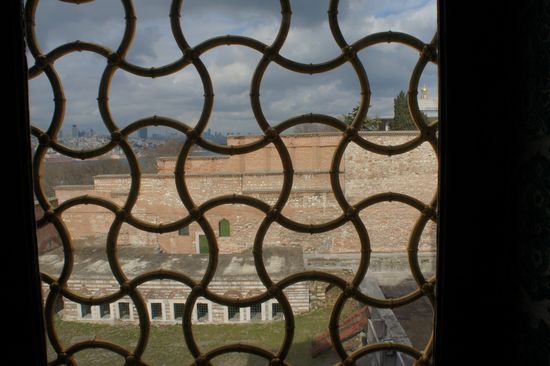
Istanbul, Turkey, 3 pm
Dean Esmay explores fears of a "Global Caliphate," or a Muslim dictatorship stretching across the Middle East and beyond:
This is like asking your average American if our own laws should be guided first and foremost by the Bible. I imagine you could get a good half of Americans to agree on that. But can you get even 10% of them to agree on exactly what that means? In anything but the most broad and nebulous terms? I doubt it. …
To get your global Caliphate you're going to need a Global Islam, and there isn't one. Just endless splinters and factions and endless debate and argument. Yeah yeah, there's one Koran. And multiple interpretative traditions of it, multiple Hadith sets and subsets and views of same, multiple cultures, multiple languages, and multiple fragmented self-interest conflicts, economic and otherwise. Add together the differences in language, culture, ethnicity, and sheer geographic logistics, and the profound differences between Muslims themselves, and you're positing an idea with no practical possibility of happening.
"Cathedral Scan" by Blake Carrington "translates the architectural plans of Gothic cathedrals into open-ended musical scores via custom software. Treating the plans as a kind of map, in the live performance Carrington navigates through them to create diverse rhythms, drones and textures." Geoff Manaugh reacts:
Of course, it's difficult not to wonder what this might sound like applied to radically other architectural styles and structural types, from, say, the Seagram Building or the Forth Bridge to troglodyte homes in Cappadocia. Further, it would be interesting to see this applied not just to plans or sections—not just to architectural representations—but to three-dimensional structures in real-time. Laser scans of old ruins turned from visual information to live sound, broadcast 24 hours a day on dedicated radio stations installed amidst the fallen walls of old temples, or acoustically rediscovering every frequency at which Mayan subwoofers once roared.
 The Dish