Huckagaffe, Ctd

A reader writes:

In light of his comments on Natalie Portman's pregnancy, it might be instructive to recall what he said about the last controversial out-of-wedlock pregnancy. For the record:

“It ought to be a reminder that here is a family that loves one another. They stuck with each other though the tough times and that’s what families do." … Huckabee said the surprise pregnancy announcement should not affect vice presidential candidate Sarah Palin’s support in the conservative and religious right communities. … “I’m grateful for the way she’s being supported by her family."

Another thinks Huckabee is being canny:

You said, "She seems an unlikely culture war target. And a hopelessly tone-deaf one." I've never been a fan of Huckabee, but is it possible you're missing the point here? Natalie Portman may be a horrible target, but clearly "Natalie Portman" is just code for "Bristol Palin." The question was specifically about Natalie Portman, and the first thing Huckabee said (to play armchair shrink here) was "people see a Natalie Portman or some other Hollywood starlet …"

Of course Huckabee can't come out and say "Bristol Palin embodies our culture's willingingess to 'glorify and glamorize the idea of out of children wedlock,'" but consider his audience: isn't Bristol who he is really talking about? Does the right-wing base really give a damn about Natalie Portman and the seriousness of her life and the maturity she plainly has demonstrated about her choices? I doubt it.

Huckabee has shown before he is extremely adept at speaking the code of evangelicals. The single biggest obstacle to his nomination is Sarah Palin. We know she's a joke, and I suspect he knows it too. But how does he communicate that without turning off the very people he needs? That's not to excuse his throwing Natalie under the bus, but I'd be careful to call this a gaffe.

Don't underestimate the man.

One Of Hollywood’s Greatest Lies

Impossibly efficient bureaucracies:

Ezra Klein explains the reality:

I can't believe in guys in suits with the ability to plan things.

That's the main thing I've learned working as a reporter and political observer in Washington: No one can carry out complicated plans. All parties and groups are fractious and bumbling. But everyone always thinks everyone else is efficiently and ruthlessly carrying out complicated plans. Partisans are very good at recognizing disarray and incompetence on their side of the aisle, but they tend to think the other side is intimidatingly capable and unburdened by scruples or normal human vulnerabilities. And there's so much press interest in Svengali political consultants like Karl Rove or David Plouffe, all of whom get built up in the press as infallible tacticians, that the place just looks a lot more sophisticated than it really is.

Bernstein couldn't agree more. By the way, Orr's review of The Adjustment Bureau is here.

The Cultural Contributions of Hipsters

Beards make the list:

The hipster obsession with all things blue collar — a fad that peaked around 2003 — was so grating and disingenuous it bordered on offensive. But one good thing did come with that look: beards. For years, they were just for older guys or dirty hippies. Now, led by such beardo icons as Will Oldham, Zach Galifianakis, and Dan Deacon, guys under 40 can proudly rock adorable facial hair.

Agreed. And I grew mine just before my 40s. So am I now just an older guy, a dirty hippie or retroactively hip?

Letters From The Front Lines: Angry Bird Edition

Angry-birds

Let me say I agree entirely with the judgments rendered above, except I would reverse the last two birds. I rather enjoy the boomerang toucan. I'm way less impressed by the owl-looking bird with the lame-ass bombs he drops. Chris Riebschlager imagines dispatches from the endless war between birds and swine:

My Sweet Adeline,

Our fortunes have taken a turn for the worse this week. The enemy has now taken to placing boxes of TNT inside their own camps. Every night, I am haunted by visions of innocent green pigs senselessly killed by these horrific explosions. They're using their own people as human shields, Adeline. What kind of god would allow such beastly, immoral acts? Sometimes I can't help but think that hurling ourselves at the enemy camps is senseless, possibly even insane. But I am just a simple soldier, one of many birds that do certain things when tapped. I'm just following orders.

I will be with you soon,
Blue Bird

(Image from The Oatmeal)

Blowing It

We all know what the Congress should be doing about the debt right now, don't we? It should be debating which mix of long-term entitlement and defense cuts and the least economically damaging tax increases would lower the long-term debt, restore global confidence in the long-term solvency of the US, and thereby ignite more business confidence and job growth. Yes, the discretionary spending budget should also be subjected to, er, strict scrutiny, mindful of the sometimes counterproductive effect of too drastic a reduction in demand in a fragile economy.

What do we have instead? A president too calculating to take a stand and an opposition so focused on drastic cuts to discretionary spending and over-reaching on collective bargaining that it is already making Independents and moderate Republicans queasy. My concern is that this dynamic leads to diminishing the chances of real cuts in the places where the real money is. Bruce Bartlett puts the meat on the bones of this argument here by noting that the GOP's Tea Party fixation on 2011 spending cuts both delays their chance to present a more considered 2012 budget proposal and pushes the real issue even further down the road.

If the lesson of the next two years becomes that spending cuts hurt people and hurt the economy, and that ending public funds for PBS or pork is a serious way to save the country from fiscal ruin, then the solid case for long-term fiscal reform is at risk of being bungled.

Jobs Report Reax

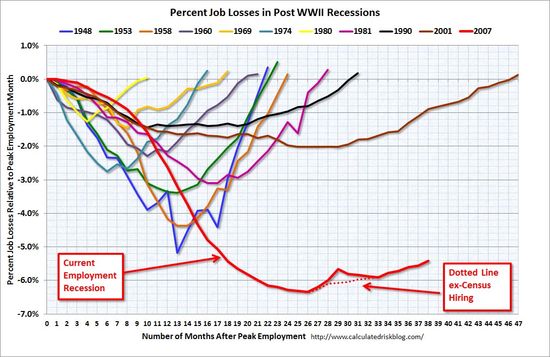
JobLossesPercentFeb2011

Calculated Risk:

This wasn't a great report. Heck, it wasn't a "good" report. But it was a little better than most recent reports. If we average the last two months together, the 63,000 payroll jobs added in January and the 192,000 payroll jobs in February, that gives 127,500 payroll jobs per month. And that is a barely enough to keep up with the growth in the labor force. Private payrolls were a little better at an average of 145,000 per month, as state and local governments continued to lay off workers (something we expect all year).  

Leonhardt:

 The best part of this morning’s jobs report may be the hints that the government is understating actual job growth. As we’ve noted before, the Labor Department’s monthly estimate of employment changes is often too pessimistic in the early stages of a recovery (and too optimistic in the early stages of a downturn). The department tends to underestimate how many new businesses are starting as the economy picks up. 

Ezra Klein:

The jobs report could’ve been better. If not for the 30,000 jobs the public sector lost, we’d have created 222,000 jobs. So it’s worth worrying that the House GOP is pushing a spending bill that economist Mark Zandi says will cost 700,000 jobs and Ben Bernanke says will cost “a couple hundred thousand” jobs. Zandi’s estimate is high enough to wipe out this jobs report and a few more like it. 

McArdle:

A lot of bloggers and commentators out there are worried about government layoffs pushing us back into the ditch.  I think if you believe in the "strong" version of stimulus (multipliers 2x or higher), then this implies that we're probably going back into the ditch regardless of the prevailing political ideology.  We're seeing 8.9% unemployment with a $1.6 trillion federal deficit.  There's no way we're going to continue that for another three years or so.  Politically, it's not supportable, and while I know that the deficit anti-hawks will scoff, I'm skeptical that the markets will happily lend us another $5 trillion in such a short period without demanding higher interest rate premiums. 

Greg Ip:

The unemployment rate is falling: to 8.9% in February from 9.0% in January and 9.8% last November. For some reason, we seem to be able to get unemployment down with far lower rates of job creation than in the past. Why? … [I]f the new normal was slow growing employment, the new new normal is a slow growing labour force. Put the two together and the unemployment decouples from the overall health of the economy. Why? Perhaps the Great Recession has permanently diminished work opportunities for big swathes of the work force, in particular prime-age men. Perhaps America is now experiencing an echo of what older Europe and Japan already have: a demographically driven slowdown in potential growth. Or perhaps it’s one of those temporary statistical mysteries that will disappear soon.

Daniel Indiviglio:

We could still see the unemployment rate tick back up once some of the millions of Americans who have left the workforce re-enter. But if the job growth continues to accelerate, then we will continue to see slow progress at whittling down the number of unemployed Americans. Let's just hope that rising oil prices, arguably the biggest threat to the recovery at this time, don't get in the way.

(Chart from Calculated Risk)

My Screw-Up

Yesterday, I accidentally scheduled a post that included Ryan Lizza's email to me rebutting my initial inference that he approved of Mark Leibovich's collecting other reporters' emails to political sources in order, presumably, to publish them. I thought I had replied to him by emailing the following:

i will run this email with your permission. i would not dream of publishing it without. but may i ask what your position actually is?

In a midday rush in a hectic week, I clicked the save button rather than the send, and drafted a post for later in the day. Except in a second bungle, I didn't just draft it but scheduled it (bloggers will know the difference – but a draft is never automatically published and a scheduled post is).

Yesterday afternoon, I was at the Atlantic offices talking to interns, and off-grid. When I got back to the laptop I searched for a response from Ryan, and found none. I checked my sent email and couldn't find my email to him. I found it in the saved box and sent it – by then way too late. Then I got an understandably furious email from Ryan pointing out the extreme irony of my publishing a personal email in a thread that was precisely arguing against such a thing, and the bizarreness of an email asking permission for something that had already run. That was when I realized my second bungle – scheduling rather than drafting the post.

Of course, the email I accidentally and prematurely published was a simple rebuttal of an inference I made and was in no way embarrassing to Lizza and helped correct the record in his favor. If I have misread something, I try to give the author a chance to correct me. But that isn't the point here. By the rare concidence of two screw-ups, I violated the confidentiality of the exchange. I've apologized to Ryan. My only defense is that this has been a crazy week for me, as you might imagine with the Beast news, and distractions, pressure and producing 300 posts a week can sometimes lead to screw-ups. So I hereby apologize to Ryan publicly as well as privately. I'm still not clear where he stands on the Leibovich question. But he says he will write a post soon explaining.

Should America Take Sides?

OBAMAPILLARSMarkWilson:Getty

Jonah Goldberg thinks so:

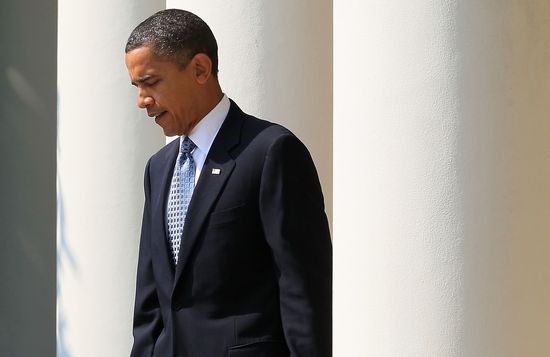
Another oddity, particularly given Obama’s high regard for the power of his own rhetoric, is that you’d think he’d be looking for ways to take credit for, and guide, the forces of reform in the region.

Larison responds:

It seems to me that this gets to the heart of what bothers so many people, especially conservatives, about Obama’s response to events in Libya. For them, American Presidents are supposed to want to exploit, appropriate, and control foreign political crises. Not doing this amounts to “dithering” or “failing to lead.” It may be that it really doesn’t occur to these critics that it is not the responsibility of the President of the United States to take credit for political forces that have nothing to do with him, much less to guide the political development of other countries.

This is indeed the core of one deep disagreement about this presidency. What I find refreshing about Obama is precisely his understanding that, even if he were in some way responsible for enabling the Arab 1848, he knows it would be counter-productive to say so. Yes, he made a speech in Cairo calling for more democracy a year or so before the uprising. More important, his very election and outreach to the Muslim world detoxified the West's image in the Arab world in a way that probably helped the next generation to be less distracted by the usual anti-Western, anti-Semitic, anti-Israel rhetoric and more focused on their own governments' responsibility for the backwardness and stagnation of the region. (He has failed in one area only in this respect: saving Israel from its slow suicide. But one suspects he is biding his time in exactly the same way. Only when Israelis realize he is right will his vision come to fruition. Right now, they prefer fear to hope.)

What's striking about Obama is his willingness not to take credit, not to constantly mouth off every news cycle, not to "guide" forces that need to reach their own conclusion first. Part of this restraint comes from the huge damage the previous administration did to America's hard and soft power – by demonstrating hard power's profound limits in Iraq and Afghanistan and wrecking the West's moral standing by embracing torture. But part is also in his nature.

No sudden moves. He waits until those he needs to engage have played their hand. Then he moves.

And not before.

(Photo: Mark Wilson/Getty.)

Poster Of The Day

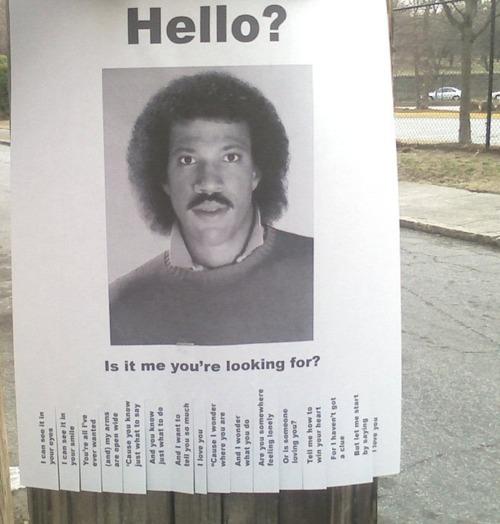
Richie

Hat tip: TDW.

It triggers a distant memory. One of the great privileges of attending my Oxford college, Magdalen, was its choir. Most evenings, you could enter the chapel and be taken into another world of spirituality – from Palestrina to Byrd. The choir was, however, er, a little campy at times. And I won't forget the day I arrived early and heard them sing their version of "Hello" by Mr Ritchie, at the conclusion of a rehearsal. One lame lyric was made somehow better by being rendered by boys and men in vestments over the medieval candle-lit chapel:

Are you out there feeling lonely

Or is lonely feeling you?

Good times.

Bleeding Heart Libertarians

That's the name of a new blog, described by Will Wilkinson here:

Liberaltarianism isn’t something Brink Lindsey and I made up. (The word is something a New Republic editor made up, I think.) The idea of blending the best of libertarianism with the best of modern liberalism has been implicit in the work of a bunch of libertarianish political philosophers/theorists, and a bunch of those guys just started a blog, Bleeding Heart Libertarianism.

Matt Zwolinski describes the new blog as “a forum for academic philosophers who are attracted both to libertarianism and to ideals of social or distributive justice.”Jason Brennan writes about what he and John Tomasi call “neoclassical liberalism” and how this contrasts with standard libertarianism and the academically-dominant Rawls-inflected view Samuel Freeman calls “high liberalism”. Andrew J. Cohen, Danny Shapiro, Jacob Levy, and James Stacey Taylor appear to be on board. Do you hear that? It’s your paradigm shifting!

The gulf between the Obama administration's campaign rhetoric and governing record on civil liberties shows that building the left-libertarian alliance is more important than ever.