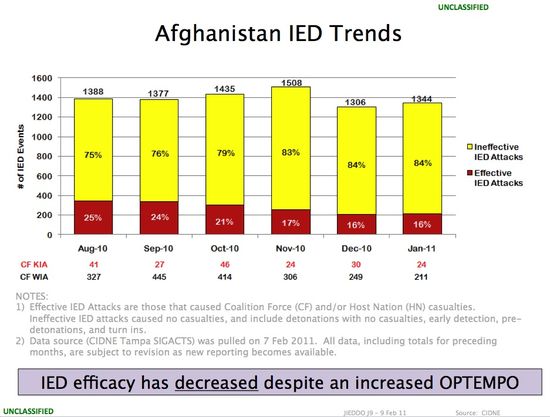
The Insurgents’ Weapon Of Choice

IED_stats

Ackerman studies the limited effectiveness of the Pentagon’s Joint Improvised Explosive Device Defeat Organization (JIEDDO):

What will ultimately stop the bombs in Afghanistan? According to the lessons of Iraq, it’s no big secret: a secure population, an “effective counterinsurgency strategy,” competent Afghan soldiers and cops, “lethal targeting” of insurgents, and “some kind of political reconciliation.” Still, it’s worth noting that according to JIEDDO’s figures, there were over 400 bomb attacks in Iraq in January alone, which might say something about what “success” in the fight against the signature weapon of the U.S.’ two long wars actually looks like.

Fetishizing “Made In America” Ctd

A reader writes:

So I haven't seen the ABC documentary, but Ikenson's selection of per capita income is problematic in all sorts of ways.

First of all, of course, it pays no attention to wealth distribution.  It should be a well known fact (although I know it isn't) that inequality has been growing significantly in the last two decades, such that the vast majority of wage growth has been concentrated among top earners, with a pretty steady climb in more wage growth the more wage you were earning before.  A per capita average is going to wash all of that out, which is why so many people use a much more stable state, the median household income, to examine wage growth.  It's still just one number in an immensely complex economy, but it's much closer at getting at the question.

In that vein, check out this graph, which illustrates a lot more. Note that single earner households have seen their income grow some, but that it's not where the wage growth has really been.  (And I would even argue that that growth is probably due to professionals marrying later in life, so in some cases you have more 30-something bachelors like myself throwing our higher earnings into that pool.) 

But where the growth really has been is in multi-earner households. So, part of this is the growth of professional opportunities for women, and part of it is simply more women entering the workforce.  I've frequently argued that women entering the workforce is on balance a very good thing, but isn't without costs.  For one, the domestic work that women used to almost exclusively do, such as cooking, housekeeping, and child care, hasn't gone away.  So, while real household income has gone up, so have total household expenses, as "women's work" moved from the informal economy to the formal economy.  (And hence where massive amounts of service economy growth has come from.) 

While I agree that this is progress, as women are free to pursue professional and entrepreneurial careers while creating jobs allowing for women with lower skill levels needing service work, all of that wage growth is not some kind of magical windfall in the economy.  Women are replacing unpaid work with paid work while turning around and paying to have the work they've left behind done. 

Take, for instance, a professional mother of two who makes $50k a year but pays $25k a year in child care, plus $15k a year in additional food costs to switch from home cooked meals to prepared food.  If we guess that the cost of the base food is the same, we can guess that all $15k of that goes into wages for the food prep, so we now have $90k in aggregate "wage growth" due almost exclusively to a mother entering the work place, but she has only seen $10k in additional earnings.

ABC may be overblowing the "collapse" of American manufacturing and the role of "buy American," but Ikenson's analysis is crap.

Getting Rid Of Bad Teachers, Ctd

59702141

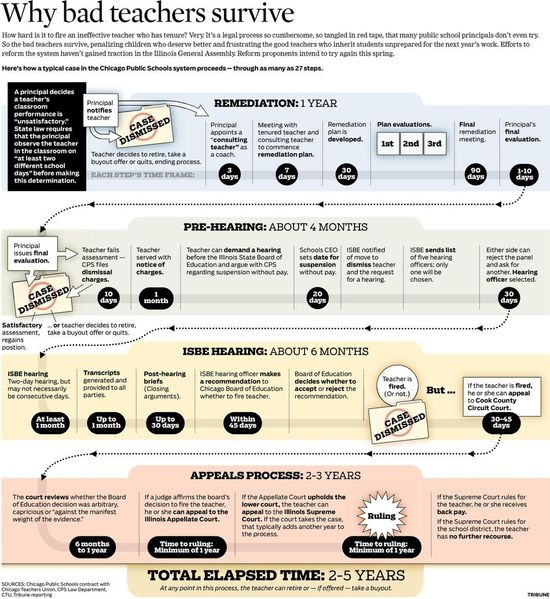
Readable version of the flow chart here. Suderman explains it:

The Chicago Tribune has put together a great, if depressing, graphic showing all the steps required to fire a tenured but ineffective teacher in the Windy City. The short version? It takes 2-5 years, and as many as 27 steps—which, according to the Tribune, is why many school principals don’t even try.

A reader in San Francisco shares a similar experience:

My wife is the principal of an urban public school. She actually succeeded in getting one particularly bad apple to resign, finally, after a dedicated two-year effort that began immediately after she took over this particular school from her predecessor.  I have grey hairs because of that ordeal (and it’s not even my job!).  My wife literally feared for her life. 

The real tell, though, is that this teacher was so bad for so long that everyone in the district, right up to the Superintendent, rolled their eyes at the mere mention of his name. He "taught" in the district for 16 years.  He bounced from one school site to the next, successfully avoiding any accountability for his criminal incompetence until my wife became his boss. 

Here is the process: She rated him “unsatisfactory” for three consecutive classroom evaluations.  This was the first prerequisite to any escalation of his case, and no small feat considering principals are only allowed to perform evaluations of tenured teachers every other year, cannot schedule more than one evaluation per teacher per 45-day period, must schedule them well ahead of time and must meet with the teacher (and their union rep if they so choose) before and after each scheduled evaluation to review the evaluation criteria, craft an improvement plan and provide support. 

After three consecutive “unsats” the case can be escalated to a union-sponsored review panel of twelve people.  Panel members include the head of the local teacher’s union and at least six other union members.  They typically assign a “coach” to assist the bad teacher twice per week (at public expense) with lesson planning and classroom instruction.  The coach, who is a member of the same union and is only at the school for two half-days per week, must file monthly progress reports back to the panel for six months (and may not consult with, or consider evidence provided by, the principal who is on-site every day). 

At any time the teacher may file “grievances” against the principal via the union, to which the principal must respond in writing and the district staff must investigate.  Any of these may derail the entire process.  Otherwise, if after six months the coach actually testifies to the panel that, yes, this teacher is really bad AND shows no sign of improving even with all the extra support, ONLY THEN will the panel take any action against the teacher. 

In the most egregious cases, after deliberating for some additional months (the panel only meets every so often and has dozens of cases to review each time), the panel may take the dramatic step of serving the teacher with a “90-day notice.”  This notice is actually a three-foot-tall stack (I’m not exaggerating) of all the documentation and evidence that has been collected by the principal, the union and the district’s lawyers during the development of the case.  The teacher then has 90 days to review the documentation and file protests if he/she feels any of the documents are incorrect or might support a legal claim against the principal or the district for harassment or discrimination.   Only if no defensible protest can be mounted will the teacher, after 90 days be faced with the choice to either resign or face termination proceedings. 

All told, this process takes at least 18 months of intensive effort by the principal and the district’s legal staff.  The legal fees alone exceed $20,000.  With all the other demands of the job, there is no way one principal can pursue more than one bad teacher at a time.  So if your school has five bad teachers, it will take eight years to rid the school of them even if every new teacher you hire (or who is assigned to your school by the district during that time) is great.

More on this discussion thread here, here, here and here.

The Daily Wrap

Today on the Dish, Rush Limbaugh and Donald Trump wanted big American balls, Palin's excesses helped her, while most politicians distance themselves from the crazies. Ramesh Ponnuru predicted a Palin-Romney smackdown, Ailes ruled the primary, and Andrew scoffed at Huckabee on imperialism. Indonesia boasted more Boy Scouts than the US, some world leaders exit gracefully, and Andrew and Lizza went another round on journalists publishing other journalists' emails. Andrew Romano weighed a Christie candidacy, high gas prices might not hurt Obama, and Newt kept flirting with America.

The blogosphere parsed the economics of state pensions, Bernstein debated the political identity of union members, and polls confirmed Walker's over-reach. Republicans believed climate change but not global warming, tea partiers wanted to solve the debt without losing their entitlements, and Noah Millman fingered bad principals. Andrew ruminated on lessons learned from Charlie Sheen's drug escapades, Tyler Cowen heralded the golden age of non-fiction, and recovery remained slow. Internet porn didn't kill marriage,  cancer rates don't change for whales, recent graduates don't always get counted as unemployed, and Americans fetishized "Made in America."

Baghdad abused prisoners, Mubarak's thugs may have scapegoated Al-Qaeda, and Simon Henderson didn't see protests spreading to Saudi Arabia. The right debated Israel's reaction to revolutions across the Middle East, no countries wanted Qaddafi, and Serbia offered a better example on no-fly zones than Iraq. Quotes for the day here and here, VFYW here, MHB here, FOTD here, chart of the day here, and a poem for Thursday here.

–Z.P.

A Painfully Slow Recovery

Tumblr_l78z89ijPK1qzpwi0o1_500

Catherine Rampell previews tomorrow's jobs report. She notes that the "median forecast, according to Bloomberg’s survey of Wall Street analysts, is a net gain of 196,000 nonfarm payroll jobs, after a gain of 36,000 in January":

If from hereon out we have job growth of 200,000 jobs a month, it’ll take more than three years before the economy regains the employment levels it had before the recession. And that doesn’t even account for the fact that the working-age population has continued to grow, meaning that if the economy were healthy we should have more jobs today than we had before the recession.

(Image via TDW)

From The Annals Of Chutzpah

An Iranian reader writes:

The shamelessness of this regime knows no bounds and the bluntness of their lies is truly shocking. This interview with Iran's new foreign minister, Ali Akbar Salehi, reminds me of Iraq's intelligence/information minister's press conferences in Baghdad who claimed to have defeated Americans while the US tanks were a few kilometres away. On the very same day that Mousavi's daughters publish an open letter to the nation insisting that their parents are lost and they have had no news of them for 18 days now, Salehi says:

[Mousavi and Karroubi] are in their homes. … They are always moving from one place to another. They are free to visit their families. They may have made their own decision to move.

What About Bad Principals? Ctd

Readers join Noah Millman and Kenny Powers in pushing the principals around. One writes:

While I am sympathetic to your argument about teacher accountability, it's also the case that most private sector positions are not very politicized, and most private sector managers are held accountable in more measurable ways than principals.  My own sense is that principals are more likely to display school board cronyism, self-protecting careerism, and pandering to parents than the average teacher. 

Certainly in my own experience I can think of a number of great and courageous teachers, as well as many lazy or incompetent ones.  I can't, however, think of any principals or vice-principals who were more than time-serving hacks or downright corrupt.  I know at my own high school, a couple of the more courageous teachers who did innovative and challenge their curriculum sometimes got complaints from parents and would almost certainly have been fired without union cover.

Another writes:

The problem with your thought experiment is that it assumes the principal is a competent manager. I'm no fan of public employee unions and believe that things have gotten completely out of control on issues like pensions, teacher tenure and benefits. At the same time, public institutions are not businesses, which hopefully operate as meritocracies.  One of the reasons that teachers unions came about in the '60s had to do with the fact that schools were often fiefdoms, run by actual crazy-people.

My father was lead attorney for the Michigan Education Assocation at that time.  His favorite story was about the principal who walked the school halls with a puppet on his arm. The principal rarely had a direct interaction with the teachers – and if he did, it was Garrisonalways as their peer.  But, when it was time for a reprimand, Mr. Puppet got very, very angry.  (And, what the guy did with the all-male school board members after house was a whole other story.  Think Mr. Garrison, except he was in charge of the whole school.) 

I concur that the firing rules outlined in your post are absurd.  But, the problem is too complex to focus on just those rules.  Your earlier post yesterday presents the core issue: government is not business and business is not government.  Addressing the challenges of public education is extremely difficult (for instance, the Gates Foundation has sunk millions into their public education program and came up short).

Another:

The people charged with evaluating teachers are often antagonistic to the teachers.  In my case, a new principal was brought into the school by the Board against the teachers' wishes.  He proceeded to hire administrators from his previous jobs into all available openings and rate as "poor" various teachers with influence in the PTA or teachers' organization.  Many of these were the Honors teachers, who left to teach at colleges (one went to work for NASA, and two went to work at the $35k private school literally next door).  They weren't "poor"; the rater in this case simply wanted to consolidate authority in the school.

Another:

California was the first state to institute tenure after two years, in 1921. This was in response to teachers being fired or reprimanded at the whim of school boards and principals. Teachers could be punished for political activity or lifestyle choices that went against social norms as dictated by their schools:

In one key California case, Paul Finot, who taught at John Muir High School in Pasadena, was reassigned to home teaching in 1963 for refusing to shave a beard he'd grown over the summer. Eventually vindicated by an appeals court, he was asked in a lower court hearing if his beard was "an outgrowth" of his "radicalism," and he replied that it was "an outgrowth of my six-week fishing trip."

Another:

My closest friend is a black, HIV positive, gay man who teaches learning disabled and behaviorally challenged kids is a mostly white conservative, suburban school district.  As you can imagine, he has to scrap with his co-workers, administrators and parents.  He has to manage kids who swear, hit, and do all sorts of dangerous things (as well as parents who do the same). 

The shield that protects him from the maelstrom is the union and his union rep.  The union defends him and his contract when he needs to fight an abusive parent, child or administrator.  And, as you may appreciate, his union contract ensures that he gets the medical leave he needs when dealing with complications of his disease or a change in medication – medication he can afford because of his health plan.

Another zooms back out:

Teachers unions – like all unions – are designed in part to protect their members from capricious and arbitrary firings. For most of us wage-slaves, one of the greatest threats to our economic security is the threat of being demoted or fired by a supervisor who is just being a dick. Protecting against that is just and reasonable, and it's a big part of what unions do. The risk of teachers being fired for bad reasons is high, both because of the subjectivity of teacher evaluations (and the gross inadequacies of any objective measure of teacher merit), the inherently political nature of much education, and the absence of any consensus about what teachers should teach and how they should teach it. It's not a matter of just counting how many widgets the employee stamps out per hour.

Unions go overboard in erecting obstacles to the firing of their members. But it would also be going overboard simply to give carte blanche to principals to fire teachers. I get that you think the AFT is coming from such an extreme position that even their proposed concession strikes you as extreme. But you should think about a counter-proposal, rather than just sloganeering.

Earlier dissents in this discussion thread here and here.
Playing Chicken With A Government Shutdown

Andrew Gelman thinks both parties "(a) don’t want a shutdown, but (b) know the other side doesn’t want it either, which means they can try to threaten a shutdown and extract concessions":

[I]n 1995 we were not in recession, so it wasn’t so natural to believe that a government shutdown would have much short-term economic effect.  Second the idea that the economy determines presidential elections wasn’t so generally accepted back then.  Also, I suspect that Gingrich et al. deluded themselves regarding Bill Clinton’s popularity. 

Nowadays we tend to think of Clinton as a political whiz, but if you take yourself back to 1995, you see a guy who snuck into the presidency with 43% of the vote in a three-way race, then proceeded to fail on health care and fight with his own party on NAFTA, and then got killed in the midterms.  So congressional Republicans at that time could be excused for thinking that Clinton was a sitting duck.

Nowhere Man

Scott Horton finds few countries willing to grant Qaddafi asylum:

Much as Qaddafi’s posture may be driven by his own failure to appreciate the depth and determination of his domestic opposition, it is also the product of forty years of wanton and at times irrational violence that made him a pariah among world leaders. Qaddafi is cornered. He has no place to run. And his end may well serve as a cautionary tale for future despots and human-rights violators.