Bill Keller remembers world leaders who've left office gracefully:
De Klerk and Gorbachev were triumphant partners in their own defeats, and thus in their countries’ victories.
Matt Yglesias has related thoughts about Juan Carlos of Spain.
Bill Keller remembers world leaders who've left office gracefully:
De Klerk and Gorbachev were triumphant partners in their own defeats, and thus in their countries’ victories.
Matt Yglesias has related thoughts about Juan Carlos of Spain.

Carl Zimmer raises a fascinating question:
Blue whales can weigh over a thousand times more than a human being. That’s a lot of extra cells, and as those cells grow and divide, there’s a small chance that each one will mutate. A mutation can be harmless, or it can be the first step towards cancer. As the descendants of a precancerous cell continue to divide, they run a risk of taking a further step towards a full-blown tumor. To some extent, cancer is a lottery, and a 100-foot blue whale has a lot more tickets than we do…
Yet there seems to be no correlation between body size and cancer rates among animal species. We run a thirty percent risk of getting cancer over our life time. So do mice, despite the fact that they’re 1000 times smaller than we are. All animals studied so far have cancer rates in that ballpark. (And yes, sharks do get cancer.)
Caulin and Maley argue that when animals evolve to larger sizes, they must evolve a better way to fight against cancer.
And thanks for all the fish …
(Photo: Mike Baird from Morro Bay, USA, via Flickr. Baird's Blurb book is here.)
A "homeschooling mom of a Boy Scout" writes:
A quick Google (Barack Obama boy scout) suggests that Obama may have grown up
going to Boy Scout meetings, contrary to Huckabee's suggestion. I don't have time to research further – that's your job – but the initial evidence is here and here.
It goes without saying that Scouting, like Rotary, is an international movement. The purple badge on every scout's uniform, the "World Crest", is a reminder of this. It is worn on the left, over the scout's heart. From Scouting.org: "It is still worn by 28 million Scouts in 216 countries and territories and is one of the world's best-known symbols."
On that note, Snopes knocked down an email rumor that Obama "refuses to sign Eagle Scout certificates." And of course there was the Jamboree uproar. Another reader:
Huckabee might be interested to know that Indonesia boasts over 17 million registered scouts, according to the world scouting movement [pdf], compared to the roughly 7.5 million in the US. Even Kenya has nearly half a million.
Of course, this is to take Huckabee literally. What he clearly meant to say is that someone called Barack Obama is not a real American. He's Palin without the figure.
This is the best column Jonah Goldberg has turned out in quite some time – putting the pretty dreary bunch of GOP candidates into two competing camps.
Those two measures to restrain the fiscal threat of entitlements have the most public support:
More than 60% of poll respondents supported reducing Social Security and Medicare payments to wealthier Americans. And more than half favored bumping the retirement age to 69 by 2075. The age to receive full benefits is 66 now and is scheduled to rise to 67 in 2027.
If you combined that with aggressive enforcement of successful cost-control pilots in the ACA, there might be a sliver of hope. But note:
Tea party supporters, by a nearly 2-to-1 margin, declared significant cuts to Social Security "unacceptable."
Here's the Republican dilemma:
More than seven in 10 tea party backers feared GOP lawmakers would not go far enough in cutting spending. But at the same time, more than half of all Americans feared Republicans would go too far.
One awaits the Republican primary candidate honest enough to tell the broader public the practical truth: that unless we raise some taxes, entitlements will have to be cut far more deeply than any of you want.
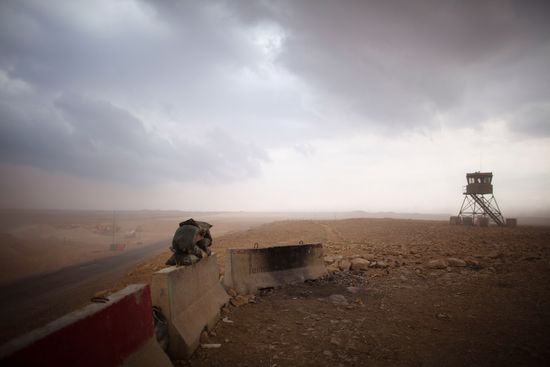
An interesting debate has developed over at Commentary on Israel's reaction to the Arab 1848. Max Boot started it off by relaying what he was hearing in Israel:
Some Israelis I have spoken to have been hopeful about what is happening; most have not been. Their view is that they have learned to live with despotic regimes and now they fear the consequences of their overthrow. That’s an understandable impulse for a small nation in a rough neighborhood, but it can be carried too far; I had one professor tell me, for instance, that it would be have been much better to have left Saddam Hussein in power because he was a “stabilizing” influence on the region. This would be the same Saddam who invaded Kuwait and Iran, who massacred the Kurds and Shiites, who tried to get weapons of mass destruction — and who, lest anyone forget, fired missiles at Israel.
Maybe scarred by his infamous statement that he wanted Ahmadinejad to win the last "election" in Iran, or having learned from it, Daniel Pipes, of all people, is psyched. Evelyn Gordon (an Israeli) not so much:
Over the past two decades, Israelis have lived through numerous regional changes, each of which, we were confidently assured — by both our own leaders and the West — would benefit us greatly. And in every single case, the change only made things worse. … We were told Saddam Hussein’s ouster would make Israel safer. And while I fully agree with Max that nobody could lament Saddam’s demise from a moral standpoint, from a security standpoint it’s far from clear that Israel is safer with Iran as the uncontested regional power than it was with Iran and Iraq containing each other. With Iran racing toward nuclear weapons and threatening to wipe Israel off the map, it’s a bit naïve to expect Israel to deem Iran’s new status as regional superpower unimportant in the broader scheme of things.
Jonathan S. Tobin seemed to fall somewhere in the middle:
The problem today for Israelis is not so much that it is foolish for them to publicly lament the fall of Mubarak and oppose the revolutionary fervor sweeping the Arab world. They should not do that; but no matter what they say about these events, most Israelis understand that, for all the changes in the air, they are living in the same Middle East that they have inhabited for the past 63 years. The rest of us should realize this too and resist the temptation to indulge in magical thinking about Israel’s ability to appease either the Palestinians or the rest of the Arab world.
(Photo: A concrete barricade at a checkpoint at the Israeli Egyptian border on February 10, 2011 in Israel. By Uriel Sinai/Getty Images.)
"Forming an exploratory committee used to be the way somebody expressed a "serious intention" to run for office. What would it even mean to show a serious intention to show a serious intention?" – Daniel Foster. Ask Roger Ailes, who seems now to be running the GOP.
After Huckabee's latest, a couple of points can't be made often enough. Jonathan Chait offers one of them:
The theory holds that Barack Obama, through his father, acquired a worldview twisted by opposition to British colonialism… Wouldn't this theory mean that our Founding Fathers were also twisted by opposition to British colonialism? Or maybe the idea is that we had a right to throw off the British yoke, but the Kenyans should have put up with it, because the British occupation there was so much more benign.
But the Kenyans were Africans! They needed imperialism, while Americans didn't. That, at least, seems to be the unspoken premise. Larison and Massie have more. Massie's insight here is particularly apposite:
The British press – especially, I am afraid, on the right – loves wetting its knickers any time a new President is elected, fretting that they won't make the "Special Relationship" the centrepiece of their foreign policy and all the rest of it.
It would be better if American discourse didn't use British chippiness as its lodestar in understanding the president. For myself, I can only repeat how amazing I find it that conservative Americans now see anti-imperialism as somehow un-American.
"I mean, really: calling these people—the Limbaugh/Fox News/Gingrich/Tea Party set—conservatives is almost as much a misnomer as calling Obama a Marxist or liberals Communists. These people need to read their Burke, their Hayek—even (am I really saying this?) their Buckley. And, of course, their Oakeshott," – Hendrik Hertzberg, in a post that includes some kind words about the Dish.
Ramesh Ponnuru envisions one:
[It would] be a straight-up power struggle between the tea parties and the Republican establishment… Class is another increasingly uncomfortable fault line in the party (as Reihan Salam and I recently described in these pages). Romney’s supporters tend to be college-educated, while Palin draws her support from people who didn’t get college diplomas… There would even be religious overtones to the conflict. Some voters find his Mormonism, and some voters find her evangelicalism, problematic.
He also notes how personality would be a huge factor:
Palin is not the type of politician who ignores unfair attacks. Instead she invites her fans to share her grievances. Any presidential candidate, and especially a polarizing one, will be on the receiving end of a lot of cheap shots. (Also on the other end.) Count on her or her supporters to turn every dismissive remark or ambiguous statement into a sexist or elitist putdown of millions of voters — and to make sure that everyone hears about every actual offense against her.
The main difference between Palin and Romney is that Palin is a star who commands a cult; Romney is a cipher who hires a lot of staff.
 The Dish