Quote For The Day

"Religious fundamentalism is dangerous because it cannot accept ambiguity and diversity and is therefore inherently intolerant. Such intolerance, in the name of virtue, is ruthless and uses political power to destroy what it cannot convert. It is dangerous, especially in America, because it is anti-democratic and is suspicious of 'the other,' in whatever form that 'other' might appear. To maintain itself, fundamentalism must always define 'the other' as deviant," – the late and great Peter Gomes.

That these hunters of deviants claim to follow a man who told the parable of the good Samaritan is all you need to know. But Peter was also a very very funny man. Readers relay some of his quips:

That voice! My son told me that Gomes was once asked why he spoke like that, having been raised in Plymouth. The response was, as only Gomes could pronounce it, with a wry smile "Puuuure affectation." And this: a common quote of his to students at commencement that I can't seem to find the original source of: "Upon concluding four years of study at this fine institution, most of you have surely learned that here at Harvard, it's not who you know that matters. It's whom."

Another:

I regret not attending Mem Church much when I attended Harvard, and blame my youth – typically recovering Sunday mornings from some late Saturday binge (whether academic or alcoholic). A good friend sang in the University Choir, however, so I made it to Easter services a couple of times. He had a powerful way with words. When I returned for my 25th reunion in 2005, Rev. Gomes was recuperating on the Cape, and sent a letter to be read to the class in his absence. I’ll never forget his intro – “I am now the age you thought I was when you were undergraduates.”

My reflections here.

Which Political Identity Matters Most?

Nate Silver draws no firm conclusions. Bernstein imagines that it changes depending on circumstance:

It's not that union members previously were in favor of GOP plans about unions and have now changed their minds; what's almost certainly happening is that people who may previously have thought of themselves primarily as outstaters envious of Madison, or as right-to-lifers, or as any one of their other possible political identities, are now thinking of themselves as primarily union members. And, of course, as union members they oppose attacks on unions.

Fetishizing “Made In America”

Daniel Ikenson complains about a new program on ABC:

The gist of the series ["Made in America"] is that Americans don’t buy many U.S.-made products anymore and are therefore responsible for the persistent and relatively high rate of unemployment in the country. …

Ugh. Where to begin?

Back in the "golden age" of 1960, when imports were oddities to marvel over in a disdainful way, the per-capita U.S. income was $2,914. In 2009, with imports ubiquitous, per-capita income was $46,411. (Economic Report of the President, 2010, Tables B-1 and B-34). In real, inflation-adjusted terms, even with a U.S. population increase from 181 million to 307 million, per-capita incomes in 2009 were almost triple what they were in 1960 ($42,277 vs. $15,669 in 2005 dollars—ERP, 2010, Tables B-2 and B-34). Oh, if only we could replicate the relative poverty, the limited consumer choices, the inefficient production processes, the massive trade barriers that compelled Americans to buy American, and the uneconomic work rules and wages commanded by once-powerful private sector labor unions.

How Big A Problem Are State Pensions?

Dean Baker says (pdf) the danger has been exaggerated. Ezra Klein summarizes Baker's main points and agrees. Josh Borro's article argues the opposite – that pensions are a disaster. Tyler Cowen polices the debate:

I don't see Baker — not once — analyzing the public choice considerations of how state governments actually behave and treat their finances.  Or how about how state voters hate tax increases, reasonably or not, and think their governments should be forced to actually solve their mismanagement problems?  A crisis usually is an institutional crisis.

… Most of Barro's piece focuses on public choice considerations — of how state and local government institutions actually work — and thus it is the better analysis.

Klein follows up:

But the bottom line is that the correct questions to ask about pension plans are: 1) Are they estimating a realistic rate of return going forward? 2) If so, are they sufficiently funded? And 3) If not, what should be done? I think there's less disagreement about the underlying nature of the problem here than some people might think. The disagreements, rather, are about the country's likely economic performance going forward (as that will ultimately decide returns) and what our state pension system should look like in general.

Birth To Death

In 1946 a British study began tracking a cohort of British newborns. The study's participants are now 65. Helen Pearson reports on the findings:

It has shown that the heaviest babies were most at risk of breast cancer decades later; that children born into lower social classes were more likely to gain weight as adults; that women with higher IQ reached menopause later in life; and that young children who spent more than a week in hospital were more likely to suffer behaviour and education problems later on.

Internet Porn Didn’t Kill Marriage

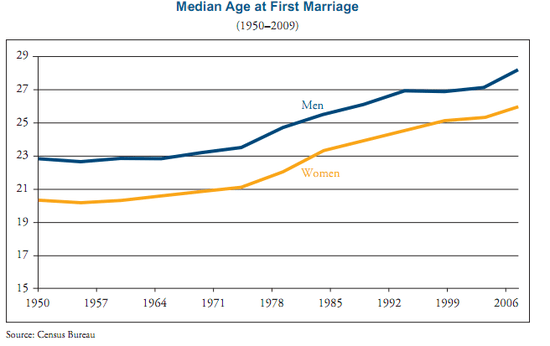
MarriageAge

Dana Goldstein slaps some sense into the rest of the Internet:

Are later marriages a bad thing? No. Economic stability and higher education are leading predictors of successful marriages, and both take time to acquire. Couples who marry before the age of 25 are twice as likely to divorce as couples who marry after 25. Avoiding divorce is good for both children and adults. Duh.

Now, if you're familiar at all with basic human biology, you ought to realize that a society in which there is over a decade gap between puberty and marriage will be a society in which there is rampant pre-marital sex. I know we're supposed to believe that premarital sex was completely taboo as recently as the mid-1960s, but I have news for those of you who don't watch "Mad Men:" The hippies didn't invent sex, ya'll. Guttmacher Institute surveys show that even among women born in the early 1940s, eight out of ten had premarital sex before the age of 25.

Who Will Rule The House Of Saud?

Simon Henderson doesn't expect protests to sweep Saudi Arabia:

A tweet or two by a young, foreign-educated, Saudi woman resentful of her lack of rights does not make a Riyadh Spring. And it is unlikely that much will come of a Facebook campaign calling for a day of protests on March 11, or that an online petition signed by more than 100 Saudi academics and activists demanding a constitutional monarchy gains momentum. The kingdom is, in the judgment of many, an extraordinarily conservative place, where people know their place and do what their parents tell them. To the extent there is a national sport, it is either driving dangerously or lethargy. 

But Henderson wonders, given the "the winds of change running through the rest of the Arab world," whether the transition to a new king will jolt the Saudi public to action.

Creating An Al-Qaeda Scapegoat?

A reader writes:

You posted about the Egyptian army's attacks on Coptic monks and bemoaned the MSM's lack of coverage, but it's actually worse than you think: Supposed terrorist attacks on Copts ramped up in 2010, but it now turns out that it might not have been actual terrorists, but rather Mubarak's Ministery of Interior, playing up the threat of sectarianism and radical Islam to make the regime look necessary in the eyes of the Americans and Israelis.

Very high profile charges were filed against the MOI, Habib el-Adly, and while they were reported in Al Arabiya English, nobody else (except Reason) really gave them them a full airing in the English-language press. I think NPR and the BBC might have mentioned the allegations with one or two sentences, but nothing really.

I don't speak Arabic, but I asked an Arabic-speaking friend in Jordan, and he'd heard about the story and said it was a big deal there. It's a pretty serious accusation – it essentially means half of the reason we supported Mubarak was a lie.