Iraq’s Darkside

Abu_ghraib_recrop1102

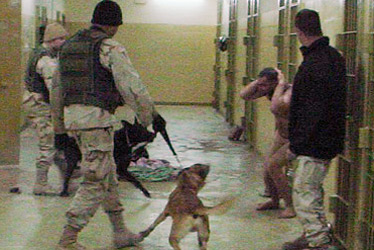
Last month, Amnesty International released "Broken Bodies, Tortured Minds, Abuse And Neglect Of Detainees In Iraq." Joel Wing summarizes the Iraqi response:

When human rights groups accuse the authorities of mistreatment, they say nothing happened. When Iraqi officials complain about abuses, Baghdad says it will investigate, but then there’s no follow up. Both reflect the official neglect of this issue, and the tacit support of the use of these extreme tactics. As long as that is Baghdad’s stance, the mistreatment and overcrowding in the country’s jails and prisons will continue.

The Climate Debate

new paper finds that wording has large effects:

Republicans were less likely to endorse that the phenomenon is real when it was referred to as “global warming” (44.0%) rather than “climate change” (60.2%), whereas Democrats were unaffected by question wording (86.9% vs. 86.4%). As a result, the partisan divide on the issue dropped from 42.9 percentage points under a “global warming” frame to 26.2 percentage points under a “climate change” frame.

Wilkinson thinks that this shows "that Americans are less polarised about climate change/global warming than they may appear."

The Daily Wrap

Today on the Dish, explosions rocked Tripoli on the 17th day of protests in Libya, Benghazi fell into a suspended state, and a Muslim dating site offered sanctuary for revolutionaries aiming to topple Qaddafi. Mark Thompson reminded us of No-Fly Zones from the past, the National Review opposed military intervention, and non-violence works.  Petraeus finally apologized for the murder of Afghan children, and Andrew consulted the Church's history on Jews and killing Jesus.

Andrew quibbled with Douthat on the Tea Party's fiscal conservatism, Joe Klein dismissed Huckabee for his old timey racism, and Ohio balanced the budget by banning same sex marriage. John Payne tracked the history of American conservatism, and the Onion nailed its youthful vigor. Readers came back hard against Andrew's teacher accountablity post, and small class size doesn't correlate with high achievement. Andrew still wasn't a fan of journalists publishing other journalists' emails to sources, but Ryan Lizza was. American confidence fed itself off of cheap gasoline, corporate tax revenues hit a new low, and intellectuals loved to bash intellectuals. Readers remembered European Imperialism, the third world wasn't prepared for treating cancer, and Gates called out Rummy's foreign policy. ClimateGate could never be undone, and the Obama-Palin poll gap was too close for comfort for Andrew.

Andrew eulogized the late Reverend Gomes, and celebrated gay milestones (and beagle owners) across the world. Technology can't replace face time (but it could troll your Facebook page), cities whooped the suburbs, and medieval scholars remembered more. Nick Carr tried to wrap his head around measuring information, and peak iPad may have already arrived. Charlie Sheen made for great New yorker cartoons and became almost indistinguishable from Qaddafi and Glenn Beck. Galliano succumbed to a vision of human beauty not dissimilar to Nazi eugenics, but Andrew was still glad he lived with America's distorted version of free speech rather than France's. Knut the cute polar bear evolved into a publicity addicted psycho, and Andrew loved his body traps.

Hewitt award here, VFYW here, MHB here, and FOTD here.

–Z.P.

The Power Of Nonviolence

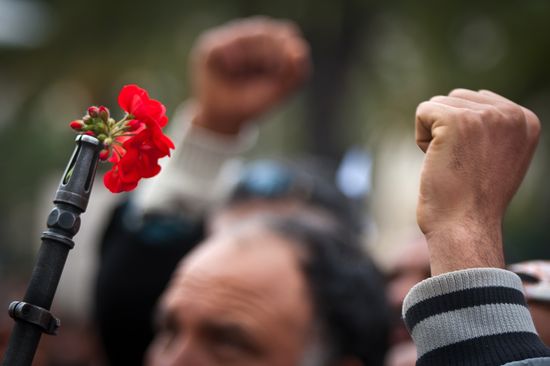
FlowerGunGetty

Erica Chenoweth finds evidence that authoritarian regimes "view nonviolent resistance movements as threatening subversive, precisely because they have fewer tools with which to deal with them without provoking backfire":

Ironically, violent insurgencies may be much easier for dictators to deal with, given that the insurgents confront repressive regimes using methods in which such regimes have a decided resource advantage. The ideal situation for Mubarak would have been for him to face a violent pro-democracy rebellion. He was quite experienced in putting down violent uprisings. This is why he took such pains to employ agents provocateurs to force nonviolent protestors to react with violence–and why we should expect authoritarians in other Middle Eastern regimes to attempt the same tactic.

But in the Egyptian case, even when Mubarak's regime unleashed a wave of armed agents provocateurs, the protestors were prepared to maintain discipline and refuse to escalate their actions, which would have undermined their legitimacy and given Mubarak's security forces the pretext to repress them. Instead, that repression backfired, inspiring near-universal condemnation, resulting in ever more committed mobilization by pro-democracy protestors, and leading to the total refusal of the Egyptian security forces to comply with Mubarak's orders. 

(Photo: Flowers are displayed on the barrel of a gun as people demonstrate against Ben Ali's Constitutional Democratic Rally on January 20, 2011, in Tunis. By Martin Bureau/AFP/Getty Images)

Dissents Of The Day II

More readers pounce on this post. One writes:

Your private sector comparison works only if you say, "Imagine an established, long-term, successful employee in a business who has been around and doing very well for the company for many years.  Then he has a bad performance review."  Should he be fired right away? I think you'd agree the answer should be no.

Another:

You suggested, "Now do this thought experiment and try and simulate it in a private sector context." We just did in full light of the nation. We bailed out the investment banks. Bailed out their CEOs. The CEOs kept paying bonuses to the very folks who gambled the nation's money to such a degree that the very same school kids will be paying off that debt for much of their lives. They kept their jobs and got paid millions for screwing up so badly that you and I had to bail them out.

You're not arguing against the reality of the private sector but rather some idealized private sector.

You're also not arguing against the reality of the public sector, where a tenured teacher in my daughter's public school was fired within a week for insulting a student. The real private sector is every bit as dysfunctional as the public sector, and the public sector is not nearly as dysfunctional as anecdotes would suggest.

Another excerpts from the original post:

No, the principal then must wait 100 days. And that's the concession. My own view is that if unions did less protection of mediocrity and more protection of wages and benefits, their general image would improve drastically. But they cannot expect to continue their bad old ways and win public support in recessionary America.

Actually, that's not all that different from a lot of jobs in the private sector. Typically, at least in most corporate jobs, you're required (as a manager) to submit regular reports on employees who perform poorly, develop learning/action plans for them to improve, and firing takes a long, long time (provided the employee hasn't done anything egregious and just sucks at their job). In my company, employees who are on these types of action plans are far more likely to be laid off in a Reduction In Force (RIF) than they are likely to get fired for poor performance.

I'm a little sympathetic to your point, but Weingarten's proposal actually lines up with the corporate world fairly well. Most of the time, you can't just fire someone because they suck.

Another:

I’ve fired people in the private sector and the lawyers are very involved.  You have to start documenting everything the employees did wrong. You have to sit with them and explain what is wrong and come up with a plan to put them back on track. Then you have to give them time to make progress, and if they make any progress, you have to keep up the talk/plan/evaluate/document thing for longer than I’d ever want to.  Granted, you can get somebody out the door for pure performance reason in less than a year, but even in the private sector it takes time to get rid of somebody without opening the company up to a lawsuit.  (The exception is when the company has layoffs and you can dump without cause.)

Another:

I am a manager in the private sector.  For six years I had an employee who was the best, the most knowledgeable, the most productive.  Then a couple of years ago, his marriage fell apart and he fell into a depression.  His productivity halved for almost a year.  He was very flaky and unreliable.  I hid this from my superiors by covering for him, myself working nights to make sure the team did enough work.  This went on for almost a year as he struggled to make sense of his life.  He finally did, as I had faith that he would, and now he is back, better than ever. 

We are not a union operation.  I wish that we were; I wish that he had someone to protect his back so I didn't have to take that burden by myself, alone.

First batch of dissents here.
Rotary Clubs vs Madrassas

240126679_5fd5bb5ecc_z

A reader writes:

As a Rotarian, Huckabee’s attempt to use Rotary Clubs to supposedly contrast with an international mindset gave me a chuckle. After all, it is Rotary International – with 1.2 million Rotarians in approximately 200 countries or geographical regions, including Indonesia. Here’s a history of Rotary in Indonesia, going back to 1927. 

Rotary’s focus is undeniably international and built upon cultural exchange. Its major goal is the eradication of polio worldwide. Members are as committed to digging wells in Africa as they are improving parks in their home communities.

Flickr user "eristiarti" captions the above photo:

Rotary D 3400 Indonesia

Award was given to bapak Ruslan (right) who helped the Disaster Relief Team D 3400 by using his home during the distribution of Shelter box

Hewitt Award Nominee

On the extreme-right radio show with Bryan Fischer, the conversation goes thus:

Fischer: “And so I’d like you to comment on that. You seem to think that there is some validity to the fact that there may be some fundamental anti-Americanism in this president.”

Huckabee: “Well, that’s exactly the point that I make in the book. And I don’t know why these reporters — maybe they can’t read… And I have said many times publicly, that I do think [president Obama] has a different worldview and I think it’s, in part, molded out of a very different experience. Most of us grew up going to Boy Scout meetings and, you know, our communities were filled with Rotary Clubs, not madrassas.”

And so we know where the GOP campaign is going, don’t we? Rotary Clubs or Madrassas? That’s the choice they want the voters to make in 2012. It’s all they got.

Huckagaffe, Ctd

A reader writes:

As a Southern Baptist growing up in the 1970s, all of us young ‘uns read a book called The Cross and the Switchblade. It was about a young minister who witnessed to gang members in New York City. The name of the main gang in that book? The Mau-Maus. That is still what I think of when I hear the term, and I would be willing to bet that SoBap Huckabee has more than a passing acquaintance with the book. So it’s not just about blackness, it’s about rampaging big-city gangs…. (The lead Mau-Mau was Nicky Cruz, a Puerto Rican.)

Another remembers this lyric by a black character in the musical Hair:

I’m a Colored spade A nigger A black nigger A jungle bunny Jigaboo coon Pickaninny mau mau Uncle Tom Aunt Jemima Little Black Sambo Cotton pickin’ Swamp guinea Junk man Shoeshine boy.