National Review Opposes Military Intervention

OppositionSoldierGetty

Wow. Here's how National Review came down in its editorial on Libya:

Qaddafi’s regime doesn’t appear to be doing much of its murder from the air. If we are serious about limiting his ability to massacre his countrymen, the no-fly zone would have to become a no machine-gun zone, too — in other words an honest-to-goodness military intervention to affect events directly on the ground. 

They go on to ask why we would taint "the indigenous glory of [the rebels] ouster of Qaddafi with an almost entirely symbolic Western military action?":

The reason that the revolts of 2011 have had a dramatic catalyzing effect across the region, when the invasion of Iraq didn’t, is that they are the handiwork of Middle Eastern populations themselves, and thus a much more appealing model of change. Indeed, it is a sign of how home-grown these rebellions have been that President Obama’s mealy-mouthed passivity hasn’t stopped them from rolling on.

Ah yes. We shouldn't taint the "indigenous glory" of the Middle East revolts, but the US president should be posturing that he is involved and in support. Do they not see that this is an internal contradiction? Still, it's good to see some sanity back on the right, even if it is tained by the indigenous partisanship that still keeps their pulses on fire.

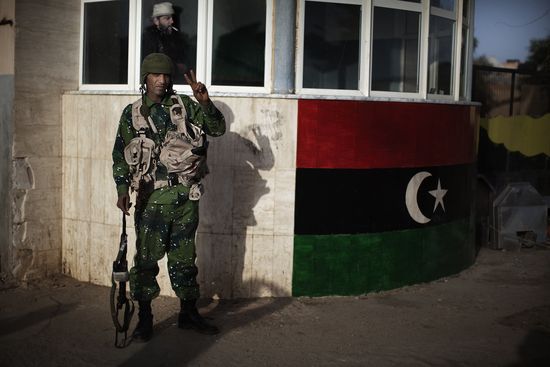
(Photo: A Libyan opposition army soldier poses outside an army barrack in Benghazi on March 1, 2011. Libyan rebels said they have formed a military council in the eastern city of Benghazi in what could be a step towards creating a unified nationwide force against leader Moamer Kadhafi. By Marco Longari/AFP/Getty Images)
Answer This

Politico asks me some personal questions. I answer them here. A snippet:

What’s a common and accepted practice for Americans nowadays that you think we’ll look back on with regret?

Our treatment of pigs.

What is your favorite body part (on yourself) and why?

My traps.

What would you attempt to do if you knew that you could not fail?

I only try things I can fail at. Anything else is no fun.

Huckagaffe, Ctd

A reader writes:

The British as a bunch of imperialists who persecuted our grandfathers?  What an alien worldview.  Certainly we never heard anything like that growing up in the Murphy household.

Another is more direct:

My own family came to the US from Ireland and Scotland.  My great great grandparents left Scotland to escape the _39509181_clear_203 felt over leaving their beloved Highlands was passed down through five generations so that as a child I was taught that the British had persecuted my family and that if they had stayed in either Scotland or Ireland, they and I wouldn't be alive. Huckabee apparently doesn't know that "Americans" are from or are descended from people who once lived in British colonies – people who do not share his view that the British Empire was some nifty thing.
Another:

I seem to remember something from grade school about thirteen colonies and the Revolutionary War.  What is wrong with these people?

Another comments on Huck's backpedaling:

He got the false information out there anyway, didn't he? I wonder how many people will be aware of the correction? Precious few, and certainly not the ones who need to hear it. He did exactly what he intended to do – insinuate Obama's "foreignness" and, yes, "blackness". And I'd wager he did it because:

Huckabee just wrapped up several days of events to promote his book, "A Simple Government" in Iowa this week and plans to head to Texas, South Carolina and several other states over the next few days.

He's got books to sell and bigots to court.

Will Democrats Retake The House?

They would need a 25-seat gain in 2012 to do so. Charlie Cook throws some icy water:

[E]ven when presidents have been reelected in landslides, their coattails have been very short. When Presidents Nixon and Reagan cruised in their reelection bids in 1972 and 1984, Republicans only picked up 12 and 14 seats, respectively. The last time a president won reelection and had his party pick up at least 25 seats was in 1964, but of course that wasn't exactly a reelection as Johnson had assumed the presidency after the assassination of President Kennedy.

Cancer’s Capitals

Margaret Chan and Yukiya Amanoof report that of the "7.6 million cancer deaths every year, 4.8 million occur in the developing world":

Throughout the developing world, most health-care systems are designed to cope with episodes of infectious disease. But most lack the funds, equipment, and qualified personnel needed to provide basic care for cancer patients. Thirty countries—half of them in Africa—do not have a single radiotherapy machine. And these countries certainly do not have the financial resources, facilities, equipment, technology, infrastructure, staff, or training to cope with the long-term demands of cancer care.

What About Corporate Tax Reform?

CorporateTaxes

Chuck Marr contemplates it:

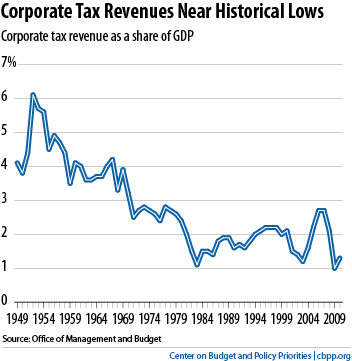
Corporate tax revenues are now at historical lows as a share of the economy (see graph), at a time when the nation faces deficits and debt that are expected to grow to unsustainable levels.  Although the top statutory corporate tax rate is high, the average tax rate — that is, the share of profits that companies actually pay in taxes — is substantially lower because of the tax code’s many preferences (deductions, credits and other write-offs that corporations can take to reduce their taxes).  Moreover, when measured as a share of the economy, U.S. corporate tax receipts are actually low compared to other developed countries.  All parts of the budget and the tax code, including corporate taxes, should contribute to deficit reduction.  Well-designed corporate tax reform can improve economic efficiency and help on the deficit-reduction front at the same time.

The Desire For City Life

Avent notes it's still there, however fast the suburbs are still growing:

Suburbs have seen massive housing growth and rapid population growth, but prices in central cities have soared, even in many places where population numbers are level or falling. If no one wanted to live in central cities, prices for homes there would not rise. And indeed, several decades ago, prices for homes in big central cities were dropping. But that trend has clearly reversed. You can't draw conclusions about demand shifts from population numbers alone. This is a very simple point, and yet its repeatedly ignored.

Derek Thompson has a related post on how "U.S. policy continues to support suburbanization over urbanization in countless ways."

The Psychology Of Higher Gas Prices

Gallup records a dip in American economic confidence:

The slump in confidence is likely tied to gas prices, which have risen sharply amid growing political instability in the Middle East, most notably in Libya. The U.S. Department of Energy reported an increase in gas prices from an average $3.14 per gallon nationwide during the week ending Feb. 14 to $3.38 this past week.

The Origin Of Iraq’s Rage: Hollow Promises

DayOfRageGetty

Joel Wing analyzes Iraq's "Day Of Rage," which occured last Friday:

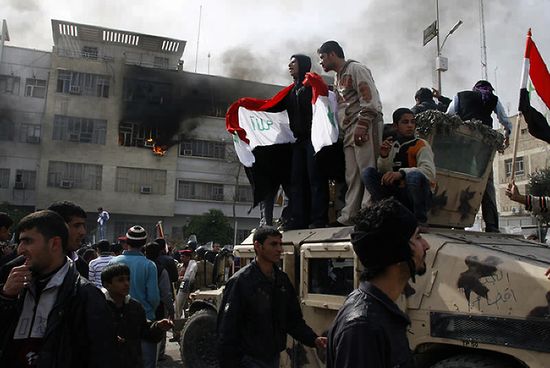
Protests in Iraq have slowly grown in size, breadth, and intensity since they began in mid-February. They are still an amorphous group with a wide variety of demands and participants, but the call for better services and government have been the main unifying factors. Increasingly, they are demanding officials elected in the 2009 provincial elections to step down for not fulfilling their campaign promises. In the last few days, some have also begun to focus their anger upon Prime Minister Maliki as well.

The problem is that the government is stuck in between a rock and hard place. They have claimed that the 2010 budget has plenty of money for the people, although some ministries have claimed that they will not have enough for their plans. Maliki has also promised that the power shortages will be solved in 12-20 months, even though others have contradicted that claim. Basically, Baghdad does not have the means or money to meet the people’s demands at this time, and making grand promises of solutions that can’t be met will only make the situation worse. This may lead to a critical mass with more and more people coming out into the streets because of hollow promises, prompting a crackdown as happened in 2009 when there were protests over power as well. The on-going demonstrations then, could pose a critical challenge to Iraq’s fledging democratic system. 

(Photo: Smoke billows from a burning building as Iraqi demonstrators stand atop an army vehicle shouting slogans during clashes at an anti-government protest in the northern city of Mosul on February 25, 2011 as a 'Day of Rage' across Iraq left at least 15 demonstrators dead in clashes with police. By AFP/Getty Images)