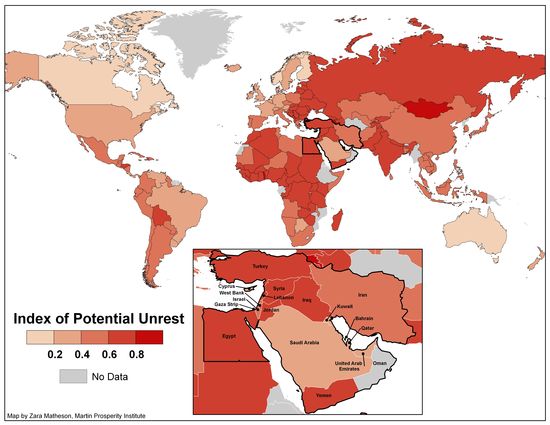
The Index Of Potential Unrest

Unrest_Index

Richard Florida has assembled "statistics from 152 nations and sorted them according to eight key variables: human capital levels in combination with percent of the workforce in the creative class, life satisfaction, GDP per capita, perceptions about local labor market conditions, Internet access, freedom, tolerance, and honesty in elections:"

The [Index Of Potential Unrest (IPU)] does reasonably well in predicting the unrest and revolutionary activism that are spreading across the Middle East today. Among the highest-scorers are the West Bank/Gaza Strip (.75), Yemen (.75), Egypt (.74), and Iraq (.72).  Seven more Middle Eastern and North African nations have relatively high IPU scores:  Morocco (.68), Lebanon (.64), Syria (.61), Jordan (.61), Algeria (.6), Tunisia (.57), and Libya (.51), while Saudi Arabia (.4) and Bahrain (.4) show more moderate levels.  On the other hand, Kuwait (.23), Qatar (.22), and the United Arab Emirates (.21) score in the same range as Luxemburg, Hong Kong, Singapore and Canada. Obviously this metric is not infallible–things are much less stable in Bahrain than its moderate score (.4) would suggest; Libya's score fails to reflect the outsized role of its insane dictator.

That said, it's interesting to note that the real powder kegs are not even in the Middle East. The nation with the highest ranking on the IPU is Togo (.93), followed by Mongolia (0.83), Armenia (.81), Haiti (.8), and the Ukraine (.79). China's IPU score of .51 is on par with Libya's.
Slippery Slopes That Don’t Exist

Andrew Koppelman takes aim at them:

Frederick Schauer … showed over 25 years ago that any slippery slope argument depends on a prediction that doing the right thing in the instant case will in fact increase the likelihood of doing the wrong thing in the danger case. If there is in fact no danger, then the fact that there logically could be has no weight. For instance, the federal taxing power theoretically empowers the government to tax incomes at 100%, thereby wrecking the economy. But there’s no slippery slope, because there is no incentive to do this, so it won’t happen.

Austin Frakt agrees:

The government isn’t holding back from mandating broccoli consumption because there is no legislative precedent regulating an “inactivity.” It’s held back because there’s simply no incentive to mandate broccoli eating. If there were, Congress would have already considered it, or ought to. In that case, one need not appeal to a slippery slope, though one certainly could. That is, it’s superfluous.

Wieseltier, Kristol And Obama

A reader writes:

I just looked over last week's Wieseltier and Kristol pieces (remarkably similar in their perspective) and now view them as wrong in their factual assumptions about what the Obama team was up to as well. They charge Obama and Clinton with being weak-willed and slow to move. I think they're right that Obama could have been more resolute in his official remarks. But with what's now come out about the row at the Security Council, it turns out that Wieseltier and Kristol were just wrong on the facts.

Hague and Clinton went aggressively for a military option to enforce the SC decisions, it now appears, and were turned back by Sergei Lavrov, Russia's foreign minister, who recalled how similar language was used by the US and UK to justify military action in Iraq. It seems the US-UK initiative had to be pared back a bit to avoid a Russian veto, and to preserve unanimity (itself significant–this is the first time a reference of a government to ICC has occurred without a single dissenting vote, for instance).

And as of today the US and UK have both frozen Libyan assets, the largest such freeze ever. It's now plain that the US was guarding its language out of fear that US citizens on the ground would be made to pay, but it was moving very zealously behind the scenes. Note that asset freezes of this sort usually occur when a dictator has been deposed or in war time, not in circumstances like these. I get the strong sense that the US and UK are maneuvering to delegitimize Qaddafi, to recognize the Benghazi authority under the former justice minister as the de facto government, and then to support it in its efforts to consolidate control. They want to do all of this in the deep background–and that's exactly what they SHOULD do. It's the Libyan's revolution and it's their government.

A heavy-handed military intervention à la Kristol/Wieseltier would make the new Libyan government look like a Western cat's paw and thus would delegitimize it. The game at this point is to convince the remaining forces backing Qaddafi that they can surrender and walk away or hang on and face certain defeat, and possible death or transport to the Hague to face war crimes trials. If done well, this will cause Qaddafi's remaining forces to melt away (the mercenaries should already be wondering how they are going to be paid), so the revolution can be consolidated with a minimum of bloodshed.

In retrospect, the Obama/Clinton game is mature, carefully thought through and focused on the long-term consequences of the use of power. The Wieseltier/Kristol game is ill-considered, emotional and places a thoroughly unwarranted emphasis on the deployment of US military power without appreciating the negatives that go with such moves. Put otherwise, the Obama Team has learned some lessons from Iraq and Afghanistan, and Wieseltier/Kristol are prepared to commit the same mistakes, all over again.

A Union Backlash-lash?

Drum uses PPP's poll to downgrade the GOP's 2012 chances:

Scott Walker's brand of hardball might easily bump up the Democratic share of the union vote to 70% or more in 2012, and that represents a gain of nearly two percentage points in the overall popular vote. Unless Republicans can somehow contrive an anti-union message that wins that back among non-union independents, their chances next year have suddenly gotten a whole lot longer.

A No-Fly Zone Over Libya? Ctd

James Mattis, the general in charge of US Central Command, tells a Senate committee that establishing a NFZ "would be challenging":

You would have to remove the air defence capability in order to establish a no-fly zone – so no illusions here – it would be a military operation, it wouldn’t simply be telling people not to fly airplanes.

Dish discussion of the possibility here, here and here.

Dusting Off Mubarak’s Old Tricks

Eric Trager reports from Cairo on the actions of Egypt's military:

To avoid direct confrontation with protesters, the military has taken a page from Mubarak's playbook and used the state-run media, which it now controls, to appeal to the broader Egyptian public. On Saturday morning, two state-run channels set up cameras along the Nile Corniche, where soldiers arranged individuals to complain about the country's troubles and request the government's intervention. On Channel 2, a man discussed the economic consequences of plummeting tourism, while another asked for the return of the police. On Channel 3, a blind man was filmed asking for services, saying that he needed a job and a home. Just off camera, four large tanks closed the road to traffic, and soldiers brandishing AK-47s lined the street next to the supposedly defunct Ministry of Information. There would be no interference with this carefully crafted media campaign and, after asking the cameramen too many questions, a soldier led me away.

Hewitt Award Nominee

“I would love to know more. What I know is troubling enough. … If you think about it, his perspective as growing up in Kenya with a Kenyan father and grandfather, their view of the Mau Mau Revolution in Kenya is very different than ours because he probably grew up hearing that the British were a bunch of imperialists who persecuted his grandfather,” – Mike Huckabee.

One App To Rule Them All

Erica Silverman analyzes Fatah Palestinian Prime Minister Salam Fayyad's recent embrace of Facebook:

Fayyad, with his eye on the presidency, is looking to demonstrate that he is a reformist who can deliver between Fatah and Hamas. His new online presence is a nod toward transparency from a government that many see as corrupt and unaccountable. Fayyad also clearly prefers for Palestinians to vent their frustrations on Facebook rather than on the streets.

And we all know who led the way: Queen Esther of Alaska.