Swimming In Quicksand

The always vivacious Carol Joynt began her blog yesterday with the following words:

It took a few days to come to terms with the words that lead this post: I. Have. Breast. Cancer. At first, I allowed them in my head in only a whisper: I have breast cancer. Soon I had to speak to them to myself. I have breast cancer.  And now, I have to learn to say them to others. "I have breast cancer." To my son. To our dearest friends. To people I'm acquainted with who matter to me. And here, too, on  this blog. I have to own them, let them in. I thought long and hard about posting them here–should I? shouldn't I?''– but realized it's happening not only to me, its happening to one in six women, and it's real;  it is the very core of "swimming in quicksand." If breast cancer isn't a swim in quicksand then what is? A doctor said, "you are in a large sisterhood."

You don't see it coming. One day life is normal, and the next its off the cliffside.
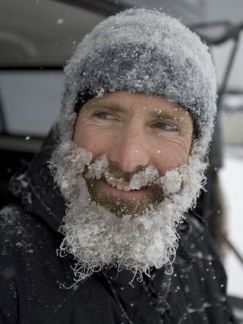
The Mystery – And Practicality – Of Beardage

A reader, inspired by this post, writes:

I'm lucky enough to take a week off work each February or March and take my family AP070220035730to Utah for some skiing.  For the last several years I've stopped shaving just after Christmas so that I have a beard by the time we get to the mountains.  I always used to tell myself (or anyone who asked about the extra facial hair) that it was good warmth and protection for my face while skiing, but that was mostly speculation on my part.  This year it was proven correct.
The week we were in Utah we got a little over four feet of new snow and had some pretty windy days.  Not being used to so much powder, I ate snow all week. But unlike my companions, I was quite comfortable after resurrecting myself from an epic wipeout.  When coupled with a pair of goggles, I probably didn't have more than a square inch of exposed skin on my cheeks.  (Plus, it looks freaky cool when you get a half inch layer of frozen snow and breath over the lower half of your face.)

And excess beardage is definitely on the upswing.  I had much more bearded company on the slopes this year and got compliments all week from my bearded brethren.  Almost inevitably, while passing a fellow viking, we'd exchange a slow nod accompanied by a wry smile, as though we both knew how good it was to have the extra facial protection but didn't want to let anyone else in on the secret. 

Balaclavas?  We don't need no stinking balaclavas!

Ah, yes. The beard nod. Been there.

(Photo: Shane Fox, 38, of Sunriver, Oregon, sits on the tailgate of his truck in the West Village parking lot at the Mount Bachelor ski area. Fox spent the morning telemark skiing in the fresh powder, collecting an icy second beard. By Andy Tullis/AP/The Bulletin)

A Small Window For Democracy

Joshua Kurlantzick lists what Egypt and Tunisia should learn from Asia's revolutions in the 1980s and 1990s:

Much of the future of Asia's emerging democracies was determined within a year after popular protest appeared to end authoritarian rule. In the Philippines, the inability to erase the influence of the country's handful of massive landowners–including the Aquino clan–meant that the country remained mired in a kind of oligarchic politics–and today, without a popular revolution, it will be hard to change that trend. In Thailand, the refusal in the early democratic period of the 1990s to use constitutional change to reexamine the role of the monarchy and its institutions led to the continuation of undemocratic power wielded by the trinity of bureaucracy, military, and palace.

Debt As A Moral Issue, Ctd

90992-2

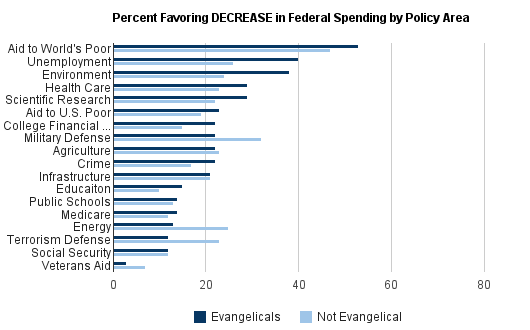
Lisa Miller analyzed a Pew report on the fiscal conservatism of evangelicals. Chait deflates my wishful thinking:

[I]f you look at programs that make up the bulk of the federal budget — Medicare, Social Security, defense, and homeland security — evangelicals support for spending cuts ranges from the low teens to the low twenties. Compared to other Americans, evangelicals are very slightly more likely to favor Medicare cuts (but still far less than 20% do), no more likely to favor Social Security cuts, and less likely to favor cuts to defense and homeland security.

I guess I was responding to the rhetoric, not the underlying practical reality. Christianists favor the biggest cuts in spending on the poor and unemployed and the smallest cuts in the military-industrial complex. Now you know a little why I find using the term "Christian" to describe this political ideology a little difficult. Bernstein nods and chips in his two cents:

What I suspect the polling shows, rather than anything particular about evangelical Christians, is the success of the GOP war on budgeting. Once fiscal conservatism, and even "balanced" budgets, are defined not as having government revenues equal spending but as not spending government money on things that the government (in one's opinion) should not be doing, then the conservative position makes sense. At least, in those terms. And evangelicals here are, near as I can tell, working within that conservative frame.

Ripping Off The Veil

BLAIRQADDAFIPeterMacDiarmid:Getty

Fadel Lamen recounts his harrowing experiences with the autocrat:

While I attended Tripoli University (al-Fateh) in 1980, Gaddafi ordered the college militarized. Along with other student leaders, I rejected this order. In response, he sent in his revolutionary guards militia.

Numerous students were hanged in the university's main square. The security forces also attacked a local mosque, which they believed was encouraging the disobedience. Several worshippers were arrested, and tortured to death; the imam, meanwhile, was taken to a wooden area outside Tripoli, shot, and buried.

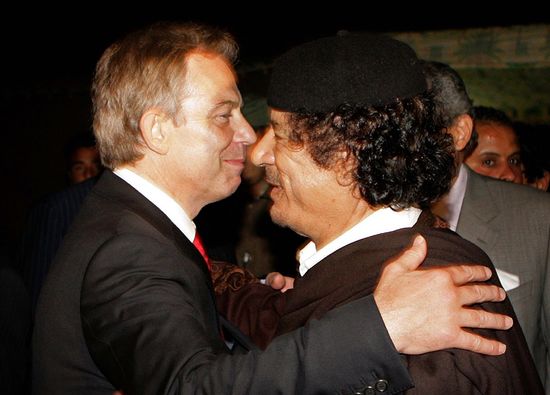
(Photo: Prime Minister Tony Blair embraces Colonel Moammar Gadhafi after a meeting on May 29, 2007 in Sirte, Libya. Blair is on a five day visit to meet with African leaders as he prepares to stand down as Britain's Prime Minister on June 27. By Peter Macdiarmid/Getty Images.)

Fear vs Hope In The Arab 1848, Ctd

A reader writes:

I often find it funny to read historians that are mindful to point out specific contexts in history that we should be mindful of, while they ignore the current environment in which this historical analogy is playing out. For example, Niall Ferguson tells us that the people in Libya are close (in education and financial wherewithal) to the sans-culottes commoner occupying the back streets of Paris. Perhaps. But a salient point regarding the current Middle East events is to recognize that they're going on NOW, not back in 1848, and are thus able to view the outside modernized world through the window of the Internet.

Back in 1848, those peasants (for lack of a better word) had little vision of the world beyond their own dilapidated streets. They saw Versailles, but not any more of the world beyond that. They violently overthrow the ruling class, but given their limited experience and knowledge base, what could they reasonably hope for? Their world was somewhat binary in that they saw little occupying the societal space between their poverty and the lavish lifestyle of those in Versailles; one can even argue that even then they were not all revolting because they all thought they would end up in Versailles if successful. In that respect, there was an ambiguity to their possible outcomes. What was between their poverty and the extravagance in Versailles? Overthrow Regime + ? = Happiness isn't the clearest equation.

But the Middle East protests are happening TODAY in an environment where those protestors have much broader access to the information that is crawling around in the world. These people will soon realize that there is a broad scale of opportunity in between their current desperate situation and the riches of the despots. At the least, given what the Information Age offers, they'll be able to mentally entertain many scenarios that they want to plot out for themselves.

I'm not trying to suggest that these societies will turn into overnight success stories of diversity and enlightenment. However, the sheer volume of information and "experience" available to people now, through our information technologies, provides them with much more direction once they overturn the current dictatorship. This was not so back in the years that Ferguson invokes.

Another reader is more succinct:

Three words: The fucking Internet.  I don't care how "ill-educated" a populous is, a revolution seeded directly by the Information Age (whatever ignorance the population collectively exhibits) cannot be compared to political upheavals of so long before information was ubiquitous.  I highly suspect these new Arab governments will have a far more modern "right to assembly" enshrined in their founding documents than most (if not all) Western nations, seeing as they've been born with online collaboration acting as midwife.

And I agree with your feeling; no matter how the Arab uprisings impact the US, I find them spiritually uplifting, without caveat.  This is human nature at its finest. And it provides me, as a terminally pessimistic cynic, the first opportunity of my life to take genuine, giddy joy in watching a large collective movement succeed.  I sincerely hope they end up somewhere much Righter, and even my inner nihilist believes they will.

Advice On Writing

“Most people are a thousand times more interesting when they’re talking than when they’re writing. Why is this? Because people panic when they start writing. People instantly revert to memories of 10th grade English class, and memories of No. 2 pencils, and lined notebooks. And then they freak out and tense up. Don’t tense up. Just relax. Seriously.”

Other tips here.

“They’re Just Short Of Firing Mortar Shells!”

Enduring America is tracking today's dramatic developments in Iran:

1254 GMT: RAHANA sums up the current situation in Tehran poignantly: "Tehran has once again become a barracks."

1535 GMT: Rah-e-Sabz reports at least 10 people arrested in Mashhad. BBC Persian reports shots fired near Vanak Square in Tehran. Tehran witness says protesters are chanting "Death to Dictator" near Azadi & Enghelab Avenues.

1605 GMT: Mardomak reports that rallies are trying to form in Tabriz and Shiraz, but are being blocked by security forces. A witness is reporting "mass arrests" in Tehran.

1616 GMT: Saham News is reporting — but now as "unconfirmed" — that two security vans were set on fire by protestors at Enghelab Square.

1724 GMT: A Journalist, speaking to Kaleme, reported that he was "spattered in blood" after security fired shots into the crowd. Kaleme is calling today's security presence in Tehran, and the resulting violence, "unprecidented." We have not yet verified these reports.

Tehran Bureau has more:

According to RAHANA, Ahmad Abad Street in Mashhad — hometown of Supreme Leader Ayatollah Ali Khamenei — has become the scene of heavy clashes between the people and security forces. An eyewitness reports, "The clashes are severe. They're just short of firing mortar shells! The number of arrests is very high. I can say that there have been at least 150 arrests."…

Another report indicates that the special forces of the Islamic Revolutionary Guard Corps and plainclothes agents attacked people trying to move toward Azadi Square from Enghelab Square. Kaleme reports severe violence. Security forces attacked smaller crowds with batons and larger ones with tear gas. The slogans "Allah-o Akbar" and "Marg bar dictator" were heard up and down Azadi Street. Another eyewitness told Deutsche Welle that the violence is comprable with what occurred the immediate aftermath of the 2009 election.