Ferraro’s White Populism

TNC reexamines the record and concludes:

I was eight when she was nominated for vice-president, and while I could not register the full import of the thing, I understood that the world had somehow opened up, and later, more specifically, that Ferraro, herself, through dint of her own hard work, had opened the world up. From Ferraro, from someone who had likely been told she was only in the 1984 race because she was a woman, many of us, indeed, expected better. 

Ferraro’s money quote:

If Obama was a white man, he would not be in this position. And if he was a woman of color, he would not be in this position. He happens to be very lucky to be who he is.

Left, Right And Time

I suffer, it seems, from an affliction that bedevils many. I now find myself largely opposed to most Republicans and in favor of a Democratic president as an even tempered pragmatist. But I have not reimagined myself as a leftist. Others have, of course, but I wince a little every time. Take the issue of taxes – and you see where the right-left paradigm is totally insufficient to the occasion.

Income tax rates are now lower than they were under Ronald Reagan and far lower than they were under Eisenhower. And yet it has become a Norquistian non-negotiable that no taxes can be raised at all on anyone, let alone the beneficiaries of the last thirty years – and those who differ must be "leftists" – even when the US is facing debt of historic and dangerous proportions. Someone advocating what Eisenhower was perfectly comfortable with would be regarded by the Republican right today as a communist. And yet, of course, Eisenhower was emphatically not a Communist, whatever the John Birch society believed. In retrospect, he might even be seen as the most successful small-c conservative of the 20th century. (This was indeed Paul Johnson's take in Modern Times.)

Similarly, those who view Obama as some kind of radical have to come to terms with what Glenn Greenwald spells out here:

Since Obama was inaugurated, the Dow Jones has increased more than 50% — from 8,000 to more than 12,000; the wealthiest recieved a massive tax cut; the top marginal tax rate was three times less than during the Eisenhower years and substantially lower than during the Reagan years; income and wealth inequality are so vast and rising that it is easily at Third World levels; meanwhile, "the share of U.S. taxes paid by corporations has fallen from 30 percent of federal revenue in the 1950s to 6.6 percent in 2009."

Conservatism cannot be defined as whatever is the most extreme right-wing narrative of the moment. Time matters. Conservatism needs to be flexible enough a governing philosophy to be able to correct for conservative ideology itself. When such an ideology threatens fiscal balance, a prudent foreign policy, and a thriving middle class, it has become the enemy of real conservatism, not its friend.
A Kibbles And Bits Society

Linton Weeks explores our media consumption:

We just don't do whole things anymore. We don't read complete books — just excerpts. We don't listen to whole CDs — just samplings. We don't sit through whole baseball games — just a few innings. Don't even write whole sentences. Or read whole stories like this one. We care more about the parts and less about the entire. We are into snippets and smidgens and clips and tweets. We are not only a fragmented society, but a fragment society.

The Top Dirty Words

London_swearing East_coast_swearing

Trends In Teenage Talk reports on the frequency of curse words in London (on the left) and the east coast in the US (on the right). Vaughan Bell goes off:

I would first like to express my disappointment that the word bollocks is being neglected by UK teenagers. Unfortunately, a decline in social standards and a lack of respect for tradition is leading to a generation of fucking obsessed adolescents.

How Japan Covered The Tsunami

Matt Alt, an expat in Japan, says the "contrast between the local and foreign coverage of the crisis has been eye-opening":

The measured, deliberate tone of Japanese news reports and government press conferences has been a lifeline for millions of Tokyo residents both native and foreign. Japan has its fair share of tabloid publications and conspiracy theorists. So why hasn’t the Japanese media sensationalized the situation anywhere nearly as much as the Western media outlets? Undoubtedly because the stakes are so high. It’s easy to play up the downsides when you’re sitting pretty in a television studio an ocean away from the reactors; not so much when you’re sitting a couple of hundred kilometers downwind.

A Libya Stalemate

110965682

Zack Hosford and Andrew Exum fear one:

The most dangerous outcome for the United States is also the most likely, which is a stalemate that prolongs U.S. and allied military intervention in Libya. The relative lack of sophistication and organization among rebel fighting forces means they may be unable to regain the momentum in Libya and defeat Gadhafi’s forces in open combat absent significant direct and indirect support from U.S. and allied militaries – which is not explicitly authorized by UNSCR 1973 and might not be supported by the U.S. Congress.

A stalemate in Libya would effectively result in a de facto partition of the country with a severely under-governed and disorganized safe haven in eastern Libya for the rebels that could provide refuge for various militant and criminal groups capable of exporting violence and instability to other countries in North Africa and the Middle East. Such a scenario would prolong U.S. and allied military intervention as only a major Western investment in developing the independent governance, economic and security force capacity of eastern Libya would be likely to forestall this outcome. However, such an investment is highly unlikely due to the overarching fiscal constraints facing the United States and NATO countries and competing priorities.

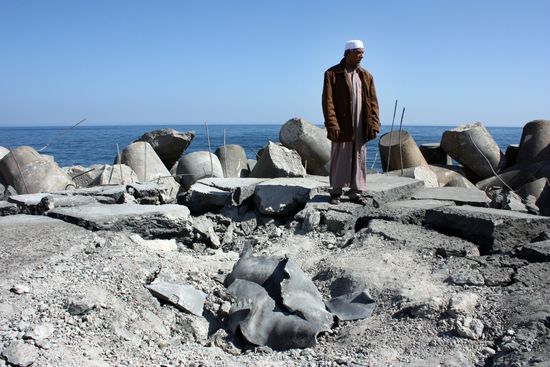
(Photo: A Libyan man stands on the bombed fishing harbor of Sirte on March 28, 2011 a day after a coalition air strike, as rebels were stopped in their tracks by forces loyal to Moamer Kadahfi who launched a fierce attack on their convoy, halting their push forward to Sirte for a second time in the day. By Imed Lamloum/AFP/Getty Images)

The Scientific View Of Man, Ctd

A reader writes:

"If I could disbelieve in God, I would." Funny, I'm the exact opposite; if I could believe in God, I would.

Another writes:

Surely a God who cares about human beings would not so limit our free will as to make it impossible to disbelieve in him. If he could do that, he might as well have put a big "I AM" sign in the sky.

I was simply expressing a personal fact, not a general truth. I'm blessed, to my mind, cursed to others. Another:

I found your remark after the bit about Hume intriguing.

I'm assuming that you mean directly "your belief in God" and not your belonging to the Catholic religion. That even if you left the Catholic Church, this statement still holds. Are you then saying that you are "forced" by an intangible something to believe in God even though you'd rather not? Or are you saying that, right now, you benefit by your belief, inconvenient as it is. If, however, you could get a similar benefit/consolation of the Big Picture elsewhere – say, by science – you'd rather not have to believe in something that is hard, if not impossible, to defend logically?

Or is there another option? Inquiring minds want to know.

Well, my faith in God is profoundly filtered through my Catholicism, although I remain open to the idea that other faiths and traditions are in touch with same deity. This is not about weighing up costs and benefits or making some kind of calculus. It's frustratingly outside those categories.

Surt Uncertain

Screen shot 2011-03-29 at 4.11.49 AM

The Guardian's Chris McGreal tweets his report from Surt, Qaddafi's hometown and a decisive stronghold. BBC has footage from the frontline. Enduring America steps back:

A striking contrast to Monday morning, when we woke to the claim — which turned out to be incorrect — that the opposition had suddenly taking the regime stronghold of Sirte, east of Tripoli. Based on that, we were speculating that Libyan leader Muammar Qaddafi's forces might be falling back on the capital for a concerted last stand.

In fact, the regime forces were fighting the insurgents to the east of Sirte, with reports putting the front-line anywhere between 80 and 180 kms (50 and 110 miles) from the town. Sirte itself, according to some reports (listen to audio in separate entry), was being reinforced by regime units, albeit with lighter weapons to avoid coalition airstrikes.

Feb17 is another great Libyan live-blog to follow. Meanwhile, what's the nutter up to?

Libyan leader Muammar Gaddafi has called for an end to the "barbaric offensive" against Libya in a letter addressed to international powers meeting in London today. AFP reported that in the letter, Gaddafi likened the Nato-led air strikes to military campaigns launched by Adolf Hitler during World War II.