One thing to remind people about New York Magazine's coup in wooing Frank Rich away from the NYT is that Rich and Adam Moss are not just friends, but creative colleagues going back for ever. Together they also were pioneers in the coverage of gay issues long before that was regarded as part of understanding the world. Maybe Rich will also write again on theater or film. But it's a big blow to the NYT.
Month: March 2011
Who Beats Her?
Rich Lowry sounds nervous sizing up 2012:
It's not inconceivable that the Republican presidential field could be Gingrich, Romney, and Pawlenty, with Huntsman and Santorum in the second tier (and Johnson and Cain further back). The odds are that Daniels won't run–he said on the NewsHour on Friday that "there are a lot of concerns that are very, very personal and family-oriented" for perhaps not doing it, and compared running to throwing "yourself off that cliff." I wouldn't be shocked if Barbour pulls up short; he hasn't had a great two weeks since he's been more out there.
I'm guessing Huckabee doesn't run, although that's only a guess, and Palin also might sit it out, but who knows? After all the build up about a wide-open, crowded Republican race, a short field would be quite the let-down.
It's hard to blame Daniels for shying away from a run – he's a fiscal hawk, who thinks (are you sitting down?) that revenue matters, that knowing how to govern – rathern than posture – matters, and whose foreign policy guru has long been Richard Lugar, and who wants a cease-fire in the cuture wars.
For me, the same question recurs: who beats her? And how exactly?
Can MoveOn Replace The UAW?
Mickey wonders if we haven't already glimpsed institutions that make unions' political role redundant:
The internet has already empowered organizations like MoveOn.org to provide both dollars and volunteers to Dems through a structure that need not have anything to do with organized labor. (Here in California, the Courage Campaign has the same idea, though it hasn’t come close to pulling it off.) Why picket when you can click it?
If MoveOn and its imitators can perform unionism’s Dem-funding role–just as OSHA can perform unionism’s workplace safety role and Obamacare can perform unionism’s health-insuring role–then who needs unionism again? The left can let it wither–which, at least in the private sector, simply requires letting events run their course.
That's also partly true of the unions' political role. Organizing and fund-raising are feasible online – just look at the Obama campaign. My own view is that union dues should operate like campaign contributions: give them if you want to. Will Wilkinson has more, in a post noted earlier. And see this item on the difference between being overpaid and underpaid too.
The View From Your Window

Port of Spain, Trinidad, 4.30 pm
Daddy’s Little Wage Booster
Eric Barker excerpts a new study:
We observe that when a daughter was born to a male CEO, wages paid to the CEO's female employees rose relative to the wages paid to male employees. The effect was stronger for the first daughter, and stronger still if the first daughter was also the first child.
Why Accept Global Warming And Not Free Trade?
Will at Ordinary Gentlemen is willing "to accept the consensus view of specialists in most fields" barring "real evidence of systematic bias or incompetence." He asks:
Why don’t we accord the same level of deference to economists? Shouldn’t the pro-free trade consensus within the field of economics be as bullet-proof as belief in global warming? It’s not a partisan issue – in my opinion, the best introduction to the benefits of international trade was written by Paul Krugman. And the strength of the pro-free trade consensus in economics is at least as robust as the consensus view among climatologists. There are a few high profile dissenters, but those exist in every field, including climatology.
Is Big Labor Green?
Ezra Klein asserts that unions "push back on business models that they don’t consider sustainable for their workers or, increasingly, for the environment." Wilkinson counters:
Private-sector unions and big business come to blows over a cutting-the-cake problem. But the interests of labour and capital are aligned when it comes to the size of the shared cake. … I think you'll find that unionised coal miners are as unenthusiastic as the coal companies they work for about regulations that would restrict the growth of mining operations or reduce demand for coal.
Child Brides
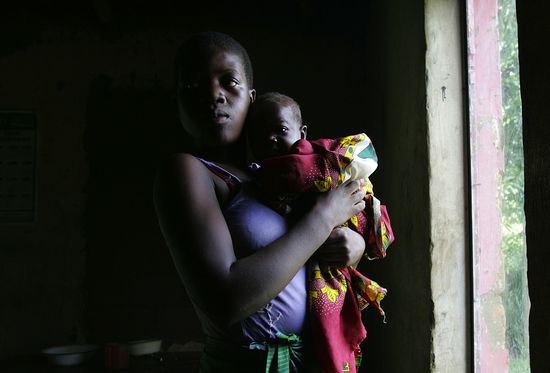
The Economist looks at the latest numbers:
According to a UNICEF report, most child marriages take place between the ages of 15 and 18, but in three countries, Niger, Chad and Bangladesh, more than a third of women aged 20-24 were already married by the age of 15. Such practices often flout the law: whilst the legal age of marriage in India is 18 around half of the Indian women surveyed were already married by that age. One negative effect of early marriage is the exclusion of women from education in favour of domestic work and child rearing. So countries with a high prevalence of child marriages also tend to have low literacy rates for young women.
(Photo: Innat Edison, 15, stands inside her mother's cramped, dingy house in Chiringani village, southwestern Malawi, nursing her 2-month-old baby, Crispin. Her former fiance refuses to acknowledge their child as his own. In isolated villages and crumbling cities across the most destitute continent, girls younger than 14 are finding boyfriends and getting married in a bid to escape the empty bellies, numbing work and overwhelming tedium of poverty. By Obed Zilwa/AP)
Running Government Like A Business
Seth Masket says it's not possible:
There's nothing wrong with the idea that governments should be run more efficiently or with better customer service, and if that's what people mean, they should say that. But to say that governments should be run like businesses is to reveal ignorance about what either governments or businesses — or both — are.
Businesses exist to turn a profit. They provide goods and services to others only insofar as it is profitable to do so, and they will set prices in a way that ends up prohibiting a significant sector of the population from obtaining those goods and services. And that, of course, is fine, because they're businesses. Governments, conversely, provide public goods and services — things that we have determined are people's right to possess. This is inherently an unprofitable enterprise. Apple would not last long if it had to provide every American with an iPad.
How The Rich Vote

Andrew Gelman revisits an old hobbyhorse:
Wealthier people tend to be more economically conservative; lower-income people are more likely to support taxes on the rich. This is no surprise: of course it makes sense that if you have more money you’ll have more sympathy with the argument that people should keep what they earn, and if you have less you’ll be more likely to favor redistribution. The correlation between income level and economic ideology is weak (we have graphs in Red State, Blue State making this point), but it’s not zero. Nor would you expect it to be.
 The Dish