The Daily Wrap

Today on the Dish, Andrew parsed Obama's speech on Libya and his undeniable belief in American exceptionalism, and we rounded up the rest of the reax. Andrew requested a budget for Libya, debated war without vital national interests at stake, and likened Obama to Angelina with an air force. Per Freddie's request, Andrew expressed relief at the massacre averted by the war, Goldblog questioned the vacuum being created, and Exum explored what winning in Libya would mean. Steve Negus decoded America's abstract mission in Libya, and Peter Feaver outlined advice for Obama. A statue fell in Dara'a, a woman protested her own rape by Qaddafi's forces, and we checked in on Benghazi. Some bristled at NATO's involvement, the pro-Qaddafi rhetoric fizzled, and John Lee Anderson still couldn't figure out who exactly leads the rebels. Demonstrations stirred in Iraq, Jackson Diehl shilled for Israel, and Greg Scoblete examined two bad options following Somalia's model.

More disturbing footage poured in from Japan, a kid from Wasilla pled guilty, and religion created political order in the world. A homosexual was stoned in Pennsylvania, while gay marriage in Holland celebrated ten years and a fraction of the divorce rate as their straight counterparts. Gingrich's favorables plummeted, Mark Blumenthal tracked the GOP's House, Nate Silver believed Romney could win, and Bachmann eyed Iowa. A Mormon seconded Andrew's review of "The Book Of Mormon," Andrew gaped at looniness on the right and Trump birthed it up with a false birth certificate of his own.

The Boomers kept trucking, goodwill wages don't last long, and the law school bubble burst. The slush pile sells well, royal weddings hurt tourism, and Roger Ebert peddled fares on Amazon. America had to get bigger buses, viruses represent a fourth domain of life, and the New York Times ignored DC's female bloggers (again). American teenagers were invented after war, information had a new lease on life, and the wall went up. Angry Birds went Hollywood, the future web on tablets beckoned, and a reader nominated TNC to replace Bob Herbert. Malkin award here, Yglesias award here, dissents of the day here, bucketload of creepy here, quotes for the day here, beard of the day here, VFYW here, MHB here, and FOTD here.

–Z.P.

“America Is Different” Reax

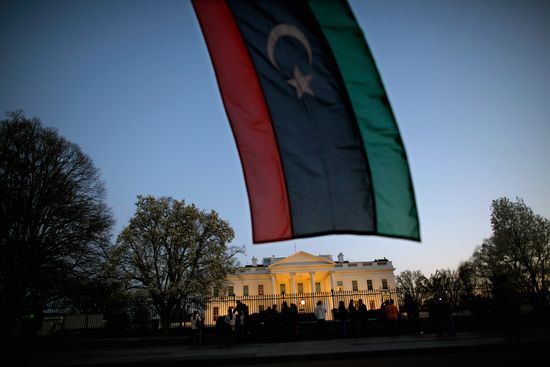
LibyaFlagWhiteHouseGetty

Daniel Larison:

During his address to the nation, Obama claimed, “When our interests and values are at stake, we have a responsibility to act.” What he failed to do was to explain how “our interests” were at stake in Libya, perhaps because he knows that there is no argument for the Libyan war based on U.S. interests. The president invoked securing the fortunes of Tunisian and Egyptian democracy, the need to deter dictators from using violence against protesters, and the credibility of the U.N. Security Council, but he did not defend this war in terms of serving American interests. Ruling out regime change as something that would destroy the coalition, Obama has accepted overseeing a stalemate between exceedingly weak rebels and an entrenched regime.

David Frum:

The most ominous of the warning signs was his comment about Iraq. Why reargue that war now? Answer: to justify cutting short the commitment to Libya. Obama’s problem is that the moment to take that position was before the Libyan intervention. If he truly did not think the outcome in Libya mattered – if he had been willing to live with a Qaddafi victory – then he could have hung back and allowed events to proceed. But having committed American power to the war, he committed America inescapably to the outcome. If that outcome is a divided, war-torn country, President Obama will not escape responsibility because he only used American airpower.

Greg Scoblete:

It seemed clear throughout the speech that the president put significant emphasis on the fact that there was a coalition (however small) and UN imprimatur on America's military action. Many critics will no doubt pounce on this as proof of President Obama's one-world liberalism, but I think it's his way of wiggling out of any precedent setting doctrine with respect to Libya. It's rare indeed to have the UN and the Arab League join hands to endorse military action against a Middle Eastern state. Obama is probably betting that the multilateral stars won't align like this again, thus sparing him the need to act if other regional despots go on their own murderous rampages.

Marc Ambinder:

Although he didn't articulate this point, the president and his aides know that from a strategic vantage point, a democratic movement in Bahrain will almost certainly be catalyzed with covert help from Iran, which wants to establish another harbor to contain the power of Saudi Arabia. Bahrain, therefore, has more leeway. (That is also the home to America’s 5th Fleet.) There is no coherent opposition force in Yemen, and the United States worries that regime change would allow al-Qaida to flourish in that impoverished country where the terrorist group has already gained a foothold.

Tom Ricks:

I was most struck by the last few minutes of the speech, when Obama sought to put the Libyan intervention in the context of the regional Arab uprising. He firmly embraced the forces of change, saying that history is on their side, not on the side of the oppressors. In doing so he deftly evoked two  moments in our own history-first, explicitly, the American Revolution, and second, more slyly, abolitionism, with a reference to "the North Star," which happened to be the name of Frederick Douglass's newspaper. If you think that was unintentional, read this

Spencer Ackerman:

[W]hat happens if Gadhafi doesn’t simply go? What happens if the rebels can’t overrun him, as the Pentagon assesses? What happens in the event of a stalemate? How does the U.S. not escalate if Gadhafi hangs on? The fact that there’s no clarity after this speech is striking. 

DiA:

It was a beautiful speech, especially the end. But I still don't know how long we're going to be in Libya. Or what we ultimately want to see there, aside from Qaddafi leaving, somehow. Or what we're obligated to do, now that we've done what we said we were going to do, but not really. It was vintage Obama: I'm moved but unconvinced.

Michael Crowley:

[Obama] offered little sense of how long it might take to dislodge the tyrant, whether we're willing to push him harder (for instance, by possibly supplying arms to the Libyan rebels) and how America would respond should Libya collapse into an Iraq-like state of violent anarchy. Of course, Obama himself may not know the answers to those questions–which is what has critics of his Libya policy nervous. But in place of those uncertainties, Obama did offer something like a larger doctrine.

Bill Kristol:

The president was unapologetic, freedom-agenda-embracing, and didn’t shrink from defending the use of force or from appealing to American values and interests. Furthermore, the president seems to understand we have to win in Libya. I think we will.

Peter Feaver:

The obligatory gestures about a "difficult task"  – "Libya will remain dangerous…"; "Forty years of tyranny has left Libya fractured and without strong civil institutions" — barely scratched the surface of what could go wrong here. I did not expect the president to run down the "dirty dozen" list of bad things that might happen. That is the work of strategic planning shops. But I did expect more steeling of the American public for possible adverse developments. And I did expect more discussion of why not intervene in other cases that looked, on the surface, like they might match the Libyan case on the atrocity scale. 

Lexington:

If Colonel Qaddafi is swept quickly from power, or reduced to impotence in some bunker, nobody will care very much about the manner in which Mr Obama put together his alliance and campaign. It might indeed be remembered as an extraordinary foreign-policy success. After the rescue of Kuwait in 1991, however, the first President George Bush also expected Saddam Hussein's regime to collapse in short order. Mr Obama's team says the circumstances this time are entirely different. They had better be right.

David Brody:

[Obama] pretty much said "Mission Accomplished." The only difference was that there wasn’t any banner behind him.

Earlier thoughts here.

(Photo: Fadi Tarapolsi holds up a pre-Gaddafi Libyan flag while standing vigil in front of the White House March 28, 2011 in Washington, DC. Tarapolsi and his parents have been living in exile in the United States from Libya more than 30 years ago. He said he has held vigil at the White House every night for the past five weeks and will continue to do so until Libyan leader Muammar Gaddafi is out of power. By Chip Somodevilla/Getty Images)
Oh Joy

The Donald's alleged "birth certificate" is not his birth certificate. Ben Smith smirks:

Trump's mother, it should be noted, was born in Scotland, which is not part of the United States. His plane is registered in the Bahamas, also a foreign country. This fact pattern — along with the wave of new questions surrounding what he claims is a birth certificate — raises serious doubts about his eligibility to serve as President of the United States.

Heh.

“America Is Different”

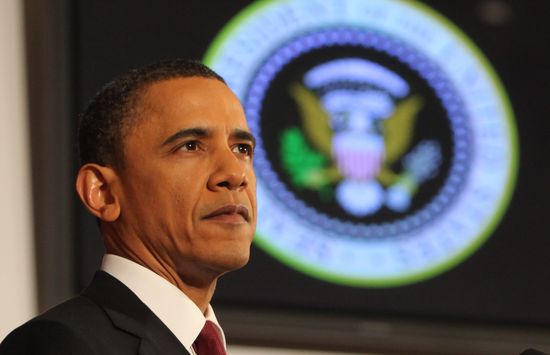
OBAMALIBYADennisBrack:Pool:Getty

That, it seems to me, was the core message of the president's speech on Libya. America is simply incapable of watching a slaughter take place – anywhere in the world – and not move to do what we can to prevent it. It is against our nature to let evil triumph in such a fashion. The Libyan example was particularly vital because a rare constellation of forces came together to make turning away even harder: European and Arab support for preventing mass murder; UN permission; America's "unique" capabilities; and an imminent massacre in Benghazi.

Obama the Niebuhrian put the moral in realism. Yes, we could not do this everywhere all the time; but we could do this when we did; and that was good enough. There was some sleight of hand here. Citing the UN Resolution as an external reason for war – when the US lobbied hard for it – was a touch too neat. But essentially Obama was challenging those of us who opposed this decision to ask ourselves: well, what would you do? If the US had insisted on looking away, America would have seemed morally callous, even compared with the French. The mass graves of Benghazi would take their place alongside the horrors of Srebrenica. And the impact on Arab opinion, especially on the younger generation that is so key to the future, would be fatal to America's long term interests.

I do not know whether the last is actually the case, or whether most young Arabs are understandably focused on the regimes they labor under rather than the murderous nutter in the North African desert. But secretary of state Clinton was in the region at the time and believed otherwise. And, yes, one appreciates that doing nothing represented a choice as well as doing something. And it too would have had unknowable consequences.

Was I persuaded? Not completely. The major objection – what happens now? – was not answered affirmatively by the president. It was answered negatively: there would be no military effort at regime change, as in Iraq; NATO, not the US, would soon be leading the mission; and, er, it may last a while. It is way too soon to celebrate a new model of international cooperation; but it seems striking to me that the rationale Obama invoked was very much GHW Bush in Kuwait rather than GW Bush in Iraq. That left Saddam in power for more than a decade. And yet Obama spoke as if Qaddafi's days were obviously numbered. I sure hope they are.

It wasn't Obama's finest oratory; but it was a very careful threading of a very small needle. That requires steady hands and calmer nerves than I possess. But this president emerges once again as a consolidator and adjuster of the past, not a revolutionary force for the future. And one hopes that the notion that he is not a subscriber to American exceptionalism is no longer seriously entertained.

He clearly believes in that exceptionalism – and now will live with its onerous responsibilities.

(Photo: Dennis Brack/Pool/Getty.)

Routes To Treatment, Ctd

A reader writes:

Just saw your recent mention of drug courts. I'm sure you're aware of this already, but Friday's episode of This American Life was about that very subject, or more specifically, a certain court in Georgia that has apparently gone off the rails. My wife and I by chance tuned into a rebroadcast of it yesterday, and were absolutely glued to our radio for the entire hour. It's a solid piece of investigative reporting.

The Wall Goes Up

On NYT paywall logistics, Felix Salmon gets deep into the weeds. The Onion proclaims:

In a move that media executives, economic forecasters and business analysts alike are calling "extremely bold," NYTimes.com put into place a groundbreaking new business model today in which the news website will charge people money to consume the goods and services it provides.

Obama’s Speech: What To Look For

Peter Feaver has suggestions:

[T]he administration has only sketched out a vision of what our role is under the best-case scenario. What is our commitment and obligation in scenarios where things do not live up to the rosy expectations? Given the many partisan (and many justified) critiques levied against the Phase IV planning in the Iraq War which was similarly based on best-case assumptions, the question is all the more on point now. What did Obama say to reassure us that the administration's public spin is not indicative of the quality of the planning involved in this military operation?

Trump’s Birther Ploy

Alex Seitz-Wald picks apart the cognitive dissonance. Frum asks:

Is Donald Trump crazy? Or does he just hold a very, very, very low opinion of the Republican primary voter?

Ben Smith leans towards the latter. Adam Serwer provides a birther lexicon. My own view is that Trump is merely very very rich. The very rich go bonkers and no one has any way to stop them.

Can Romney Win?

Nate Silver believes so:

[M]ost of the early polls show Mr. Romney running second [in Iowa] behind Mike Huckabee, whom he lost to in 2008. But if he were able to in Iowa, Mr. Romney would very probably follow it with wins in New Hampshire, Nevada and Michigan, which would make him the heavy favorite to win the nomiantion.

But Mr. Romney, also, will probably have the most money from among the Republican candidates (other than, perhaps, Donald Trump). He may have the strongest argument about electability, since he polls relatively well against Barack Obama. He’s run for president before, and in 2008, he accumulated a lot of delegates in a lot of different states, including in some that other candidates ignored. Mr. Romney, therefore, could potentially win the nomination as a “long haul” candidate as well.

An Abstract War

Steve Negus puts words in Obama's mouth:

US President Obama is coming under increasing pressure to explain exactly what it is that the United States is doing in Libya. If he's honest, he might say something like the following: "We are there in support of a document produced by a committee, under time constraints, which is consequently rather fuzzily worded, authorizing vaguely-described actions to achieve some very generally defined goals. We are there to prevent a tragedy, the scale of which will remain unknown unless we allow it to happen. We will probably remain committed to some degree until a wide range of Libyan actors, most of whose identities and agendas we do not know, can reach a stable ceasefire agreement, the terms of which we only guess at."

Negus thinks that "that this is a good mission" and explains why.