I guess this will be dismissed as an advance suck-up, but Christina Hoff Summers is onto something in her review of the "Women In The World" conference last month. It was remarkably devoid of p.c. cant and a powerful testimony to the struggles and resilience of women in the developing world.
Month: March 2011
Mental Health Break
A five month old has mixed feelings about nose-blowing. Reminds me of my own reactions to the Libya war:
A Frank Lloyd Wright Home
It’s Working, Ctd
A reader writes:
Enjoyed your last post and appreciate your consistent ‘opposition’ to the Libyan conflict. It is interesting to watch the debate because it was essentially the same debate over Yugoslavia.
I have found myself to be strongly anti war with the exception of military being used for protecting a mass atrocity. Historically, this has put me on the opposite side of every war relative to your positions. If I may be glib, you are for ‘recreational’ war, wars that accomplish something the US wants. It put you in favor of Afghanistan and Iraq. Prevention of atrocity I support, has put me on the side of Yugoslavia and Libya. Interestingly the failures have been the recreational wars, and I believe the successes will be those that actually save lives.
This is the right war at the right time, and it also has a reach greater than Libya itself. The message it sends keeps the energy in the other movements throughout the Arab world, including today Syria. Has Libya turned into massacre, the chill would have likely stopped the Syrian efforts in their tracks. Instead we have a likely additional member to democracy in Syria coming in the next several days.
This is multi-dimensional chess at its finest, and Obama plays this game best of anyone I know. It is a pleasure to watch the Arab 1848 play out and to know the West has contributed to it, by means of preventing atrocities in the region.
The truth is, I did eventually agree with action in the former Yugoslavia, but it took a while and only after the case was thoroughly made that the benefits outweighed the costs. And yes, the morality of the genocidal actions of Milosevic factored in. I know it's frustratingly complicated, but of course, I don't think purely humanitarian concerns can be surgically separated from all decisions on war and peace. If great evil can be prevented at a minimal cost – and figuring out when this is possible is entirely prudential – I'm for it. If it isn't, I'm not (hence my opposition to intervening in Somalia and Rwanda and Iran).
I'm just extremely skeptical as a general rule of using the military without vital national interests at stake. I agree with candidate Obama on this, not president Obama. But I wish the president, at this point, and the allied armed forces, the best of luck. How can one not?
The History Of Information
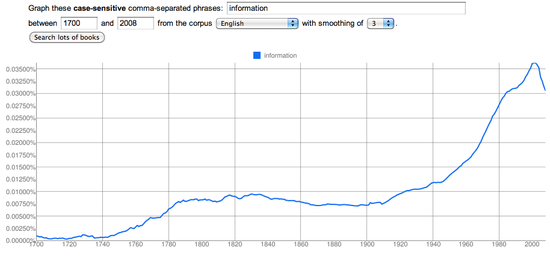
Jennifer Schuessler checks the word's origins:
The use of the word “information” itself certainly seems to have exploded since its earliest recorded appearance in 1387. (“Fyve bookes com doun from heven for informacioun of mankynde.”) As Michael Proffitt, the managing editor of the Oxford English Dictionary, notes in an essay written for the recent relaunch of the O.E.D.’s digital edition, “information” is the 486th most frequently occurring word in Project Gutenberg’s searchable corpus of mostly pre-1900 literature. A 1967 survey of contemporary American English ranked it 346th. And the rise of digital technology seems only to have speeded its ascent. One recent survey of online usage lists “information” as the 22nd most common word.
“This is an old word with a new lease on life,” Proffitt writes.
(Chart showing the usage of "information" in books 1700-2008 from Google Ngram)
Iraq Simmers
Joel Wing keeps his eye on Iraqi protests:
Despite the authorities concerted effort, there are still weekly protests in Iraq. Their demands vary, but in general they have emphasized the lack of governance in the country. Services like electricity are still spotty, corruption is rampant, unemployment is highest amongst the young, not all the government positions have been filled one year after national elections, politicians are unresponsive to the demands of the public, etc. While the demonstrations do not threaten to overturn the system of government like in other parts of the region, they do pose a challenge to those in power.
Already several governors have been forced to step down, and Maliki has felt the heat as well. As a result, the prime minister has given his ministers 100 days to improve or else. At the same time, he has actively attempted to suppress the demonstrations, and coverage of them as well. Little is likely to change after that deadline, so people will still attempt to hit the streets. That could lead to a battle of wills between those angry at the condition of the country and who demand change, and the prime minister who would rather solidify his power over the nation and be done with the public outbursts.
The Pigs Are The Enemy
Angry Birds gets the Bruckheimer treatment:
Who Leads The Rebels?
Jon Lee Anderson can't be sure:
Significant questions remain about the leaders of the rebellion: who they are, what their political ideas are, and what they would do if Qaddafi fell. At the courthouse on Benghazi’s battered seafront promenade, the de-facto seat of the Libyan revolution, a group of lawyers, doctors, and other professionals have appointed one another to a hodgepodge of “leadership councils.”
There is a Benghazi city council, and a Provisional National Council, headed by a bland but apparently honest former justice minister, Mustafa Abdel Jalil, who spends his time in Bayda, a hundred and twenty-five miles away. Other cities have councils of their own. The members are intellectuals, former dissidents, and businesspeople, many of them from old families that were prominent before Qaddafi came to power. What they are not is organized. No one can explain how the Benghazi council works with the National Council. Last week, another shadow government, the Crisis Management Council, was announced in Benghazi; it was unclear how its leader, a former government planning expert named Mahmoud Jibril, would coördinate with Jalil, or whether he had supplanted him.
Beard Of The Day
(Hat tip: Reddit)
Bachmann 2012!
National Review plays it straight – and thinks she has a real shot in Iowa (I didn't realize she was born there). The way in which formerly sane conservative outlets never actually declare the loony right loony is truly unnerving. But then the way in which Iowa has become such an outlier is even scarier:
For example, the 2010 GOP [Minnesota] Secretary of State nominee, Dan Severson, recently said, “Quite often you hear people say, ‘What about separation of church and state?’ There is no such thing…I mean it just does not exist, and it does not exist in America for a purpose, because we are a Christian nation.”
 The Dish