A Turning Tide?

110961784

Reading Nic Robertson's Twitter feed is a glimpse into history-as-it-happens. From today:

#Tripoli: Only about 1/2 stores open. Muted atmosphere on streets. Men hanging around cafes, no phony triumphalism for cameras today

One man did tell us he's worried abt situation–even w/minder, there was none of usual pro-Gadhafi rhetoric, which in itself spoke volumes.

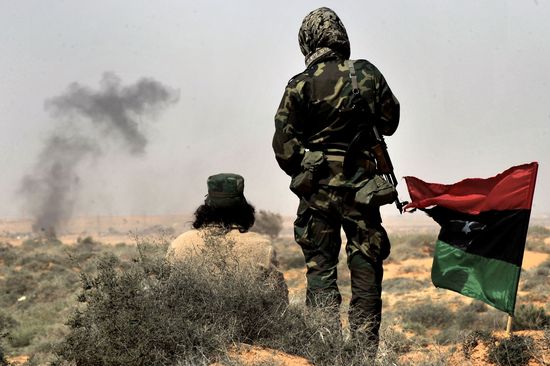
(Photo: Smoke billows as Libyan rebels progress westward from the town of Bin Jawad towards Moamer Kadhafi's home town of Sirte on March 28, 2011 as NATO finally agreed to take over full command of military operations to enforce a no-fly zone in Libya from a US-led coalition. By Aris Messinis AFP/Getty Images)

Hoping For Success

A reader writes:

Of course, Andrew, neither you nor anyone should hope for failure in the Libyan effort. But the 'meep meep' strain of your blogging suggests that you're looking for a way Obama's decision/action might be justified.

The tricky question, not addressed by your response to "Freddie": if the end result seems to prove reasonably good, would that put you in the realm of "I was wrong" or rather "you can be reckless and lucky, and we were — but I maintain that it was wrong to do this"?

The latter, with one caveat. I maintain it was foolish to do this. It may turn out to be right. At this point in time, no one knows.

NATO Steps In, Ctd

A Guardian reader bristles at the new intervention:

I fail to see just how this is anything to do with the North Atlantic Treaty Organisation. Nato exists as a mutual defence pact in the event that one member country is attacked, all members are deemed to have been attacked and all members retaliate appropriately under Nato command. Only one country has been attacked – Libya is not a member state and the attackers are. The Nato involvement in Afghanistan was stretching the purpose of the treaty to breaking point but this has gone too far. If the US, France and UK need a legitimate "umbrella" organisation to cover their aggression then come up with a new one.

Judah Grunstein uses the NATO intervention as an opportunity to examine global security gaps.

The Triumph Of “The Book Of Mormon” Ctd

110849865

A reader writes:

I am a practicing Mormon.  I don't claim to represent the mainstream of my faith, but I do hold up well enough to have taught adult Sunday school weekly for most of the last 12 years.  I have enjoyed your review of "The Book of Mormon".  My reaction to the show was in most ways similar to yours, though with some bitter-sweetness, as it was my faith so effectively mocked and honored during the show.

I attended a preview of the musical with a close friend who left the church several weeks into his mission, after concluding that it wasn't true and he couldn't teach people that it was.  Oddly, the event of him leaving the church tightly bound us together due to the way that we both reacted.  I learned through that event that my friendship with him wasn't a function of his faith, but rather his character.  Over the intervening 20ish years, we have stayed close.  Religion continues to be one theme of our relationship and discussions.  When we found out about this musical, we couldn't resist meeting in NY to share the "Book of Mormon" experience together.

My reaction to the musical borders on awe.  

It wasn't perfect, but it was darn close.  Orgazmo, while entertaining, didn't feel "Mormon" to me.  It missed on too many critical facts and cultural issues to feel genuine.  "The Book of Mormon" felt like the faith I grew up with and maintain.  I knew those missionaries.  I know them.  I was one of them.  The way missionaries are represented  (young, clean, enthusiastic, naive, committed, sincere) feels like my experience in the church. 

Trey and Matt deconstructed religion through the lens of Mormonism.  The deconstruction seemed to me fair and universal.  It showed the goofiness, inconsistency, inadequacy, and importance of faith and dogma.  There were a few very minor inaccuracies (time at the missionary training center is 3 – 7 weeks, you have your assignment before you get there, companionships change every couple of months throughout the two years, etc.) but nothing that was wildly inaccurate or unfair.  Church doctrine and history was shown in a comic and satirical manner, but I heard nothing that was unfair or dishonest.  If anything they went lighter than I expected especially given our history on polygamy and minorities.

I know that few, if any, in my congregation would have lasted beyond the first few minutes.  The raunch alone would have finished most off; the blasphemy would have taken care of the rest.  So, I don't purport to represent the mean for Mormonism. But for me, seeing the absurdity of the human condition and the difficulties of religion in addressing it woven into such a spectacle was inspiring.  The Mormons felt like Proverbs and the Ugandans like Ecclesiastes.  

My friend, who is no longer Mormon, had the same reaction I did: this show paid honor to faith and myth and hope.  It did so with satire and humor and raunch and blasphemy.  That it wrapped its sweet, warped message so lovingly in frog-humping, clitorises, and Yoda is the show's magic.

My wife called me after the show.  She worries a lot because faith isn't easy for me and attending the show felt to her a bit like me flaunting my unorthodoxy.  When she asked, "So how was it?", I responded, "You would have hated it.  I've never felt better about being a Mormon."  And I meant it. The most connected I have felt in years to my faith and experience as a Mormon came while I was laughing my guts out while my beliefs and my life were mocked and honored with equal sincerity during a show nobody but Matt and Trey would have had the guts to make.

Another writes:

I wholeheartedly agree that the show is an absolutely amazing piece of theatre and, as someone who sees a LOT of Broadway shows, this show ranks among the best I have seen in the past 10 years. However, I want to make sure that you and your readers do not overlook Parker and Stone's collaborators, without whom this amazing piece of theater likely would not be what it is.

Bobby Lopez (co-composer/lyricist of "Avenue Q"), as Trey and Matt's continually credit in interviews, was the one who sparked the idea to do a musical about Mormons, and his musical theatre songwriting background is clearly seen in the overall structure and the music for Book of Mormon. As co-director and choreographer, Casey Nicholaw deserves much of the credit for making the evening fly by at a breakneck pace, and likely helped guide Broadway neophytes Parker and Stone through the process of getting the ideas on the stage rather than in animated characters.

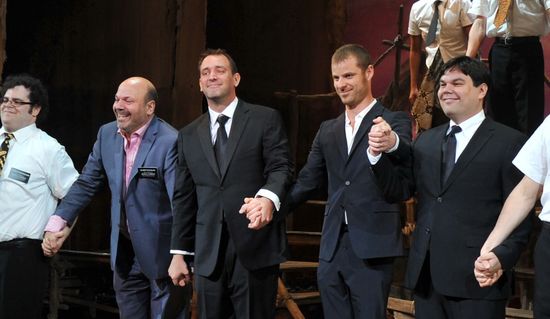
(Photo: Choreographer Casey Nicholaw, writer Trey Parker, writer Matt Stone, and writer/lyricist Robert Lopez take a bow during the curtain call on the opening night of 'the Book of Mormon' on Broadway at Eugene O'Neill Theatre on March 24, 2011 in New York City. By Stephen Lovekin/Getty Images)
What Would Winning Mean?

BinJawadLibayRebelGetty

Andrew Exum sizes up our interests in Libya:

Sec. Gates said yesterday, correctly, that Libya is not in the vital interests of the United States. He then, added, also correctly, that the United States has (presumably non-vital) interests in Libya and that Libya is part of a greater region in which the United States does, in fact, have vital interests. But the reason Sec. Clinton jumped into the conversation and immediately "clarified" the remarks of Sec. Gates is because she knew he had just committed a Kinsey gaffe, which is to say he had spoken the truth when, ahem, something else would have perhaps been a better political option.

Vital interests are those interests for which you are willing to bleed. And so if we have no vital interests in Libya, why are F-15 pilots punching out and having to be rescued by Marines? As Steve Biddle argued in an op-ed on Saturday, we have gone to war in Libya not to protect any vital interests but because events in Libya "offend U.S. values [and] threaten peripheral interests."

Exum thinks the administation has communication problem:

When the administration went to war in Libya, it did so without talking through the crisis of Libya, its possible responses to the crisis, and the consequences for action or inaction. As a result, nine days into the intervention, we are at war without a clear policy, clearly defined goals, or stated assumptions. Instead, we are at war with a laundry list of activities — things we are doing, but things untethered to a broader framework.

The president will presumably make the best case he can, after the fact, on the basis of humanitarian concerns. With any luck, he'll avoid any kind of "doctrine" and be as candid as he can be about the limits of the operation. My guess is that he hopes the rationale will be forgotten if Qaddafi quits or is pushed. But that's a big "if".

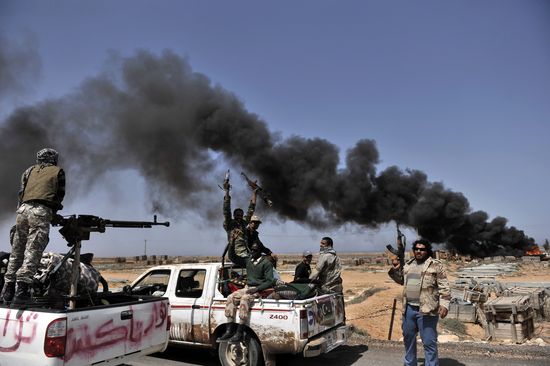
(Photo: Libyan rebels survey fighting along the front line during shelling with forces loyal to Libyan leader Moamer Kadhafi at a location close to the town of Bin Jawad, which was seized yesterday by rebel forces, on March 28, 2011. By Aris Messinis/AFP/Getty Images)

Quotes For The Day

"I firmly believe that when innocent people are being brutalized; when someone like Qaddafi threatens a bloodbath that could destabilize an entire region; and when the international community is prepared to come together to save many thousands of lives—then it’s in our national interest to act.  And it’s our responsibility.  This is one of those times," – Barack Obama.

"A more mischievous idea cannot exist than that any degree of wickedness, violence and oppression may prevail in a country that the most abominable, murderous and exterminatory rebellions may rage in it, or the most atrocious and bloody tyranny may domineer, and that no neighbouring power can take cognisance of either or afford succour to the miserable sufferers," – Edmund Burke.

How Deep Is Qaddafi’s Support?

110869296

It's a question without a firm answer. The view from Benghazi:

[W]hatever the differences from one end of country to the other, people in Benghazi emphatically believe that this will not become a civil war. They see their enemy as a mafia state run by very few with a great deal of power and little real support. The tribal divisions have been exaggerated, they say, and, unlike Iraq, the population is not divided by major fault lines of either sectarian or ethnic differences that can be exploited. Nor are any of Libya's neighbors in a position to play the complicating role that, say, Iran did in Iraq.

Well, we'll see soon enough.

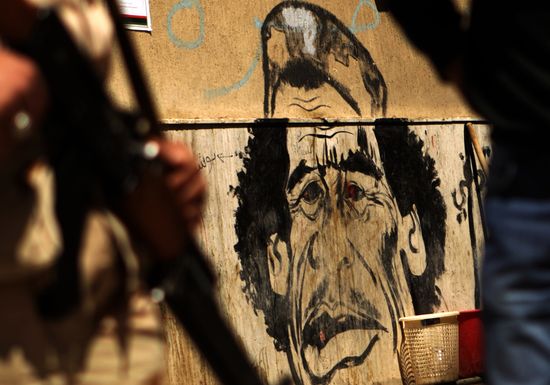
(Photo: Libyan rebels walk past a caricature of Libyan leader Moamer Kadhafi painted on a wall in Benghazi on March 25, 2011. By Patrick Baz/AFP/Getty Images)