In Pennsylvania, near the Delaware border. Because the Bible told him so.
Month: March 2011
How Religion Created Order
Evan R. Goldstein reviews Francis Fukuyama's new book, The Origins of Political Order:
"There is no clearer illustration of the importance of ideas to politics than the emergence of an Arab state under the Prophet Muhammad," Fukuyama writes. "The Arab tribes played an utterly marginal role in world history until that point; it was only Muhammad's charismatic authority that allowed them to unify and project their power throughout the Middle East and North Africa." Fukuyama's portrayal of religion as a unifying force in history will irk some atheists, for whom religion is at all times a source of intolerance, conflict, and violence. He does concede, however, that religion's role in the contemporary world is more problematic. Pluralistic societies require religions to coexist in proximity. As a result, he says, "integration today has to be based on shared political values, not deep, religiously rooted cultural beliefs."
The Corruption Of War
Or what happens when a young kid from Wasilla is given total power over human beings in a foreign land. Exhibit A.
Roger Ebert: Amazon Salesman
Ebert chronicles his experiments in funding journalism via newsletters and Amazon commissions.
The Military Machine
Ezra Klein wants, you know, accountability:
The way we decide whether something is worth it is to test whether we’re willing to pay for it. If a war is not worth a tax or spending cuts, then perhaps it is not worth engaging in. It’s understandable that the administration might need to act before offsets can be found, but only for the early days of a conflict. After that, it should have the money in hand.
So, ahem, a president addressing the nation on a war should be quite explicit on how it will be funded, under a range of scenarios. Some reports this time around suggest that the Saudis may pay the bill. Fine, but tell us. And each year of the costs needed for Afghanistan and Iraq should come out of some other part of the defense budget or require cuts in domestic spending elsewhere. Of course, none of this would be necessary if the Congress just did its job – and demanded fiscal responsibility from the increasingly trigger-happy executive branch.
Malkin Award Nominee
Monster Viruses
Carl Zimmer previews his next book:
A flu virus has just ten genes, for example, but a number of giant viruses have well over a thousand. Giant viruses even get infected by viruses of their own. For years, researchers have been finding that the diversity of genes in viruses is tremendous. It turns out that giant viruses are particularly bizarre, genetically speaking. The genes are so different, the scientists argue, that giant viruses represent a fourth domain of life.
Let The Commemorative Muggings Begin
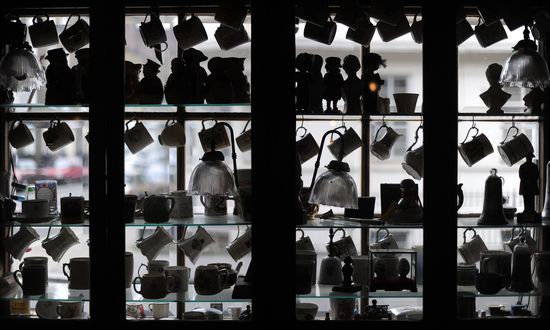
Will Frears tracks the economics of royal weddings:
[I]t turns out that historically, royal weddings actually are bad for tourism—even when the royals in question were considerably more vivid than the current pair. The wedding of Charles and Diana accompanied a 15 percent drop in U.K. tourism, while that of Prince Andrew and Sarah Ferguson saw an 8 percent decline from the average for that time of year. Perhaps tourists don’t like knowing they’re officially not the center of attention.
(Photo: Royal memorabilia in the window of the Windsor Castle pub in central London, on March 16, 2011. By Carl Court/AFP/Getty Images)
More Junk In Our Trunk
Nicola Twilley reports on the Federal Transit Administration's proposal to change the average passenger weight from 150 lbs to 175 lbs:
The FTA's earlier 150 lb passenger weight assumption was based on calculations carried out by the National Highway Traffic Safety Administration in 1971, which in turn was based on data gathered by the Centers for Disease Control between 1960 and 1962. In its October 22, 2008, National Health Statistics Report, the CDC reported an average male adult weight of 194.7 lbs and an average female adult weight of 164.7 lbs.
Slush Sells
Henry Baum flouts the idea forwarded by Roxane Gay that independent authors still need gatekeepers:
On many self-released books with a Kindle ranking of 10,000 or lower, you’ll seem comments like, “badly in need of an editor.” Yet you’ll also see 30 5-star reviews that don’t mention editing whatsoever. This book that was potentially rejected by an agent/publisher is selling hundreds of copies a day, despite its weaknesses.
At the risk of sounding like a snob: non-sophisticated readers will not care if writing is non-sophisticated, and there are a lot more non-sophisticated readers than sophisticated ones. That’s millions of potential readers. Publishers might like to believe that they have the finger on the pulse of what sells – or what should sell – but when mediocre writing is becoming a bestseller, this pretty much renders the slush-pile meaningless.
Applying the same principle to music, Baum points to a piece by Meghan Daum on the "Friday" phenomenon:
[A]ttention and fame these days are as much about hate as about love. To do anything in a public arena is to invite an insta-response that will echo just as loudly with harsh critics as with fans. It means having as many "dislikes" as "likes," as many people making fun of you as embracing you and, when it comes to the Internet, as many scathing, borderline abusive comments as supportive ones (and often many more). It means understanding — or learning the hard way — that being extremely popular is now basically the same thing as being extremely unpopular. …
Many young people today grasp that, at least on an unconscious level. But for just about anyone who came of age in the pre-Internet era — and that would include [Rebecca] Black's mother — the notion that public hate can be a perverse form of public validation will always remain, well, perverse.
And regardless of how "good" Black's song is, she's still making bank for a thirteen year old.
 The Dish