How The Law School Bubble Burst

Annie Lowrey fingers cultural forces:

In the past year or two, scads of blogs have committed themselves to exposing law school as a "scam," and the New York Times and Wall Street Journal have devoted thousands of words to telling readers why law school is a bad, bad idea if you do not actually want to be a lawyer. Look to any of a dozen blogs or news sites to explain how wages for legal workers might continue to fall, as automation takes over rote tasks and businesses increasingly refuse to pay obscenely high per-hour fees. Wandering further into the realm of anecdata, virtually every young lawyer or law student I know would love to talk my ear off about the worrisome employment prospects for new legal professionals.

Once the conventional wisdom has spotted a bubble—whether in housing or gold or anything else—it tends to burst.

Swallowed By The Sea

As Japan continues to experience aftershocks, another piece of surreal footage from the March 11 tsunami surfaces, this time from the city of Kesennuma: And that wasn’t all:

All along this northeast coast, town after town was struck first by the earthquake and then by the tsunami, but [in Kesennuma] there was a third element.

Having been first shaken and then inundated by water, Kesennuma was finally burnt, in a fire kindled by the first two disasters. Large tuna fishing ships in the harbour smashed into one another and caught alight. They were carried by successive waves into neighbourhoods that burnt to the ground after the waters had withdrawn. As the tsunamis rose and then receded, those who survived witnessed an unprecedented sight: the sea overwhelming the land, not only with water, but with fire.

The Boomers Keep Chugging

Emily Yoffe reports on the rise of retirees with second careers:

According to the U.S. Bureau of Labor Statistics, older workers are increasingly staying on the job. In the period between 1977 and 2007, their study found, the number of employed men 65 and older rose 75 percent. That was nothing compared with the older women, whose presence in the workforce increased nearly 150 percent. The bureau reports the trend is only going to accelerate: "By 2016, workers age 65 and over are expected to account for 6.1 percent of the total labor force, up sharply from their 2006 share of 3.6 percent."

Knowing Oneself, Ctd

Lsd2

A reader writes:

It occurs to me, while reading your discussion of LSD and what meaning it might bring, that it is much like dreaming in this sense: some people dream and wonder what it meant, and some people dream and shake it off as nonsense. Some might wonder if the dream is a divine message; some think of it as messages from your subconscious, making you face your inner self. Some ponder the dream for weeks, while some forget it immediately, saying, "It was just a dream." That some find meaning in their dreams says more about the person than the dream, and how introspective the person is.

LSD is like that. Some people will ponder over the experience for meaning, while others say, "I was just tripping." It's a question of your own level of introspection. There is always meaning to be found if you are looking for it, in a dream, a novel, a painting, or a trip.

Another writes:

Your line, "A notion of salvation that has absolutely nothing to do with the future?" reminded me of this Rumi poem (translated by Coleman Barks):

Lovers think they are looking for each other,
but there is only one search: wandering
This world is wandering that, both inside one
transparent sky. In here
there is no dogma and no heresy.
The miracle of Jesus is himself, not what he said or did
about the future, Forget the future.
I'd worship someone who could do that.
On the way you may want to look back, or not,
but if you can say "There's nothing ahead",
there will be nothing there.
Stretch your arms and take hold the cloth of your clothes
with both hands. The cure for pain is in the pain.
Good and bad are mixed. If you don't have both,
you don't belong with us.
When one of us gets lost, is not here, he must be inside us.
There's no place like that anywhere in the world.

This is a good example of Rumi's non-dualistic theism, something I think we are more in need of than ever.

Another:

Let me assure you that salvation has nothing at all to do with some future time, but is available to anyone here and now. This is the Universal message of every spiritual Master as well as the mystics and metaphysical philosophers throughout the ages. It is this basic Truth which has been distorted by every organized religion. Salvation, or atonement cannot be granted to you by any outside force, but only through self-realization.

We could philosophically conclude that time does not exist (see Augustine's thoughts on the subject). This would force us to come to the realization that NOTHING occurs at some future time; that there is no future or past if time does not exist. From this position it throws into doubt all beliefs about questions such as life before or after death (and even the question of death itself–How can something have a beginning or end if time doesn't exist?), karma (How can events from a non-existent past influence the present?), and the notions of Heaven and Hell. Without time in the equation of Life we are forced to admit that everything occurs in the eternal Now moment and that it is our minds which create the appearance of separateness between objects and the events.

And this was my epiphany obtained during my first LSD trip.

I was given a glimpse of the one-ness of all of creation. I couldn't express it in words at that time, but I knew with all certainty that what I saw around me was not "reality", but that there was something else "behind the veil". My experiences with LSD set me on a life long path of attempting to re-connect with that something.

I can only speak from my own personal experience, but in my world the same mind which produces the dualistic nature of the appearance of "reality"  also produces the illusion of an individual being separate from all of creation including the creator. And so, returning to your question; salvation is not something to wait for in the future, but something to work toward obtaining now. And, yes it is obtainable. "What you seek is right here, in your presence"

The Real Gen. Butt-Fucking Naked

A reader writes:

I haven't seen "The Book of Mormon" yet, but I think this reader, or perhaps his human rights lawyer girlfriend, had either his geography or his warlords confused. Unless I'm mistaken, there is no General Butt-Fucking Naked in Northern Uganda. There is, however, a General Butt Naked (real name Joshua Blahyi) who was a notorious warlord in the civil war in Liberia in the 1990s.

He got his name because he would go into battle naked. He was featured extensively in the excellent (if you like their style) Vice Guide to Liberia, where he describes how his soldiers would kill an innocent child and drink the blood before going into battle. There is also a new documentary about him that was shown at Sundance this year.

The General has mainly attracted interest due to his transformation from brutal warlord to his current incarnation of Christian evangelist. Fascinating character, to be sure.

How Words Weaken Over Time

John McWhorter isn't concerned about increasing profanity in pop music:

Language is all about creeping numbness, jokes wearing thin, feeling devolving into gesture. Terrible once meant truly horrific. The will we use to mark the future once meant that you quite robustly “willed” to do something, but diluted into just indicating that sometime you would. Hence a burnt steak as terrible, a good movie as awesome, trivial terms like shopaholic based on the glum source alcoholic, and just as naturally, we now have snowpocalypses, and even what we process as irresponsibly casual usages of Holocaust.

Profanity is hardly immune to this inexorable weakening, and as such, what we process as a peculiar encroachment of curse words into the public sphere is actually a matter of the words ceasing to be curses in any coherent sense.

It’s Working

MRLArisMessinis:Getty

Well, I'm nibbling on some crow right now, but it's hard not also to feel joy at this news:

Rebel fighters pushed past the oil towns of Brega and Ras Lanuf, meeting little resistance as they recaptured two important refineries. By the evening, they had pushed the front line west of Bin Jawwad, according to fighters returning from the front. Emboldened by the retaking of the strategic crossroads city of Ajdabiya on Saturday, the rebels have moved rapidly, taking advantage of what the Qaddafi government has called a “tactical pullback.” There were clashes with government forces overnight near the town of Uqaylah, on the main coastal road to Ras Lanuf, but nothing after that. “There wasn’t resistance,” said Faraj Sheydani, 42, a rebel fighter interviewed on his return from the front. “There was no one in front of us. There’s no fighting.”

The key town, by all accounts, is Surt, Qaddafi's Tikrit. It was bombed by NATO last night:

If Surt falls, “it is game over,” one man said, insisting that the atmosphere in the capital was already slipping. “The government is losing control,” he said. “You can’t touch it but you can feel it.”

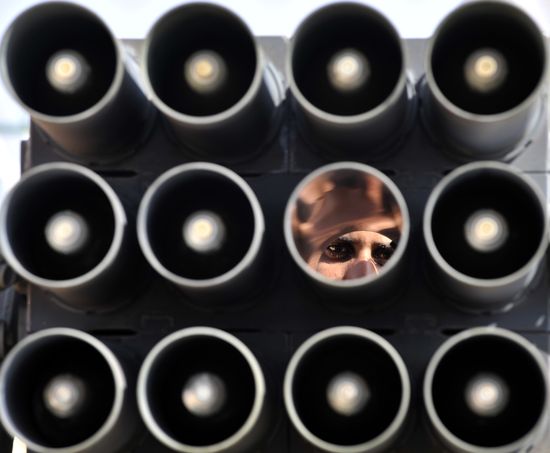
(Photo: A Libyan rebel looks though a multiple rocket launcher (MRL) on the outskirts of the town of Bin Jawad on March 27, 2011 as rebels pushed westwards in hot pursuit of Moamer Kadhafi's forces, winning back control of the key Ras Lanuf oil site and pressing on towards Kadhafi's hometown of Sirte, a central coastal city. By Aris Messinis/AFP/Getty Images.)

More Control, More Anxiety?

Jacob Sugarman interviews Taylor Clark, author of Nerve: Poise Under Pressure, Serenity Under Stress, and the Brave New Science of Fear and Cool:

Perhaps the most puzzling statistics are the ones that reveal that we're significantly more anxious than countries in the developing world, many of which report only a fraction of the diagnosable cases of anxiety that we do. One of the reasons for this is that the people in many of these third-world nations are more accustomed to dealing with uncertainty and unpredictability. I talk about this a fair amount in the book, but lack of control is really the archenemy of anxiety. It's its biggest trigger.

Peter Lawler meditates on this finding:

Is it true that more "rational control" we have, the more anxious we are?  Maybe that's because each of us is stuck with knowing how much the very future of one's own being is in one's own hands.  We're stuck with being control freaks, always calculating–nervously or anxiously–about our personal security.  We're the people least likely to relax and let God or nature take its course.

Recycling, Revisited

Staller

Kerri MacDonald reviews the work of photographer Jan Staller:

“The thing about photography is it’s like DNA,” [Staller] said. “Once one sees a photograph of something, then they tend to see the world as other people have photographed it.” He’s determined to document the remaining vestiges of the industrial age in the New Jersey landscape. His newest work, completed in late 2010, centers on recycled materials. Common motifs include grids and barriers, which suit the panoramic format.

It is a sort of accidental aesthetic. And it’s strangely beautiful.

(Photo: “Sims Recycling Center” by Jan Staller, New Jersey. 2010.)