Aging, Sped Up

Doree Shafrir had to put her dog down:

Watching a dog age comes with its own set of daily, incremental choices and changes. Her tan spots have mostly faded; she is grizzled and gray, and her eyes have the same film over them that I remember seeing in my great-grandmother’s eyes when I was a child. One day she can get up on the bed; the next day she falls, whimpering, when she tries to leap onto it, and no amount of coaxing can get her to try again. One day she stops barking when I turn the key in the lock and that is when I realize she’s losing her hearing, and at the park, when I’m not directly in front of her, she seems panicked and lost and I know she can’t see as well as she used to. She can’t make it up three, then two, then one flight of stairs.

Lee getting old reminds me of my own mortality; in her I see what it is to become elderly, to not be able to do the things you used to be able to do, to have things happen slowly, seemingly forever, and then very and irrevocably quickly. And for this I am irrationally and deeply jealous of people whose dogs die suddenly and young, because although they feel a different kind of pain, this is something they never have to face.
Neurons For Free Will

Researchers implanted electrodes in patients to track their neurons. They asked them to look at a clock and press a button, and then to tell them the exact time they decided to press the button. Daniela Schiller and David Carmel report:

[A]bout a quarter of these neurons began to change their activity before the time patients declared as the moment they felt the urge to press the button. … So it turns out that there are neurons in your brain that know you are about to make a movement the better part of a second before you know it yourself. What does that mean?

It might be tempting to conclude that free will is an illusion.

Some have believed this since the days of Libet, who recorded EEG and found it contained a specific pattern that predicted his subjects movements before they felt the conscious will to act. EEG measures electrical activity on the surface of the head, combining information from billions of neurons; Fried and his colleagues have gone further, by finding individual neurons that do this. But before reaching any sweeping conclusions, it is important to remember that this study looked at a very rudimentary kind of action. The decision to move a finger hardly ranks as the same kind of free will we exercise when we make moral choices or major life decisions.

(Video: "Ode to the Brain" is the ninth episode in the Symphony of Science music video series, featuring Carl Sagan, Robert Winston, Vilayanur Ramachandran, Jill Bolte Taylor, Bill Nye, and Oliver Sacks.)

The First Year Alone

 Julian Barnes reviews Joyce Carol Oates' A Widow's Story: A Memoir:

That both [Joan] Didion and Oates limit their books to the first year of their widowhoods is logical. Long-married couples develop a certain rhythm, gravity, and coloration to the annual cycle, and so those first twelve months of widowhood propose at every turn a terrible choice: between doing the same as last year, only this time by yourself, or deliberately not doing the same as last year, and thereby perhaps feeling even more by yourself. That first year contains many stations of the cross. For instance, learning to return to a silent, empty house. Learning to avoid what Oates calls “sinkholes”—those “places fraught with visceral memory.”

Asking Questions

Dojc

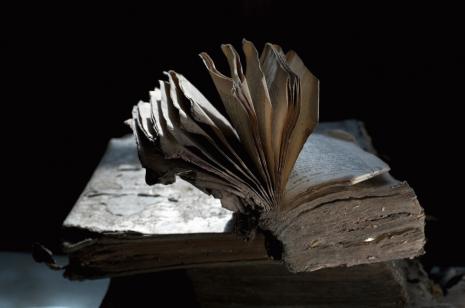
A recent study pitted students in a library against students using Google. Both groups had to answer a set of questions. Hal Varian, Google's chief economist was overjoyed at the results:

It took them 7 minutes to answer the questions on Google and 22 minutes to answer them in the library. Think about all the time saved! Thirty years ago, getting answers was really expensive, so we asked very few questions. Now getting answers is cheap, so we ask billions of questions a day, like “what is Jennifer Aniston having for breakfast?” We would have never asked that 30 years ago.

Nicholas Carr isn't satisfied:

How did the University of Michigan researchers come up with the questions that they had their subjects find answers to? They "obtained a random sample of 2515 queries from a major search engine." Ha!

Maybe the question we should be asking, not of Google but of ourselves, is what types of questions the Net is encouraging us to ask. Should human thought be gauged by its output or by its quality? That question might actually propel one into the musty depths of a library, where "time saved" is not always the primary concern.

(Photo: from the exhibit "Last Folio," by Yuri Dojc)

When Money Doesn’t Buy Happiness

In a follow-up to his post on connectedness and solitude, Wilkinson briefly discusses the "alleged Easterlin Paradox":

Why haven’t Americans become much happier even though they became much richer? I really think there’s something to the idea that the way we’ve lived and worked as we’ve  become richer hasn’t had much payoff in an increased sense of autonomy. There’s a left-wing version of this argument that stresses a sort of enslavement by false consumer desire, an imagined loss of worker’s rights, and so forth. There’s something to this. But I’m stewing up version of the argument that stresses barriers to self-employment, the debt loads and like-it-or-not rootedness encouraged by the American cult of homeownership, that sort of thing. Consider this a preview. 

The Web As Matriarchy

Aileen Lee explores why women beat men in social networking and e-commerce:

Dave Morin of Path introduced me to Dunbar’s Number, proposed by the anthropologist Robin Dunbar.  The number is the theoretical limit of how many people with whom one can maintain stable relationships (thought to be 150).  But Dunbar’s most recent research shows there are different numbers for women than men—that women are able to maintain quantitatively more relationships within every ring of closeness than men. 

Worshipping Lost Remains

Heather Pringle chronicles how the Spanish stole the Incas' sacred kings:

As the empire crumbled, the Inca and their descendants made a valiant attempt to preserve the symbols of imperial authority. Servants collected the precious bodies of the sacred kings and concealed them around Cusco, where they were worshipped in secret—and in defiance of Spanish priests. In 1559 Cusco's chief magistrate, Juan Polo de Ondegardo, resolved to stamp out this idolatry. He launched an official search for the bodies, questioning hundreds. With this information he tracked down and seized the remains of 11 Inca kings and several queens.

For a time colonial officials in Lima displayed the mummies of Pachacutec, Huayna Capac, and two other royals as curiosities in the Hospital of San Andrés in Lima, a facility that admitted only European patients. But the damp coastal climate wreaked havoc with the bodies. So Spanish officials buried the greatest of the Inca kings in secrecy in Lima, far from the Andes and the people who loved and worshipped them.

The mummified remains are still missing today.

The Race Of Adolescence

Mark Oppenheimer analyzes runners in movies and in real life:

What was it to be a cross-country runner? It was to be invisible to the rest of the school. It was to run away from school every day, through the middle-class streets of a nondescript town, nodding occasionally at townspeople, talking amongst ourselves, discussing Hamlet or fractals or Say Anything… or our coach’s legs. It was to participate in the one sport that valorizes flight rather than encounter. Runners are cowards, and cowards have a choice: they can either bulk up and become fearsome themselves, or they can learn to flee. Cross country was training in cowardice.

I preferred it to rugby, which is proof enough, I guess, of cowardice. We used to run literally away from the rugby fields, across a small road, and into the Surrey hills, often in the pouring rain. After a few hundred yards, my asthma would kick in; after a mile or so, it either cleared up, or I'd have to find shelter in the secret copse some had made into a refuge in the woods. You'd find someone there usually, smoking a cigarette or huddled over some porn. I'd catch my breath, and artfully miss a few laps around the bottom of the hill, then try and slip back into the field, without the teacher noticing. We had it pretty much down. The boys, if not the teachers, knew that Sullivan couldn't breathe, so gave me a pass.

It's still so vivid in my mind: the mud, the autumn leaves, the panicked lungs, and, in my teens, the sense of such cheerful inclusion among all these horny boys, and yet also so much silent displacement. The porn was not for me.