No Offense

Last-supper-20110322-103709

Isaac Chotiner praises Stefan Collini’s That’s Offensive: Criticism, Identity, Respect:

Treating people with respect is a fine goal, but Collini notices that respect tends to be shown with special deference to so-called “out groups.” Claims of offense that would otherwise be ignored are instead given credence and even deference. Collini also correctly identifies the people who tend to fall into this trap. Very few “progressive” forces, for example, would have shown any “understanding” of hurt Christian feelings if Jesus had been mocked in a Danish newspaper. The entire force of the argument against the offensiveness of the Danish cartoons was based on the concern that Muslims were somehow less powerful than other religious believers. But this hardly qualifies as an adequate justification for a double standard.

Michael C. Moynihan looks into the specific example:

The issue of how the Scandinavian culturati would react to “offensive” portrayals of Christians isn’t, alas, merely a “what if,” to which the answer is obvious. In 1998, some religious groups in Sweden objected to Elisabeth Ohlson Wallin’s photo collection Ecce Homo, which includes depictions of Jesus dying of AIDS, a transsexual Last Supper, and God hanging out with some leather boys. Pretty tedious stuff.

Despite the niggling fact that the exhibition was displayed in various Lutheran churches throughout Sweden, with the approval of Archbishop K.G. Hammar, the editorial pages bravely united in opposition to those demanding that the photos be removed from what was then still state churches. Almost a decade later, those very same newspapers would upbraid Jyllands-Posten, the Danish daily behind the infamous “Mohammad cartoons,” for antagonizing a religious minority. And predictably, following fashionable opinion, Ohlson Wallin denounced the Danish cartoons as needlessly offensive, claiming to see no similarity between her exhibit and the satirical illustrations.

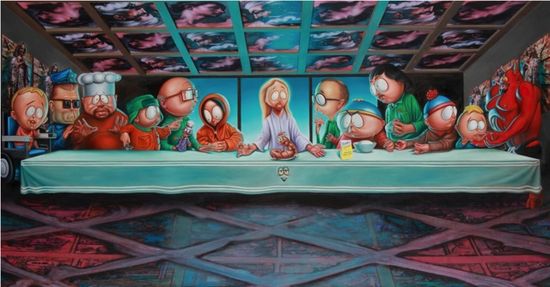
(Image: “Last Supper in South Park” painting by Ron English part of 15 artists paying tribute to the 15th season of South Park at Opera Gallery in New York City. The show runs from March 28 through April 10th.)

Humanity’s Flow

City_pict3a_custom

Krulwich admires the photography of Russia's Alexey Titarenko:

We're two-thirds water, after all. Our cells carry, "a concentration of that indescribably and liquid brew which is compounded in varying proportions of salt and sun and time." And so, like water, we flow. … People, said Loren Eiseley (and, I suppose, all living things) are water's way of escaping the seas, the air, the streams. Because human cells are little packages of moisture, of salt water, if you want a sciency metaphor, look at Alexey Titarenko's photos and see these crowds as blurry, wool-wearing tides of sea water, moving along streets, rolling in and out.

(Photo: Untitled, (Crowd 2), 1993 by Alexey Titarenko/Nailya Alexander Gallery, New York)

The Scientific View Of Man

Howard Darmstadter revisits the philosophy of David Hume after 300 years, ending with his Dialogues Concerning Natural Religion:

When we open the Dialogues today, we know how the story of design ends: with Darwin’s Origin of Species, published a hundred years later. With evolutionary theory at hand, it’s easy to see how logically flimsy the argument from design really is; but while Hume was able to demolish the design argument’s logical pretensions, he knew that he had no positive theory to offer in its stead. Indeed, our belief in God seemed to Hume to resemble our belief in the reality of the external world: we cannot adequately answer the skeptical arguments about God or external objects, but we cannot help believing in Him or them.

That is certainly my own experience. If I could disbelieve in God, I would.

The Butterfly Wings Of A Revolution

Rebecca Solnit takes the long view:

The revolution [in Egypt] was called by a young woman with nothing more than a Facebook account and passionate conviction. They were enough. Often, revolution has had such modest starts.  On October 5, 1789, a girl took a drum to the central markets of Paris. The storming of the Bastille a few months before had started, but hardly completed, a revolution.  That drummer girl helped gather a mostly female crowd of thousands who marched to Versailles and seized the royal family. It was the end of the Bourbon monarchy.

… That the flapping of a butterfly’s wings in Brazil can shape the weather in Texas is a summation of chaos theory that is now an oft-repeated cliché. But there are billions of butterflies on earth, all flapping their wings. Why does one gesture matter more than another? Why this Facebook post, this girl with a drum? … The point is not that causation is unpredictable and erratic. The point is that butterflies and sparrows and young women in veils and an unknown 20-year-old rapping in Arabic and you yourself, if you wanted it, sometimes have tremendous power, enough to bring down a dictator, enough to change the world.

(Video: 26-year-old Asmaa Mahfouz of Egypt from January 18th)

Churchill, Translated

Winston Churchill referred to his depression as his Black Dog. In Chinese, the characters for black and dog combine to form one that means "silence; quiet; speechless; mute." Neuroskeptic reflects:

This is as good a one-word description of depression as any. Churchill's metaphor has always struck me as slightly misleading in one sense (although it's excellent in others): depression is not a thing; not even a black one. It is a lack, of motivation, energy, joy, imagination; you don't wake up and feel depressed, you wake up depressed and feel terrible, but the depression is hidden, only evident in retrospect, just as you don't tend to notice how quiet it is until a noise breaks the silence.

Growing Into God

Jesse Bering recaps a new study that asked children to guess which box held a ball. Some children were informed that a doll, or "Princess Alice," would send them a sign, in which case researchers flipped a light or made a picture frame fall from the wall:

The Princess Alice findings are important because they tell us that, before the age of seven, children’s minds aren’t quite cognitively ripe enough to allow them to be superstitious thinkers. The inner lives of slightly older children, by contrast, are drenched in symbolic meaning.

Ghost Bike Memorials

3143081888_40c4554d78_o

Keith Goetzman weighs both sides to the debate:

I sympathize a bit with both the pro- and anti- camps here. As a year-round urban bike commuter, I understand the bikers’ need to mark the places where their own have fallen, and both bikers and motorists can always use more reminders to be careful out there. Nothing does that quite like the bicycle equivalent of a skeleton.

However, I confess that became firmly opposed to roadside automobile death shrines on travels through the Western United States, where they became more common than mile markers in some areas, and often unsightly: From a distance, many looked like crucifixes growing out of a trash heap. Some scenic stretches of road began to feel more like funeral routes.

(Photo by Flickr user Osbornb)

Fearing Hell, And Other Dangers

Daniel Treisman ponders the connections:

[I]t seems nonsensical that in countries where more people believe in hell, more would also admit to worrying about the safety of genetically modified food. What connection could there be between these two things? It is certainly possible that the association I found occurs purely by chance.

But it is part of a more general pattern. It turns out that in countries where more people worry about genetically modified foods, more also worry about contracting mad cow disease and avian flu and about being injured by a serious medical error. In these countries­—such as Italy, Greece, Cyprus, and Lithuania—people appear to have a predisposition to fearfulness that manifests itself with regard to a variety of perceived dangers. In others—­such as Sweden and the Netherlands­—respondents express relatively low levels of fear, whatever the danger in question.

A Nuclear Ruin Is Being Born

Chernobyl

Morgan Meis marks the strange moment:

A cathedral is designed with the idea that it should stand, and function, for a very long time — perhaps beyond time. A nuclear power plant is designed with the knowledge that it must become a ruin, and rather quickly. It is born to die, and then to sit as a corpse, a testimony to the strange and unsettling function it once had. …

A "zone of alienation" — as the Soviets dubbed the area around Chernobyl — is being created in Japan around Fukushima as we speak. A portion of the planet is being cordoned off and removed from the space-time continuum the rest of us inhabit. In a few months it will be a ruin, too, as old as the oldest places we know, lonely and uncanny in its suspended state, preserved as a living relic to the present we are still making.

(Photo: Still from “Chernobyl”, a video installation by Los Angeles artist Diana Thater)