Of Gods And Wars

J. Peter Nixon views Libya through a religious lens:

[W]ar—particularly modern war—represents the height of human pride and arrogance, an arrogance that forgets that God is God and we are not.  Rather than being fought over territory or to settle rival dynastic claims, modern wars are increasing fought to shape the course of History itself and to usher in some form of utopia, whether communist, fascist, or liberal-democratic.  They are a form of eschatology masquerading as politics.

A Poem For Sunday

 110681220 Sam Tanenhaus examines disaster poetry:

[C]atastrophe defies logic. It faces us with disruption and discontinuity, with the breakdown of order. The same can often be said of poetry itself. It operates outside the realm of “logic.” Rather, it obeys the logic of dreams, of the unconscious. This is especially the case with lyric poetry, with its suggestion of vision and prophecy.

“The Second Coming,” by W. B. Yeats seems most apt.

(Photo: A man holds a portrait of Libyan leader Moamer Kadhafi as he stand in the wreckage of the Boussetta Libyan navy base on March 22, 2011, the day after it was bombarded some 10 kilometres east of Tripoli center. By Mahmud Turkia/AFP/Getty Images)

The Endless Debate About Porn For Women

  Boinot

Tracy Clark-Flory explores the largely untapped market and the main problem therein:

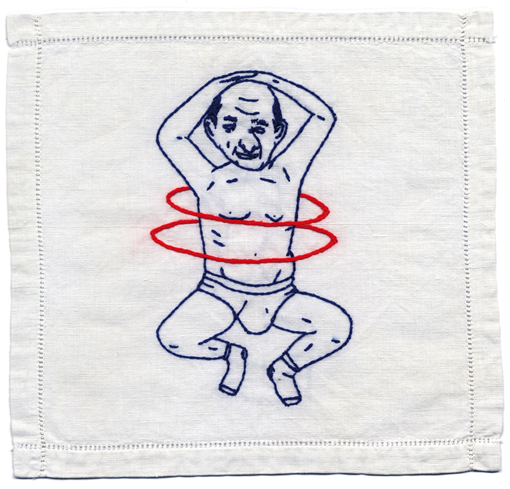
Physiologically, we respond strongly to videos of gay sex, lesbian sex, straight sex and even monkey sex, but our subjective arousal is a separate, though sometimes intersecting, issue. … Every woman has a different definition of "porn for women" based on her own finicky desires. There might be some common requests — like more kissing, more narrative — but those things are highly subjective. Inevitably some women will complain that there's too much kissing and too much narrative — which is how I've felt about most of the "porn for women" that I've seen. The debate continues because there isn't a single answer to the question — but we so badly want there to be. It sure makes for a nice fantasy.

(Image: Broderies by Isabelle Boinot)

Examining Our Gaze

Keith Miller reviews four new books on beauty:

There have been certain identifiable refrains in Western writing on beauty. One is that it must be apprehended disinterestedly: that you have to step back from the pleasure part, or rather sternly set aside the liking for pleasure we usually call desire. Beauty should somehow be its own reward rather than something which stimulates or satisfies an appetite for something else. This is easier said than done: Greek statues perturbed Kant sexually; Dutch still lifes made Schopenhauer feel hungry. Love comes in at the eye, says Yeats in “A Drinking Song”, echoing the Neoplatonists of fifteenth-century Italy; and so should beauty, engaging nothing of us below the neck, let alone the waist.

The Urge To Scrawl

Baloonfb-thumb

Chris Wright finds value in ancient graffiti:

The sexual boasting, the political griping — if it weren’t for the cryptic-sounding names and the strange syntax, you could be reading this stuff on the benches of the Harvard Square T. And then there’s this, more than 2,000 years old, etched into a wall in the Villa of the Mysteries in Pompeii: “Rufus est.” This is Rufus.

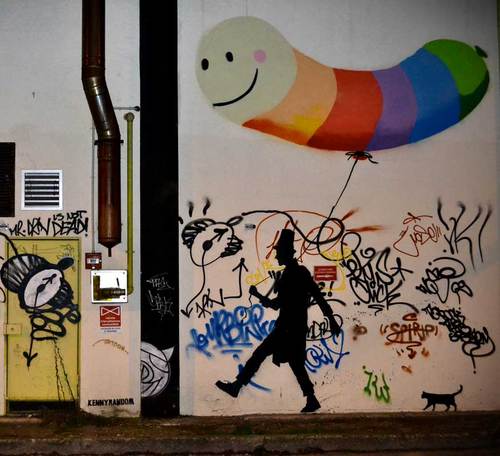
Susan Farrell, who oversees the website www.graffiti.org, says that the underlying motive for all graffiti writers is “the urge to make a permanent mark during an ephemeral life.” This fact is as true of the wall-scratcher Rufus as it is of the kids in Sao Paulo who climb railroad bridges to spray paint their elaborate tags. “I think of it as the need for meaningfulness,” says Farrell, “which I believe is a basic human urge.”

(Photo by Kenny Random)

Brokers Of Our Own Attention Span

Rob Horning wonders about the attention economy:

My RSS feed demands more from me than a newspaper, because I’m responsible at a meta level for what information it brings me; before, my decisionmaking would end with the decision to buy a paper. Now I have to tell myself I have enough, even as the culture tells me that in general, too much is never enough, and “winning” is having more. As a result, I start to feel cheated by time because I can’t amass more of it. I become alienated from it rather [than] inhabiting it, which makes me feel bored in the midst of too many options. The sense of overload is a failure of our focus rather than the fault of information itself or the various media. Calling it “attention” in the contemporary sense and economizing it doesn’t repair focus so much as redefine it as a shorter span, as inherently fickle and ephemeral.

“The Stakes Fuel The Block”

Laura Miller studies the roots of writer's block:

First proposed by two psychologists in 1908, [the principle of Yerkes-Dodson Law] holds that the more "aroused" (i.e., engaged and challenged) a person is by a task, the better he or she performs, up to the point that the arousal becomes anxiety or worry, at which point performance declines. In other words, beyond a certain point, the more difficult a writing task, and the more you think it matters, the more likely you are to become blocked. This may explain why journalists with, say, two deadlines per week almost never get blocked: no individual story ever has to carry that much weight.

A Poem For Saturday

Spirit

"Verisimilitude" by Stanley Plumly appears in this month's issue of The Atlantic:

Very similar, very simile—
a smile, a gesture, a mark on the air
to wave hello, goodbye, to throw a kiss
across the rainbow distances. “The word love,”
writes syphilitic Paul Gauguin, in his journal in Tahiti,
“I’d like to kick whoever invented it in the teeth.”
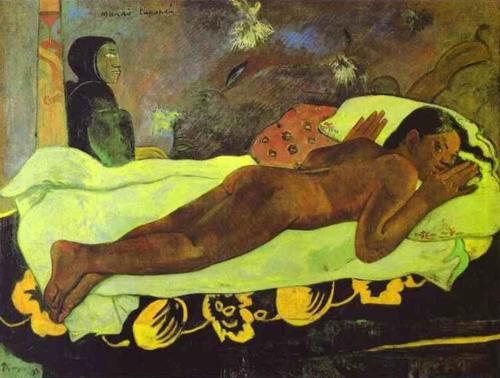
Gauguin the realist in paradise, painting
cinnamon women in native floral outlines
in real two-dimension, beautiful flat faces.
Then the counterargument: Plato’s homely metaphor
of how, in our first life, we were whole,
male and female, but cut in half
by gods no less fearful than Gauguin,
the way we cut eggs in half with a hair,
the eggs hard-boiled, the hair the thread of a tailor.
When is a thing not like another thing,
like the split sweet heart of an apple?
We’re so filled with absence,
or as Yeats, after Porphyry, puts it,
the “honey of generation,” no wonder we stand
in the street at night, half or wholly drunk, shouting.

(Image: Manao Tupapau (The Spirit of the Dead Keeps Watch) by Paul Gauguin, 1892)

Gaming For Godot

Salvatore Pane interviews Mike Rosenthal, creator of "Waiting For Godot":

Taking all the fun out of a game is funny.  Basing a game on a play where nothing happens is funny.  And people played it!  One guy told me he made it to the surprise at level 99.  That still amazes me.  What a great guy.  I mean, I can barely make it to level 99.  The game is pretty difficult in a way, but rather than testing your reflexes, it tests your patience.