Today on the Dish, Andrew raved about the "Book Of Mormon," weighed in on homophobia's evolutionary roots, and countered Damon Linker on the fascistic undertones of neoconservatism. Andrew defended the duty of opinion bloggers to take a stand and cheered the unbelievable Arab Spring and the real American exceptionalism being helmed by Obama. NATO is taking control of the no-fly zone, Babak Dehghanpisheh visited a Benghazi prison camp, and Andrew debated Scoblete about whether Bill Kristol really believes Iraq was a victory. Larison challenged Kristof on humanitarian gains, Liz Sly expanded on Qaddafi's supporters, and the unrest in Syria spread. Andrew followed this week's violence in Israel, and the resultant neo-fascist laws. Frum outed Al Qaeda as being mobile, Newt blathered on, and Freddie DeBoer reminded us that this war will never be the last time we play sheriff.
Andrew called out Palin on her mixed David and Goliath metaphors, and Michelle Bachmann inched closer to the Washington elite. The Catholic tides shifted, the US Hispanic population surged, Scott Morgan tracked the emerging cannabis markets, and J.F. at DiA grappled with drug courts for addicts. Kate Sheppard mapped nuclear danger zones, Helen Epstein tracked the political problem of malaria, Haiti beat Japan in donations, and Dave Roberts contemplated the harder virtues to celebrate. Barry Eisler opted to self-publish for more money, history turned us on, grammar made us laugh, and Hitchens was always two steps ahead. Readers dished on Pawlenty's Minnesota disappointments and rebutted Paglia on today's curvy women, and Andrew tube-crushed. Money made rich people sad, baldness made Andrew exotic and erotic, and unlike mole rats, humans need to be alone sometimes.
Classified ad of the day here, creepy ad watch here, quote for the day here, VFYW here, MHB here, and FOTD here.

Ventura, California, 8 am
Thursday on the Dish, Andrew deconstructed the divisions on the right's foreign policy, Wilkinson weighed the suffering factor in Libya, Julian Sanchez connected Bush and Obama on universal morality, and Andy Bacevich concentrated on removing Qaddafi. Andrew began to understand his pessimism as stemming from the Irish belief in Sod's law, and wondered if Obama had meep-meeped him again. Larison abandoned hope for an anti-war right and theorized why Germany didn't veto the UN resolution, and Rory Stewart stuck it to both pro and anti-interventionist sides. Ackerman wanted us to call the war in Libya a war, Adam Garfinkle critiqued our slipshod strategy, and Fox battled CNN on the other Libyan front. A new report outlined the torture under Bush as a form of warfare, rather than an attempt to stop a ticking time bomb, and Heather Hurlburt distrusted the Libyan endgame. Misurata took a turn for the worse, the rebel force is smaller than expected, and Libya isn't WWII. Twenty thousand may have marched in Syria, Assad may be caving, but the violence ratcheted up.
Catholics favor gay marriage (even the ones who attend church weekly), and Andrew held out hope for a change in DOMA and immigration policy. Andrew soaked up the results of the Coalition government's austerity measures, Nick Clegg left his mic on, and Andy Sumner examined international poverty. A straight, Catholic Republican student in Indiana supports gay marriage, Pareene got giddy over gay Republican candidate Fred Karger, and readers didn't underestimate T-Paw. Julian Sanchez pondered copyright and Google Books, Caitlin Truman endorsed euthanasia for the dead relationship, and a judge grappled with sentencing based on numbers alone. LSD confronts you with yourself, Arizona brought a tank to stop a cockfight, Dana Goldstein admired a charter school's dedication to diversity, and Andrew was off to celebrate the new pro-faith show of "Book Of Mormon." Groupon offered solutions for being hungry or bored, Camille Paglia praised Liz Taylor's body, and Lileks found a man who'd never heard of an iPad. A paywall is less humiliating than a pledge drive, and this doctor wanted to solve your symptoms the tech way.
Chart of the day here, quotes for the day here, here, here, and here, VFYW here, MHB here, and FOTD here.
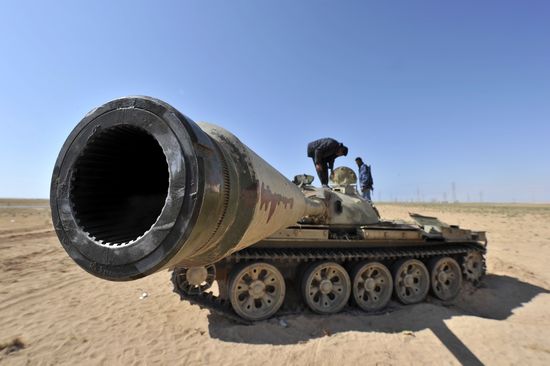
By Aris Messinis/AFP/Getty Images
Wednesday on the Dish, Andrew urged Obama to avoid leadership and to let Sarko own it, while questioning the very nature of the uprising in Libya. Andrew chastised those who would support this war as if Iraq never happened, reacted to the Obama Undoctrine of pragmatism, and Ezra Klein went after Wieseltier. Qaddafi supporters scared us more than Fox News, Stephen Budiansky understood the military's limits in tactical regime changes, and Andrew called bullshit on "logistical contributions" from Kuwait and Jordan. Readers differentiated between Libya and the Greek War for Independence, and the Arab League's bets could backfire. Adam Rawnsley decoded "Operation Odyssey Dawn," Qaddafi exposed himself, and Syrian crackdowns escalated. Matt Steinglass characterized the vague goals of "winning" as being intentional on the administration's part, and a dispatch from Misurata praised the positive effect of the strikes. The kidnapped NYT reporters recounted their harrowing tale, while the NYT still refused to call what we do at Guantanamo torture. The Tea Party turned nationalist for the Libyan war, Gingrich flip-flopped, and Matt Larimer questioned how the GOP morphed into the party of perpetual war.
Palin skirted the shores of Jews For Jesus, illegally fished for life, and Andrew guffawed at Janet Malcolm's review of Sarah Palin's Alaska. Huckabee challenged Pawlenty on being the most anti-gay candidate there is, and conservatives cooed over non-procreative marriages of old people as long as they weren't gay. GDP output exploded, tax fundamentalism ruled the GOP, and a town paid rent on an empty Borders store. A Mexican police chief tortured to curtail the corruption, and new nuclear reactors are built smaller. Bloggers debated final chapters, HuffPo landed Balko, and a reader explained that the BBC isn't free. Lewis Black cautioned everyone over smallpox, the gallows humor kept rolling in, and Christians pole-danced for Jesus. People envy their neighbors more than millionaires, policies change when rich opinions do, and Scott Adams taught us how to fall asleep. Readers called us on our frog necrophilia, and Andrew marveled at a new model for Ken the ideal boyfriend, Kurtis Taylor, a mountain of mocha muscle.
Tweet of the day here, quotes for the day here, here, here, how to have a rational discussion here, cool ad watch here, VFYW here, MHB here, and FOTD here.

By Eric Feferberg/AFP/Getty Images.
Tuesday on the Dish, Andrew magnified Frum's examination of why Obama didn't ask Congress for approval, and examined his own scars from Iraq and the last ten years. Obama promised a hand-off soon(ish), and Andrew praised Egypt's huge steps towards democracy. Bill Kristol loved war, Obama supported most US military interventions, Romney didn't like nuance, and Douthat didn't defend Bush. Larison feared we were encouraging weak rebellions, Tom Ricks demolished the idea of an exit strategy, and Freddie DeBoer skewered the colossal arrogance of any interventionist logic. A reader tracked Joe Biden's role in the resolution, and Dylan Matthews policed Leon Wieseltier's fight with Ezra Klein. A reader offered 1831 as a better example than Arab 1848, and Andrew wished for Secretary of State John Quincy Adams' response. Libya adventure has already cost more than the discretionary spending cuts desired by the GOP, Reihan considered the astronomical costs, and rebels ate Snickers.
Palin skipped the West Bank possibly because she forgot it isn't part of Israel, broke the rules and offended the Republican Jewish Coalition, and a reader berated her for sporting a Star of David. We sized up Pawlenty's presidential bid, Johann Hari interviewed Gideon Levy, and Charlie Chaplin narrated events in the Middle East. The Economist tallied Japan's earthquake damage as the costliest ever recorded, Richard Posner considered the politics of unlikely disasters, and since no one has gotten a lethal dose of radiation from this nuclear meltdown George Monbiot now supports nuclear energy. Readers skirted the NYT paywall and offered other fundraising alternatives, Timothy B Lee wanted to support real reporting elsewhere, and Andrew posed questions behind a paywall. The Argentine military stole babies in the 1970s, Andrew was grateful for modern medicine, and the week's news was too much for some. Politicians lagged behind public opinion in Indiana on gay marriage, Meghan bought a house to live in, and healthcare opinions haven't changed. Katie Roiphe wrote recommendations for 18-month olds and real talent requires grit.
Cool ad watch here, question of the day here, answer here, chart of the day here, headline of the day here, Yglesias award here, quotes for the day here, here, here and here, map of the day here, FOTD here, MHB here, and VFYW here, and VFYW contest winner #42 here.
Monday on the Dish, Andrew considered this war's effect on Jihadism, and historic predecessors like British Foreign Secretary Lord Palmerston who exercised restraint in aiding others' democratic movements. Chait, Klein and Andrew asked why intervene this time, Goldblog's jaw remained dropped, and the right sniffed Obama's blood in the water. Andrew couldn't get behind Marc Lynch's argument that Libya determines how other dicatators act in the Middle East, PM Carpenter believed in Obama's character, and Ambinder parsed Clinton's developing doctrine. John Lee Anderson interviewed one of Qaddafi's fighters and shook hands with the rebels, Issandr El Amrani questioned the non-violent intentions of Libyan rebels, and Megan Scully and Exum calculated the cost of this war. Andrew meditated on the tao of Derb, Peter Beinart reminded us we can't control the rebels, Manzi warned of an international arms race, and insurgencies started. The African Union and Putin echoed the Arab League, the UAE balked, and the British split, confused over Resolution 1973. Weigel didn't foresee a congressional vote, Yglesias demeaned the "better than Iraq" yardstick, and David Boaz missed the anti-war movement in lieu of an anti-war president. Public support dwindled, Tripoli quieted down, and Alan Taylor viewed the war through the photographer's lens. Yemen's regime may be approaching an end, and Steven L. Taylor saw Libya as an incentive for dictators to go nuclear. Frank Gaffney jumped from Libya to Israel, and Palin plastered herself with Israeli flags.
Seth Masket compared Japan to New Orleans, we viewed the tsunami from a boat, and XKCD charted radiation dosages. Schools traded calories for IQ points, Simone Eastman bemoaned being the poster couple for gay marriage, and Freddie DeBoer wondered why a longread on gentrification didn't feature any poor people. Readers fell on opposite sides of tasteless jokes, medical workers shared tales of laughter in hardship, and Felix Salmon argued the paywall will prevent people going to the NYT in an emergency. Andrew 80's-gasmed, and the arms trade landed in stoners' hands.
Billboard of the day here, quotes for the day here and here, nit-pick of the day here, chart of the day here, Malkin award here, MHB here, FOTD here, and some pure joy here.
–Z.P.

 The Dish