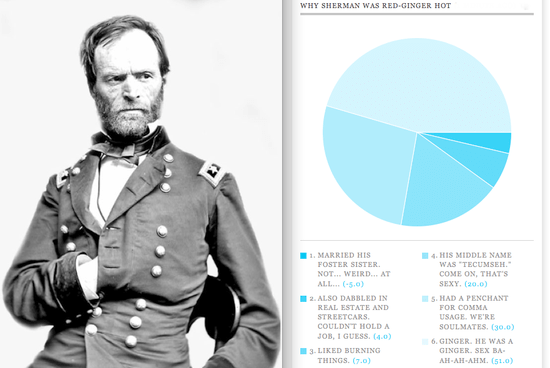
Drew Grant interviews Megan B, founder of the blog Bangable Dudes In History, on which era has the sexiest historical figures:
The Civil War, for sure. I think it might have something to do with all that facial hair and the monochrome uniforms.
Drew Grant interviews Megan B, founder of the blog Bangable Dudes In History, on which era has the sexiest historical figures:
The Civil War, for sure. I think it might have something to do with all that facial hair and the monochrome uniforms.
A reader writes:
You wrote, "Gender is at bottom biological, based on different hormones at different stages of development. There's no social constructionism in the womb. After that, social norms obviously have their say – but within the boundaries of biology." I'm thinking you're confusing sex with gender.
Replace the word gender with sex in the above sentence and I would totally agree with you. But my years of work as a psychotherapist with transgender folks have utterly convinced me that there is indeed a difference between biological sex and subjectively understood and experienced (as well as socially constructed) gender. It's a small point, but one I thought worth making.
Another writes:
I think, in discussing Paglia's misguided critique of modern sexuality (Hollywood doesn't like big breasts and asses, really?), you may have stumbled upon a real issue in modern femininity. It is no coincidence, I don't think, that Paglia chose two older actresses to point out the supposed waif-like ideals of modern sexuality. However easy it is for her to ignore the Christina Hendricks and Scarlett Johansens of the modern world, she does have point – the actresses she mentions are skinny. Even the once-plump Julianne Moore is now thinner than she ever has been.
The reason seems to be that as an actress gets older, starvation is one of the primary ways she's able to keep herself "acceptable" to mass audiences. Angelina Jolie, once the queen of voluptuousity, is now thinner than a deck rail. And who could forget the now-infamous Madonna arm photos? This is what has become of "aging gracefully," and it is indeed a cause for concern.
Eyal Press surveys opinion among the youth in Israel:
[Y]oung Arabs, who are often portrayed in the Israeli press as implacably hostile to the country’s ideals, support principles such as “mutual respect between all sectors” in higher proportions than their Jewish counterparts (84 versus 75 percent). …
“Maybe it’s not a surprise that the minority in any country is very supportive of democratic rights,” says [public opinion analyst] Dahlia Scheindlin. “But it does seem ironic that in the Jewish State, which insists on defining itself as the Jewish democratic state and the only democracy in the Middle East, the Arabs are our most democratic citizens.”
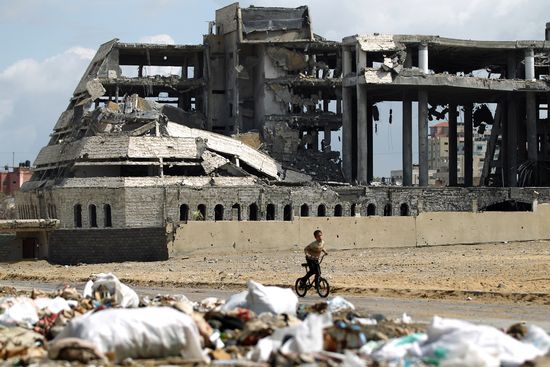
(Photo: A Palestinian boy rides past the Hamas Prime minister Ismail Haniya's destroyed office in Gaza City, on March 25, 2011, as Israeli aircraft attacked four targets in the Gaza Strip during the night, lightly wounding three people, in response to Palestinian rocket attacks on Israel. By Thomas Coex/AFP/Getty Images)
Freddie DeBoer counters a Dish reader:
The important part of this email … reflects the general tenor of the conversation: that, somehow, this latest action will be the last one. That, after this, we get out of the sheriff business. And what I want to tell you is: we will continue to do this, over and over again, and every bit of historical evidence supports me.
Look at the last several decades; we intervene again and again and again, bringing weaponry to bear wherever and whenever we please, providing our bountiful justice for more and more of the world’s people. Look at the recent history; what possible argument can be made that this behavior will not continue? There is no such argument. We’ve just endured a series of events that should have made intervention in an internal conflict in a Middle Eastern nation harder than at any other time; we jumped into a Libyan civil war without even talking about it. Your country is in the world policing business, and the continuing canard that this intervention represents some sort of a unique one-off or a last dance is fraudulent on its face.
Well, the US will run out of money some time. Perhaps then it will draw down its military.
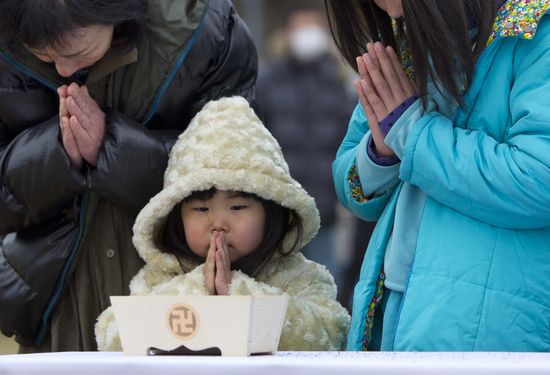
Families and relatives of the dead pray as they identify their family members at a temporary burial ground on March 25, 2011 in Higashi Matsushima. Under Japanese Buddhist practice, a cremation is the expected traditional way of dealing with the dead. But now with the death toll so high, crematoriums are overwhelmed and there is a shortage of fuel to burn them. Local municipalities are forced to dig mass graves as a temporary solution. Two weeks after the magnitude 9 earthquake and tsunami struck Japan, the death toll has risen to 10,000 dead with still thousands missing and the expectation is that it will end up well over 20,000. By Paula Bronstein/Getty Images)
Israel's headlong descent into extremism was not helped these past few weeks by a hideous, ghastly murder of a settler family occupying the West Bank, more missiles from Gaza and a bomb in Jerusalem after many years of relative calm there. Nonetheless, the growing backlash seems almost designed to facilitate even more embitterment among Palestinians in Israel and in their occupied country:
The new law allows the Finance Ministry to remove funds from municipalities or groups if they commemorate Independence Day here as a day of mourning or reject Israel as a Jewish and democratic state. The original bill, which produced much alarm and was altered, would have imposed prison sentences.
The second new law that has drawn criticism from the left establishes admissions committees for small communities in the Negev and Galilee, areas with large Arab populations. The new law says that communities with 400 or fewer families may set up committees to screen potential residents for whether they fit in socially. At the last minute, a rider was added barring discrimination based on race, gender or nationality, but critics contend it will still serve to keep Arabs out of Jewish communities.
These neo-fascist laws have been promoted by the fanatic, Danny Danon, who, naturally escorted Sarah Palin around Israel.
On Libya, I wrote that "a blogger has to take a position, even if not make a decision." James Downie dissents:
No, bloggers do not have to take positions. There is no law or principle that requires writers to say, no matter how much or how little expertise they have, "This is what should be done. This is the right thing to do." One could argue, perhaps, that taking no position is a position in itself, but then "no position," "I don't know what to do," and "I am not too sure" are positions all too rarely taken.
In the same way that everyone can give advice to friends without telling them what to do, bloggers and pundits (and commenters, for that matter) can observe and opine while leaving the positions and decisions to those actually carrying out the actions. "The credit belongs to the man who is actually in the arena," as Theodore Roosevelt said, because they are the ones who have to take positions, in order to make choices. The rest of us have the good fortune to avoid that burden. We do not need to force positions on ourselves.
Andrew Sprung finds Downie's argument "refreshing" but incomplete:
In a democracy … all of us are arguably 'in the arena' to at least a limited degree — in fact, each of us to the degree we choose. If you vote, you undertake to judge elected officials' actions — though not every action individually, and not right away. That's the job of the elect(ed), as Downie points out. Moreover, our judgment on any given issue is — and should be — informed by our evolving judgment of our our elected leader's judgment.
I guess my view is a personal one. I regard this blog as a constant bur to figure things out. As an opinion writer, it seems to me a professional duty to tackle issues in real time the way politicians responsible for them have to. Otherwise you can lapse into vague commentary to save yourself any embarrassment or error. A columnist has a few days to figure things out. On some questions, I have a few minutes, or a few hours. At least, that's how I distinguish blogging from other forms of opinion writing. It happens now. And now never ends.
By all means, change your mind, as I do from time to time, as events and facts change and as perspectives shift. But also take a position – with caveats, sure, with conditions, fine. But take one.
J.F. at DiA supports drug courts, i.e. courts that "take arrested addicts and put them in intensive, supervised treatment rather than prison". Nevertheless a new report gives him pause:
[T]he [Justice Policy Institute] report [pdf] points out some real problems with drug courts, the most troubling of which is that they have been shown (in an admittedly small sample) to encourage arrests. Community-based treatment (that is, free treatment for poor addicts that does not involve being arrested) is hard to find; cops arrest addicts to get them the treatment they need, and they end up entangled in the criminal-justice system, often with a felony conviction, a record of which stays with them even when the charge has been formally expunged.
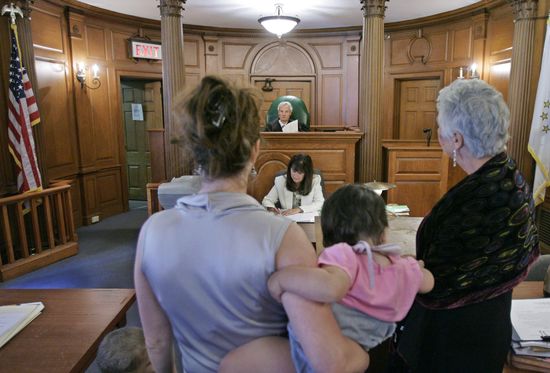
(Photo: Adult drug court Magistrate Gordon M. Smith listens to a statement from Heather Lanphear, of Charlestown, R.I., front, as Lanphear holds her one-year-old daughter Samantha during court proceedings, in Providence, Rhode Island. By Steven Senne/AP)
Will Wilkinson, Mike the Mad Biologist and Jeremy Yoder have all taken issue with a recent post by Jesse Bering. Bering revisited Gordon Gallup's 1983 research which attempted to find an adaptive, or evolutionary, explanation for homophobia. Gallup's basic point:
In its simplest form, parents who showed a concern for their child’s sexual orientation may have left more descendants than those who were indifferent.
Yoder's main problem:
[Gallup] hypothesized that treating homosexuality as taboo helped to prevent homosexual adults from contacting a homophobic parent's children, which would reduce, however slightly, the prospects of those children growing up to be homosexual, and ensure more grandchildren for the homophobe.
Gallup supported this adaptive hypothesis with … evidence that straight people were uncomfortable about homosexuals coming into contact with children. Here's the opening sentence of that paper's abstract:
In a series of four surveys administered either to college students or adults, reactions toward homosexuals were found to vary as a function of (1) the homosexual’s likelihood of having contact with children and (2) the reproductive status (either real or imagined) of the respondent.
If you've noticed that this doesn't mention evidence of heritability or a fitness benefit to homophobia, that's not because I left it out—that's because Gallup's work contains no data to support either.
Bering defends himself:
But, and I’ll stand by this claim, with the possible exception of artificially populated communities such as certain neighborhoods in San Francisco, there is not a single human society on this planet—and there probably never has been, even in ancient Greece, even among the Sambia of New Guinea—where two men can share a romantic kiss and embrace, especially in the presence of children, without meeting palpable disapproval. …
I, for one, would like to know why this aversion to gay people is, always has been, and always may be, so endemic to our species. Evolved social biases—in whatever form they take—can only wither away the more by shining a mercilessly bright light of science on them. If this reveals unsavory blemishes, such as the stereotype that gay men are pedophiles, so be it. Some are—and as Blanchard’s data reveal, homosexual males are in fact overrepresented in this category. Most aren’t. As I’ve said before, data don’t cringe; people do.
But why could it not be simply the universal human suspicion of the other? Like racism or anti-Semitism, homophobia springs from the same roots of in-group defense. Moreover, the relationship of this xenophobia to children is easily expained, it seems to me, without having to find an evolutionary explanation. The deepest smear against gay people is that they molest children, just as Jews were also long seen as a threat to children. This means the xenophobia is very extreme in both case – in some ways murderously so. There's a reason gay people were a small but real part of the Holocaust. Germans were protecting their youth from blood-sucking Jews and butt-fucking homos.
I agree that homophobia will always be with us, to which I say: bring it on. Why should I care? I also agree that many parents don't want gay kids, for a variety of reasons, not least of which a lack of grandchildren. That's also explanation enough for me.
But homophobia is only genetic in the same way racism is. People hate people from other groups. And everyone hates the Jews and the fags.
"That's staggering to think I am a gay man and I give college girls orgasms," – Dan Savage, from a Nightline profile.
 The Dish