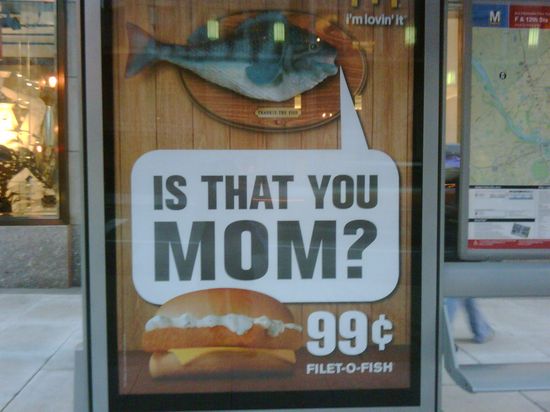
Alone Among The Hypersocial Beasts

Will Wilkinson ponders our place in the animal kingdom:

[W]e aren’t like naked mole rats, or bees, or ants. We’re the hypersocial animal that, every now and then, needs some “me time”, that slams its bedroom door and screams “Why can’t you just leave me alone!” at its mom. Mole rats don’t walk off the job because they feel humiliated by the boss. No bee on with a backpack and Eurail pass ever burdened a Moleskine with the immortal line: “What am I looking for? Probably myself.” 

In humanity, there is personhood. And in personhood, there is separateness, and our separateness is important to us.

This is surely the flipside to Brooksism. In America especially, where the wilderness has always beckoned to the adventurer, the individual endures.

The Obama Effect

Those who accuse him of "weakness" are living in past paradigms. And little wonder, since most of them grew up in a different paradigm. But soft power matters as much as hard power in promoting US interests and values. And on that score, the promise of Obama's election (that I argued for here) is being fulfilled:

Usleadership

Ezra notes:

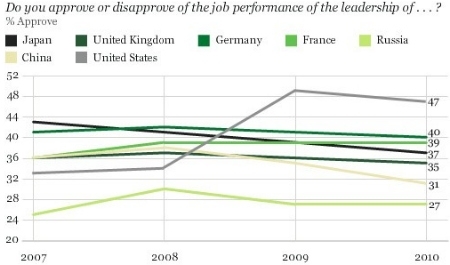
In 2007, the world preferred the bureaucrats running the authoritarian Chinese government to the people in charge of the American government. Today, they don’t. In fact, they don’t prefer the leadership of any major power to ours.

That kind of American exceptionalism – based on reality, not theological myth – is the kind of exceptionalism we should be cheering on.

Yes, Al Qaeda Is Mobile

David Frum points to the core incoherence of US anti-terrorism policy:

Q: Wait a minute. You just mentioned Somalia as a place where al Qaeda operates. If Libya breaks apart, could al Qaeda find a home there?

A: Yes indeed. When Iraq descended into civil war, local Sunni radicals organized themselves into an al Qaeda of Iraq. Many Libyans traveled to Iraq to fight with them, against the Americans. So yes, the potential is there.

Q: That would be a big, big problem, wouldn’t it?

A: You mean to have al Qaeda terror cells operating in a huge, disorganized territory a short boat ride across the Mediterranean from Italy? Yes, that qualifies as a huge problem.

Q: Is it possible that we have defined our strategic problem incorrectly? President Obama has put 100,000 Americans into Afghanistan in order to deny al Qaeda a base in that one country. But maybe our strategic problem is to deny al Qaeda a base in any country?

A: You could put it like that.

Q: Which would mean that concentrating so much American force in one place — and such a remote place — risks missing larger and nearer dangers in places like Libya and Yemen?

A: The usual answer to that is “We can walk and chew gum at the same time.”

Q: Is that a good analogy?

A: No.

Qaddafi’s Supporters, Ctd

AP100323018968

Liz Sly provides more context:

Libya’s role as a sparsely populated, oil-rich state may go some way toward explaining why Gaddafi has been able to retain the support he has. Libya is nearly twice as big as Egypt, yet contains less than one-tenth as many people. Per capita incomes are more than double those in Egypt, where a successful revolt last month inspired Libyans to take to the streets. The government funds generous social welfare programs that include free education and health care, helping keep at bay the poverty that has fueled discontent elsewhere.

Moreover, he said, the powerful tribal structure that forms the backbone of the government has remained behind Gaddafi, despite initial reports in the early days of the uprising that powerful tribal leaders had defected. Gaddafi has apparently been helped in this regard by making good on a pledge to distribute weapons.

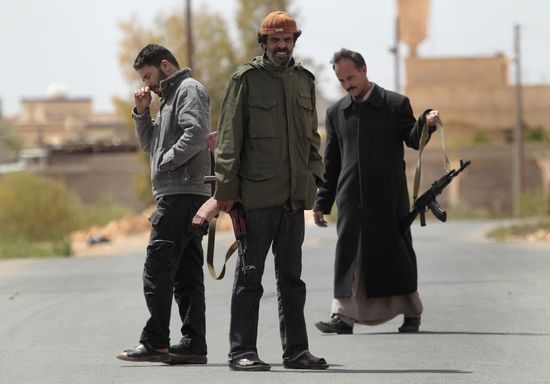
(Photo: In this image taken during an organized trip by the Libyan authorities, Libyan supporters of Moammar Gadhafi are seen with their new weapons in Ban-Waled, home of the Warfallah tribe, 160kms (100 miles) south east of Tripoli, Libya, Wednesday March 23, 2011. International airstrikes forced Moammar Gadhafi's tanks to roll back from the western city of Misrata on Wednesday, giving respite to civilians who have endured more than a week of attacks and a punishing blockade. By Jerome Delay/AP)

The Politics Of Malaria

Helen Epstein has an article (gated) in Harper's on the subject. Laura Freschi summarizes:

Recent anti-malaria campaigns like that of the Global Fund to Fight AIDS, Tuberculosis, and Malaria, are similarly “predicated on the optimistic notion that fighting malaria is easy;” that if we can just distribute enough insecticide treated bednets, malaria will become a thing of the past. But [Helen] Epstein’s main takeaway is that malaria is ultimately a political problem as much as a medical one, and “local politics, rather than the charity of outsiders, determines how successfully it can be controlled.”

The Triumph Of “The Book Of Mormon”

The-book-of-mormon-slice-01

Ben Brantley delivers a rave review after the opening night I am still recovering from:

This is to all the doubters and deniers out there, the ones who say that heaven on Broadway does not exist, that it’s only some myth our ancestors dreamed up. I am here to report that a newborn, old-fashioned, pleasure-giving musical has arrived at the Eugene O’Neill Theater, the kind our grandparents told us left them walking on air if not on water. So hie thee hence, nonbelievers (and believers too), to “The Book of Mormon,” and feast upon its sweetness.

That word "sweetness" does not spring to mind when you think of Eric Cartman serving Scott Tenorman's parents to him, like Titus, in the classic "Scott Tenorman Must Die". But the real genius of Parker-Stone is precisely the underlying humaneness of their view of the world, packaged in surreal, scatological, obscene and invariably hilarious scripts and performances. South Park episodes rarely end without reconciliation. And The Book Of Mormon – while wildly blasphemous – becomes by its end a loving celebration of religious faith, stripped of its obsessive logical contradictions, idiotic neurosis and literalist and fundamentalist certainties. Rule 23 versus Rule 72 in Utah becomes "Fuck You God In The Cunt" in Uganda. The comedy inherent in juxtaposing desperate black Africans with earnest white Americans never quite distracts us from the message underneath.

That is not so say that Matt and Trey are proselytizing. They are merely judging faith by its actions, and judging Mormonism by Mormons. We need a higher calling, they seem to say as an empirical observation; we need a grander narrative; and if religion can do that, and bring compassion to the world, why should we stand in the way?

The innate small-c conservatism of the duo endures. This is an almost classically traditional musical score, each song unique, but united and woven together in show-stopping finales. Their blend is of subversive material filtered through tradition and sincerity. There is no cynicism here. Yes there is General Butt-Fucking Naked. There is an African woman called Neosporin. There is a fantastic send-up of Bono; a lovely dig at Johnnie Cochrane; some rudely sodomized frogs; and a baptism that sounds like sex. But there are also moments of unexpected poignancy, as when an African woman discovers that she has in fact been deceived.

It is the best thing they have ever done – musically, theatrically, comically. They are slowly becoming the Hogarths and Swifts of our time – because by trashing the world with anarchic humor and biting commentary, they are obviously also intent on saving it. And loving it regardless.
How To Gauge Humanitarian Gains?

Larison challenges Kristof's rosy view of intervention in Libya:

Saying that the war has averted a humanitarian catastrophe is an extremely useful claim, and there’s no obvious way to disprove it. Outside governments intervened, and a humanitarian catastrophe hasn’t happened, and supporters of the war take it for granted that one would have happened otherwise…. The more serious problem for humanitarian interventionists is that their interventions can make things drastically worse.

They can create humanitarian catastrophes where they wouldn’t have existed otherwise. The growing humanitarian crisis in Misurata isn’t the fault of the intervening governments, but to the extent that intervening governments prolong the civil war they are contributing to the conditions that will create humanitarian crises around the country. If Libyan civilians begin dying “on a huge scale” partly because outside governments chose to prolong the conflict, bolstered the losing side in a civil war, and made it more difficult for the civilian population to receive food, water, and medicine, what war does Kristof think Libya will look like then?

Douthat jumps on Dennis Ross' bold claim that 100,000 Libyans were spared slaughter due to UN intervention.

How Big Are Nuclear Danger Zones?

Kate Sheppard debates the question:

The Nuclear Regulatory Commission (NRC) currently sets the evacuation zone around American nuclear power plants, also known as the "Plume Exposure Pathway Emergency Planning Zone," at 10 miles. Japanese authorities have evacuated residents living within about 19 miles of the damaged Fukushima Daiichi Nuclear Power Plant. But US officials have urged all Americans within 50 miles of the troubled Japanese reactors to get out of the way. …

Widening the evacuation zones to 50 miles around the United States' 104 plants would affect a number of densely populated areas. The Indian Point zone would, of course, then include all of New York City—meaning that the 21 million people in the 50-mile radius might need to relocate in case of a serious emergency. Maryland's Calvert Cliffs Nuclear Power Plant is nearly 50 miles from Washington, DC, home to 500,000. The McGuire Nuclear Station is just 17 miles from Charlotte, North Carolina, which has 730,000 residents.

Rich Man’s Woes

Graeme Wood glimpses the results from an exclusive study of roughly 165 wealthy households, the majority of which have at least $25 million in assets:

But just as the human body didn’t evolve to deal well with today’s easy access to abundant fat and sugars, and will crave an extra cheeseburger when it shouldn’t, the human mind, apparently, didn’t evolve to deal with excess money, and will desire more long after wealth has become a burden rather than a comfort. A vast body of psychological evidence shows that the pleasures of consumption wear off through time and depend heavily on one’s frame of reference.

… Among other woes, the survey respondents report feeling that they have lost the right to complain about anything, for fear of sounding—or being—ungrateful. Those with children worry that their children will become trust-fund brats if their inheritances are too large—or will be forever resentful if those inheritances (or parts of them) are instead bequeathed to charity. The respondents also confide that they feel their outside relationships have been altered by, and have in some cases become contingent on, their wealth.