The Daily Wrap

Today on the Dish, Andrew urged Obama to avoid leadership and to let Sarko own it, while questioning the very nature of the uprising in Libya. Andrew chastised those who would support this war as if Iraq never happened, reacted to the Obama Undoctrine of pragmatism, and Ezra Klein went after Wieseltier. Qaddafi supporters scared us more than Fox News, Stephen Budiansky understood the military's limits in tactical regime changes, and Andrew called bullshit on "logistical contributions" from Kuwait and Jordan. Readers differentiated between Libya and the Greek War for Independence, and the Arab League's bets could backfire. Adam Rawnsley decoded "Operation Odyssey Dawn," Qaddafi exposed himself, and Syrian crackdowns escalated. Matt Steinglass characterized the vague goals of "winning" as being intentional on the administration's part, and a dispatch from Misurata praised the positive effect of the strikes. The kidnapped NYT reporters recounted their harrowing tale, while the NYT still refused to call what we do at Guantanamo torture. The Tea Party turned nationalist for the Libyan war, Gingrich flip-flopped, and Matt Larimer questioned how the GOP morphed into the party of perpetual war.

Palin skirted the shores of Jews For Jesus, illegally fished for life, and Andrew guffawed at Janet Malcolm's review of Sarah Palin's Alaska. Huckabee challenged Pawlenty on being the most anti-gay candidate there is, and conservatives cooed over non-procreative marriages of old people as long as they weren't gay. GDP output exploded, tax fundamentalism ruled the GOP, and a town paid rent on an empty Borders store. A Mexican police chief tortured to curtail the corruption, and new nuclear reactors are built smaller.  Bloggers debated final chapters, HuffPo landed Balko, and a reader explained that the BBC isn't free. Lewis Black cautioned everyone over smallpox, the gallows humor kept rolling in, and Christians pole-danced for Jesus. People envy their neighbors more than millionaires, policies change when rich opinions do, and Scott Adams taught us how to fall asleep. Readers called us on our frog necrophilia, and Andrew marveled at a new model for Ken the ideal boyfriend, Kurtis Taylor, a mountain of mocha muscle.

Tweet of the day here, quotes for the day hereherehere, how to have a rational discussion here, cool ad watch here, VFYW here, MHB here, and FOTD here.

–Z.P.
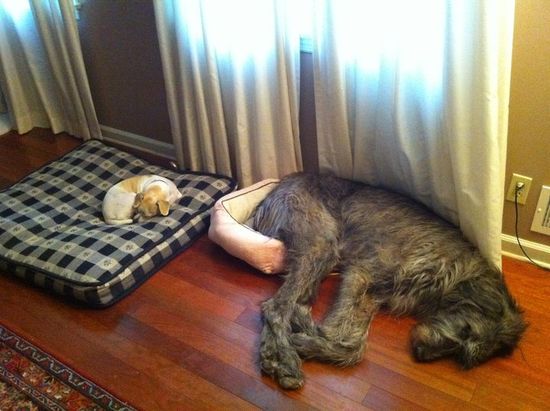
How To Sleep

SleepingDogs

Scott Adams advises:

Don't think words. … Let's say something is bugging you, or fascinating you, and the thought is keeping you awake. I'll bet that in those situations you're obsessed with the verbal elements of your problem. You're imagining what you will say to someone, or how you will explain yourself, or maybe what words someone else chose when annoying you.  To fall asleep, don't abandon the troublesome topic, because you probably can't. Just picture the situation in images alone. That will satisfy the part of you that can't let go of the problem while putting you on the sleep trajectory.

(Photo from Imgur)

Gingrich Ties Himself Into Tighter And Tighter Knots

Behold the reasoning of the GOP's "intellectual," as he tries to make sense of his utterly incoherent mutterings over the last month. A reader adds:

I'm voting for Newt. I know that, if I wait long enough on any issue, he'll eventually take the position I agree with. It's kinda Waiting for Political Godot.

1831, Not 1848, Ctd

A reader writes:

Richard Samuelson, assistant professor of history at California State University, San Bernardino, proposed in 2002 that JQ Adams' position is the antithesis of what is claimed by your previous correspondent. I quote from Samuelson's article, which should be read in full:

Europe's indifference to the fate of the Greeks shocked Adams, just as Europe's moral obtuseness in the Middle East shocks many of us today.

Adams criticized "the more than stoical apathy with which they regard the cause, for which the Greeks are contending; the more than epicurean indifference with which they witness the martyrdom of a whole people, perishing in the recovery of their religion and liberty." Adams complained that Metternich and other European leaders thought too narrowly about the war, "seeing in the Greeks only revolted subjects against a lawful sovereign." Much more was at stake, Adams claimed. Europe's statesmen misunderstood the conflict between Greece and the Ottomans because they thought that Islam was a religion like all the others they knew: they expected Muslims to compromise their beliefs in the interest of peace.

Although I do not have clear documentation, I do believe that Secretary of State Adams was probably thinking more about the ferment in Latin and South America than the Peloponnese peninsula.

Another writes:

I agree with you wholeheartedly on the folly of the war with Libya.  That said, I can't share your enthusiasm for the early 19th century quote from John Quincy Adams.

First, in 1821, we had not power to project beyond our shores.  (Denmark currently goes not abroad in search of monsters to destroy, for like reasons). Second, the 20th century and the advent of standing armies and mechanized destruction wrought a world of whihc JQA could scarcely dream.  One wonders if he'd still hold to his own view.

Thirdly, and most importantly, the "in search of monsters" quotation would have justified (and indeed was used by many here in attempts to procure and justify) our non-intervention in WWII, and you'd have been born not just the subject of a German monarch, but of a German empire.

Cannabis: Gaining On Viagra

Ryan Grim reports:

The fast growing medical marijuana trade is on pace to eclipse the market for Viagra, the first sophisticated analysis of the industry found in a report out Wednesday. The study only focused on transactions, ignoring ancillary businesses that serve the industry, such as insurance companies, law firms, public affairs companies or hydropo equipment makers.

Medical marijuana sales will total $1.7 billion in 2011, just $200 million less than sales for Viagra, Ted Rose, the study's author, said in a conference call with reporters

What’s In A Code Name?

Adam Rawnsley explains the non-meaning behind "Operation Odyssey Dawn":

Each command within the vast Defense Department apparatus is given a series of two-letter groupings that they can use for their operations’ two-word sobriquets. Under the system, the U.S. Africa Command, nominally in charge of the Libya strikes, was given three sets of words that it could begin the operation with.

“These words begin between the letters JF-JZ, NS-NZ and OA-OF, and those three groups give about 60 some odd words,” explains Africom spokesman Eric Elliott. “So, the folks who were responsible for naming this went through and they had done recent activities with NS and they went to O.”

Using the O series of letters, Africom officials picked out “Odyssey” for the first word. The second word is picked “as random as possible because that’s the goal of these operational names,” says Elliot. Africom pulled out “Dawn” for its second word and the resulting combination, “Odyssey Dawn,” is devoid of any intended meaning, Elliott insists.

AJE adds:

Meanwhile, the Army Rumour Service – an unofficial UK military online forum, among others, have been debating the term Operation Ellamy, the British operational name. And the reasoning behind the naming of Canadian Operation MOBILE is also unclear.

The French operation is named Operation Harmattan. The Harmattan, according to Wikipedia, "is a dry and dusty West African trade wind. It blows south from the Sahara into the Gulf of Guinea".