Thinking Of Warfare As Welfare

The Republican party's resilient love of all things military and its elites' love of waging war at will anywhere in the world seem to me to be at odds with a core conservative insight. The critique of open-ended welfare was always that it perpetuated dependency and, in the long run, deepened poverty rather than alleviated it. But that logic never seems to be applied to the wars and nation-building efforts in Iraq, Afghanistan and now, potentially Libya.

If you remove the military welfare, individual countries have to gain the skills necessary for self-government. Similarly, it seems to me, if you reduce the US's thumb on the scales of sectarian conflict in, say, Iraq, a more sustainable equilibrium will emerge. Hence my concern about the "surge" in 2006 – 2007. It did not and could not achieve sectarian peace, which alone can be forged by the parties themselves. And any peace we did achieve remains premised on an American presence. Until that presence is removed, we will never know what has actually occurred beneath. And when that presence is removed, a different pattern will have to emerge, based on the actual facts on the ground, rather than those distorted by US intervention. Or else we have to stay for ever – a fate only Moqtada al Sadr – rather than Barack Obama – seems capable of saving us from.

What has been truly thrilling about the Arab Spring – as with the Green Revolution in Iran – was the irrelevance of America and the West.

That irrelevance meant that the revolution was real in Egypt and Tunisia – and its legacy far more stable. Of course, the neocons wanted to make it about us, hence their itching for the trigger, or complaining about inaction. But making it about us hurts democratic movements, by distorting them. Think of Afghanistan. At this point, the US presence is sustaining a government so corrupt it might have fallen by now without our support. And the US military has made Afghans' own fight against the Taliban and al Qaeda less their fight than ours'. Watching American soldiers train Afghans for a fight they have yet to psychologically make their own is like pushing cooked spaghetti around a plate. Observing the US act as a safety barrier in Kirkuk simply brings home how Iraqis themselves have been relieved of solving their own problems by US intervention.

When you see nation-building as a very expensive and usually counterproductive form of international welfare – you can see why its logic never ends. Intervention creates dependency which prevents departure. Like government programs, these wars have a life of their own. Afghanistan seems as ineradicable as the mohair subsidy. And it develops its own constituency: the Pentagon that doesn't want to be seen to fail, the NGOs and contractors that follow in a swarm, and the fear of any president that he might be seen as a defeatist or weak if he truly pulls the plug.

I'm not sure why conservatives who grasp this point domestically refuse to seize it internationally. But Libya could be a good point to start fighting back against the welfarism of constant intervention. And when you look at the recipients of this welfare, it would be tough to find harder cases: Iraq, Afghanistan and now, for goodness' sake, Libya. It's like providing welfare to individuals who are the most hopeless cases, and from whom you do not dare remove the teat.

We need to break the paternalism that requires us to guide or distort the choices and non-choices of others. The US is fast becoming not the world's policeman, but the world's welfare officer. I favor welfare reform. Which means leaving all these places as quickly and as cleanly as we possibly can.

Shoes – Not “Boots” – On The Ground, Ctd

Andrew Exum's view:

I was not too angry about the fact that the United States is conducting clandestine operations in Libya. Frankly, I support liaising with the rebels (though not arming them), and I also support observing air strikes. Air strikes are generally more effective at doing what you want them to do — and not doing what you do not want them to do, like kill civilians — when they are observed. 

If all the CIA is doing is ensuring a more effective no-fly zone, fine. But as I said before, count me suspicious. And the line between liaising with and supporting the rebels is a very fine one. We know where these things lead. The key test will be if Qaddafi regains control of the country even with a no-fly zone. He's already adjusting:

Rebels also said many loyalists now roamed the battlefield in pickups, making them indistinguishable from rebels when viewed by pilots overhead — a shift in tactics that could render air power less effective.

To be perfectly clear, Qaddafi may be capable of achieving his ends without the kind of obvious brute force he displayed theatrically (and foolishly) at the start of this. If that happens, it seems vital to me that NATO not recast its mission as regime change. We did what we could. We can still isolate the regime, debrief defectors, freeze assets, etc. But we should do no more militarily – or risk getting sucked into Iraq II.

The Iraq Effect

Hitchens believes in it:

Can anyone imagine how the Arab spring would have played out if a keystone Arab state, oil-rich and heavily armed with a track record of intervention in its neighbors' affairs and a history of all-out mass repression against its own civilians, were still the private property of a sadistic crime family? As it is, to have had Iraq on the other scale from the outset has been an unnoticed and unacknowledged benefit whose extent is impossible to compute. And the influence of Iraq on the Libyan equation has also been uniformly positive in ways that are likewise often overlooked.

I really have no idea what Hitch is talking about.

The example of Iraq tainted the idea of democracy in the region and may well have postponed this reckoning, rather than aided it. And the indigenous pursuit of non-violence in Egypt and Tunisia as the path to democracy could not be more different than the external application of shock and awe, the use of torture (as a weapon for democracy!), and the chaotic, horrifying deaths of over a hundred thousand people.

Thus it is indeed rich to hear the unapologetic supporters of the Iraq war cite possible civilian casualties as the reason for intervening in Libya. Dennis Ross even claimed that 100,000 lives could have been lost in Banghazi. But roughly that number of civilians were killed while the US bore responsibility for internal security in Iraq. In that sense, we were as bad as Qaddafi if only in terms of gross negligence. And as for the regional effects of the Iraq war, it's clear that its empowerment of Iran's regime has led to the US' acquiescence in suppressing democracy in Bahrain.

A True Test Of Dishness

Note1

A reader writes:

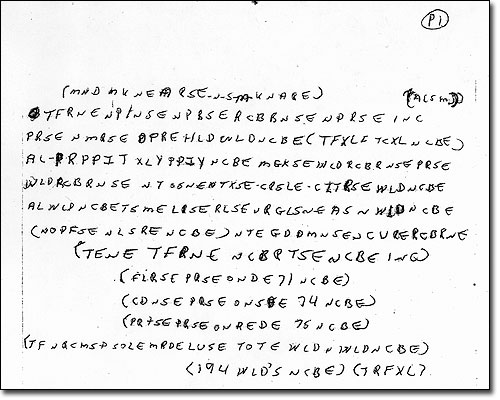
You might not think it appropriate for your site/readers, but the FBI needs help solving encrypted notes found on a murder victim.  Watching the various ways your readers figure out the VFYW contest pics is delightful, and watching them solve this mystery would be quite interesting.  (Although, I somehow doubt you'll get responses like "I remember that because I was there…")

Worth a shot.

The Imperial President, Ctd

A shocking piece of contempt for democracy and the constitution from the secretary of state:

The White House would forge ahead with military action in Libya even if Congress passed a resolution constraining the mission, Secretary of State Hillary Clinton said during a classified briefing to House members Wednesday afternoon …Rep. Brad Sherman (D-CA), who asked Clinton about the War Powers Act during a classified briefing, said Clinton and the administration are sidestepping the measure's provisions giving Congress the ability to put a 60-day time limit on any military action.

"They are not committed to following the important part of the War Powers Act," he told TPM in a phone interview. "She said they are certainly willing to send reports [to us] and if they issue a press release, they'll send that to us too."

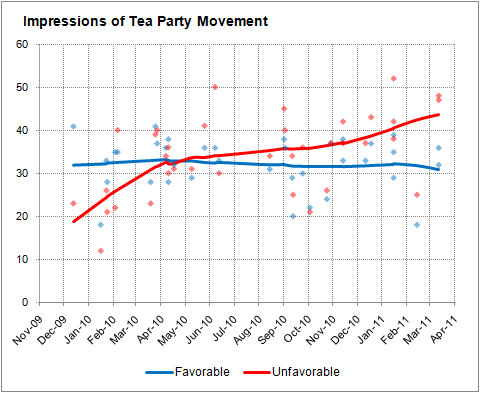
That's a gauntlet for anyone left in the Congress not in thrall to the emperor's growing power-grab. I fear, as Yglesias notes, that the Congress doesn't even want to exercize its powers or even go on the record … because they're a bunch of pansy-ass losers. But I hope that some of them actually care about the Constitution (hello, Tea Party!) and fight back. If the Obama administration is refusing even to abide by the War Powers Act, then the Congress really needs to vote to defund their adventurism at least or impeach them if it comes to that. Going to war outside even the War Powers Act qualifies as an impeachable offense, it seems to me.

But we are, it appears, in a particularly decadent moment in the decline of the American republic and its Congress. We are governed by an executive that goes to war in secret and at will, openly contemptuous of the democratic process and even minimal transparency. and when you realize that that executive actually campaigned against this kind of secretive, dictatorial presidency, you realize how this has become systemic, and the anti-democratic rot is deep.