
Too soon?
Too soon?
Freddie DeBoer argues that a "colossal, almost impossible arrogance underpins all interventionist logic":
What interventionists ask of us, constantly, is to be so informed, wise, judicious, and discriminating that we can understand the tangled morass of practical politics, in countries that are thousands of miles from our shores, with cultures that are almost entirely alien to ours, with populaces that don't speak our same native tongue. Feel comfortable with that?
I assume that I know a lot more about Egypt or Yemen or Libya than the average American– I would suggest that the average American almost certainly couldn't find these countries on a map, tell you what languages they speak in those countries, perhaps even on which continents they are found– but the idea that I can have an informed opinion about the internal politics of these countries is absurd. Absurd. I followed the health care debate, an internal political affair with which I have a great personal stake and a keen personal interest, with something resembling obsession. I can hardly comprehend how many hundreds of thousands of words I read on the subject. And yet in some ways I know so little.
And yet I am supposed to have knowledge enough about the internal politics of Libya? Enough to wager the future of the lives of every citizen of that country? Enough to commit human lives and millions of dollars to engineer the outcome that I think we want in that foreign country? With the fog of war, the law of unintended consequences, and all of those unknown unknowns, floating around out there, waiting to entrap us?
This is folly. It is insanity.
David Frum muses:
In his mind, he may have been signaling: this is a humanitarian police action (like Somalia or Bosnia), not a real war (like the Gulf war, the invasion of Afghanistan or the invasion of Iraq). But he opened the door to his critics alleging: Obama is a liberal one-worlder who thinks that a Security Council vote can substitute for American democratic processes. Did he possibly fear that Congress would say No? Is he hoping that he’ll wrap this thing up faster than the debate would have required?
Is he signaling inner discomfort with his own decision, a preference for talking about almost anything else? Or is he just recklessly forgetting the old rule: if you don’t invite them to join you at the takeoff, they won’t be there for the landing?
The other obvious explanation: there was no time. But I think this blatant breaking of a core campaign promise strengthens the hand of those insisting that this be a short, limited engagement with no troops on the ground and no alliance with rebels we scarcely know anything about.
Of course, the Republican position on this is a fantastic example of opportunism.
They loved an executive branch under Bush that declared its unilateral power to declare war and peace at will, to simply reinterpret the law as something to be gotten around rather than complied with, and that summed up its ethos in one piece of cult-lingo: "the Decider." There was only one "moment of accountability" for the last Republican president – his re-election in 2004. In matters of war, outside the law, he was a monarch.
Nonetheless, even granting this massive piece of situational politics, I'm glad the right has now remembered the things it wilfully forgot under Bush: that you have to live within your means, and that the Congress has the ultimate say on whether to go to war. I'm also relieved to see some Democrats not shifting, in reverse fashion, to back the imperial presidency, but insisting on accountability from the executive branch.
If we are ever to restrain the Washington machine from its addiction to unfunded and unbudgeted and unending war, now is as good a time to start as any.
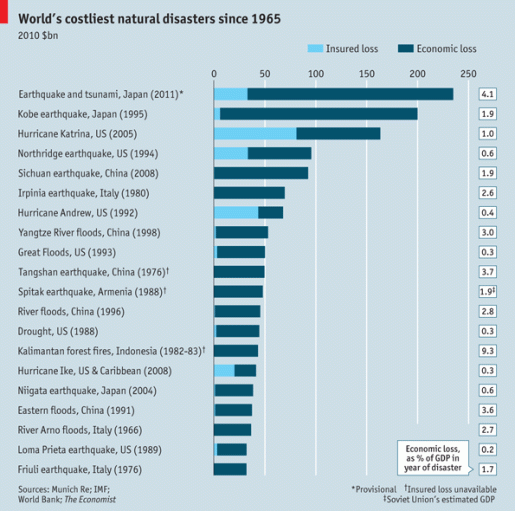
The Economist charts the latest estimates:
Provisional estimates released [yesterday] by the World Bank put the economic damage resulting from the disaster at as much as $235 billion, around 4% of GDP. That figure would make this disaster the costliest since comparable records began in 1965. The Indian Ocean tsunami in 2004, which caused some 250,000 deaths, does not feature on this chart. Economic losses there amounted to only $14 billion in today’s prices, partly because of low property and land values in the affected areas.
A reader writes:
Why is Germania holding a bunch of pot in her sword hand?
A lovely detail from her trip to Israel:
Defense Ministry officials claim the US politician neglected to submit a formal request to tour the West Bank, despite it being standard procedure for any foreign dignitary. The Daily Telegraph hinted that Palin was not aware of the fact that Bethlehem is not Israeli territory, saying this is a common mistake amongst foreign tourists but not amongst politicians.
But it is Israel. God granted it, right?
A reader writes:
You've been comparing the events in Egypt, Libya, Yemen, and Bahrain to 1848, but I think that another interesting analogy is the series of revolutions that took place in Ottoman Europe in the 1820s and '30s – a comparison that is particularly relevant when it comes to the response of the West.
Like the revolts in the Middle East today, the revolts in Serbia (1804-1815), Greece (1821-1830), and Bosnia (1831) were pro-democratic insurgencies that created a dilemma for Britain, France, and Russia, forcing them to choose between upholding Metternich's "Concert of Europe" or supporting these democratic uprisings. In your staunch advocacy for a realist approach to Libya, you sound an awful lot like Metternich, who favored the entrenchment of the existing balance of power and opposed anti-monarchial uprisings. Metternich was on the wrong side of history.
The dilemma faced by the Great Powers then is the same as the dilemma faced by Obama now, and he has made the same decision that they did. Like Qaddafi, the Ottoman Sultan Mahmud II provided the West a humanitarian casus belli with his brutal counterrevolutionary sweep across Greece in the 1820s, which led to an intervention culminating with the defeat of the Turks at Navarino and the establishment of the modern Greek state. Now, obviously, you are not exactly like Metternich – you don't favor Qaddafi over the rebels – but while your realism is born out of prudence, don't you worry that you too will be caught on the wrong side of history?
If it weren't for the intervention, a Qaddafi victory would have been all but guaranteed, and the same was true of Greece circa 1827.
In the sense that I obviously support – and the Dish has aggressively covered and championed – the various uprisings against the stagnant, ugly autocracies in the Middle East, I hope I am not on the wrong side of history. The question of how outside powers respond to the events we cannot control and do not fully understand seems to me a separate one. My judgment may be debunked by events. I sure hope so.
Johann Hari interviews the man Marty Peretz has called an intellectual psychopath.
Stephen Walt reminds us of the great elite consensus in Washington:
When you have a big hammer the whole world looks like a nail; when you have thousand of cruise missiles and smart bombs and lots of B-2s and F-18s, the whole world looks like a target set. The United States doesn't get involved everywhere that despots crack down on rebels (as our limp reaction to the crackdowns in Yemen and Bahrain demonstrate), but lately we always seems to doing this sort of thing somewhere. Even a smart guy like Barack Obama couldn't keep himself from going abroad in search of a monster to destroy.
The American people experienced the Iraq fiasco as something never to be entertained again. The neocons and liberal interventionists in Washington saw it as one road bump in their plan to make the whole world a better place (and treat it as if it were a matter of history, not still absorbing American arms and money and occupying troops). That's why a man like Paul Wolfowitz is unashamed to speak of America's moral standing, when he was integral to an administration that authorized torture; or why Lawrence Kaplan who was spectacularly wrong about the commitment in Iraq now feels no hesitation to pontificate on Libya without any acknowledgment of his massive failure of judgment only a few years ago; or why TNR, having had to beat its breast over Iraq, snaps back into the familiar posture that doing nothing is equivalent to massacring thousands ourselves.
It turns out that in Washington, where no one is held accountable for anything real (like torture) but everyone is held accountable for things that are utterly irrelevant (a Craigslist posting, or a gaffe), the Iraq war crowd is as powerful now as ever.
Tom Ricks rejects the question:
I grow weary of talk of an "exit strategy." It is a canard and a false concept. Can anyone remember the last time there actually was an exit strategy going in that actually worked? Military actions aren't interstates.
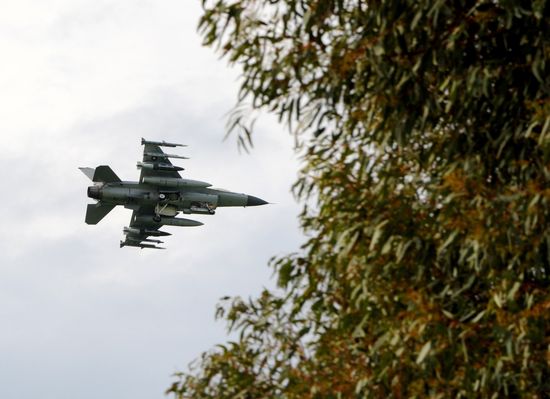
(Photo by Mario LaPorta/AFP/Getty Images)
 The Dish