The Quiet In Tripoli, Ctd

There are no mass demonstrations in the capital, as Libyans seem either to support Qaddafi or to hide. And then there are moments like this:

An old woman, in her late 70s at least, I'm told, entered the bank to collect her 500 Libyan dollars ($410; £253) in state aid announced a couple of weeks ago. There were two long queues – one for men and one for women. She stood in the men's queue. The men urged her to move to the women's section. "Why?" she challenged. A man told her: "Ya haja [a term of respect for an elderly woman] this line is for men, women is the other one." She loudly replied: "No. All the men are in Benghazi."

(Hat tip: Mackey.)

Uh-Oh

Nate Silver analyzes CNN's poll:

[S]upport for military interventions tend to be highest at the outset — the so-called rally-around-the-flag-effect — before declining until and unless some concrete objective is achieved. An important caveat is that the Libyan situation has evolved so quickly that we may still be midway through the rally phase. But if 50 percent approval is as good as the numbers get for Mr. Obama at the peak, overall support may turn negative unless Mr. el-Qaddafi is ousted fairly quickly.

Palmerston 1848; Obama 2011

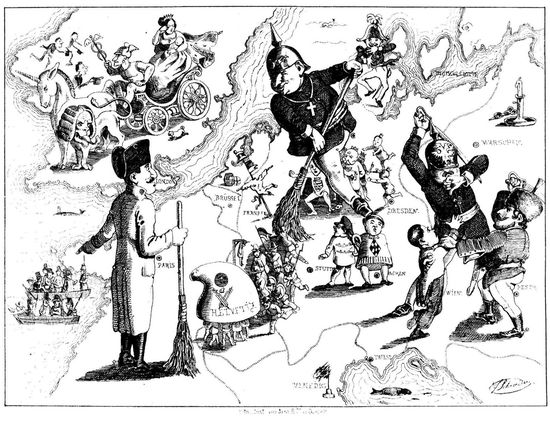
Rundgemälde_Europa_1849

Here's a fascinating historical detour. Britain faced the very same dilemma as America does today with respect to revolutions unfolding in a critical region. In the end, realism prevailed:

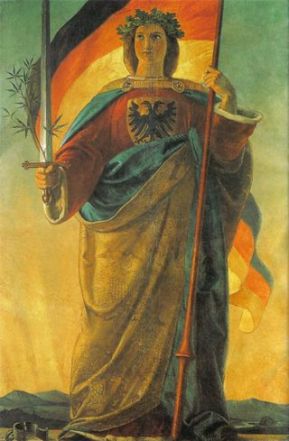
The British Foreign Secretary, Lord Palmerston, was primarily concerned with maintaining the balance of power in Europe.  That had been Britain's chief objective for decades, and all players understood that by weighing in, Britain could tip the  balance.  According to The Cambridge History of British Foreign Policy, "Appeals poured in upon him from all sides — desperate cries for help from Image_Germania_(painting)distressed potentates, insistent demands for aid from struggling patriots."
While Palmerston "iterated and re-iterated with a frequency that became monotonous his exhortations to the dynastic despots to make timely concessions to national democracy," he rebuffed all pleas for outright intervention for liberal or nationalist causes.

For example, when the Hungarian nationalist leader Louis Kossuth begged for British assistance in the face of Russian intervention to re-impose Austrian rule over Hungary, Palmerston resisted, even though "British public opinion … began to express itself clearly and loudly on the Hungarian side." 

Palmerston was personally appalled by the crackdown against the revolutionaries, writing privately that he thought the "Austrians are really the greatest brutes that ever called themselves by the undeserved name of civilised men."  In the end, however, he contented himself with diplomacy to help save Kossuth's life, not his Hungarian regime.

Maybe history will vindicate Obama's move, and see it as the moment that the regional revolution was saved from being snuffed out. But what Palmerston showed is that it is possible to be thrilled by and supportive of democratic movements in foreign lands, while remaining strictly uninvolved. Revolutions and rebellions are by their very nature unpredictable, fickle and confounding. It's very hard to see them in context at the time. 1848 was widely seen as a failure – crushed in many countries. And yet a couple of decades later, it was seen as the first earthquake toward a democratic future.

(Cartoon: Ferdinand Schröder on the defeat of the revolutions of 1848/49 in Europe (published in Düsseldorfer Monatshefte, August 1849); Painting: Germania (painting), wall fresco, St. Pauls Church, Frankfurt am Main, designed to cover the organ during the Frankfurt Parliament, 1848-49, by Philipp Veit.)
Incentivizing Dictators To Go Nuclear

Steven L. Taylor points out an irony:

It struck me as ironic that just under eight years ago Gaddafi specifically engaged in a course of action [by giving up his nuclear program] clearly intended to forestall US military action against his regime and that, despite that, he is now under military attack from the US and its allies. Moreover:  if he had actually acquired just one nuclear weapon, the current actions would likely not be taking place.

Says Doug Mataconis: "If you are Mahmoud Ahmedinejad or one of the Iranian mullahs, what lesson do you derive from Libya’s experience?"

A Civil War

110503137

From Jon Lee Anderson's latest Libya dispatch:

In front of another tank, a man fiddled with a camera and asked me to take his picture with his elderly father, who seemed overcome with emotion, and suddenly lifted both hands in a “V for victory” sign. Men wandered up to me to ask my nationality: “French, American?” and shaking my hand happily, shyly, expressing their gratitude to the West and their outrage at Qaddafi, and their humiliation, too. “Qaddafi, you know, he’s not normal,” Libyans often say in an ashamed way, as if trying to fathom the man who has dominated their lives for more than forty years and who is now sending bombs and planes and tanks against them. “What does he think, that we will somehow forgive him and agree to live with him again, after this?”

The underlying question is whether the pro-Qaddafi forces are entirely mercenary or whether they are genuine. The same question applies to the pro-Qaddafi crowds in Tripoli. Pure propaganda? Paid stooges? Or brainwashed enthusiasts? Wilkinson encourages plain language:

It seems to me obviously correct to characterise the military conflict between Libyan factions as a "civil war", and thus to characterise the actions of the Americans, French, and British, which target the Libyan state's air defences, as "taking sides in a civil war". 

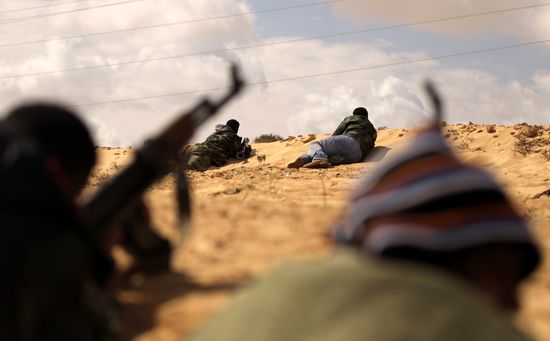
(Photo: Libyan rebels duck for cover behind a sand dune during a failed attempt to take the town of Ajdabiya from Moammer Khaddafi's forces on March 21, 2011 as news reports said Libyan government forces pulled back 60 miles from rebel-held Benghazi but showed they still had plenty of fight as they beat off an insurgent advance. By Patrick Baz/AFP/Getty Images)

Where Is The Anti-War Movement?

David Boaz is wondering:

On a street corner in Washington, D.C., outside the Cato Institute, there’s a metal box that controls traffic signals. During the Bush years there was hardly a day that it didn’t sport a poster advertising an antiwar march or simply denouncing President George W. Bush and the war in Iraq. But the marches and the posters seemed to stop on election day 2008. Maybe antiwar organizers assumed that they had elected the man who would stop the war. After all, Barack Obama rose to power on the basis of his early opposition to the Iraq war and his promise to end it. But after two years in the White House he has made both of George Bush’s wars his wars.

He proceeds to remind us (painfully) of Obama the candidate:

In October 2007, Obama proclaimed, “I will promise you this, that if we have not gotten our troops out by the time I am president, it is the first thing I will do. I will get our troops home. We will bring an end to this war. You can take that to the bank.” Speaking of Iraq in February 2008, candidate Barack Obama said, “I opposed this war in 2002. I will bring this war to an end in 2009. It is time to bring our troops home.” The following month, under fire from Hillary Clinton, he reiterated, “I was opposed to this war in 2002….I have been against it in 2002, 2003, 2004, 5, 6, 7, 8 and I will bring this war to an end in 2009. So don’t be confused.”

Indeed, in his famous “the moment when the rise of the oceans began to slow” speech on the night he clinched the Democratic nomination, he also proclaimed, “I am absolutely certain that generations from now we will be able to look back and tell our children that . . . this was the moment when we ended a war.”

Reality is a stark contrast:

…he has tripled President Bush’s troop levels in Afghanistan, and we have been fighting there for more than nine years. The Pentagon has declared “the official end to Operation Iraqi Freedom and combat operations by United States forces in Iraq,” but we still have 50,000 troops there, hardly what Senator Obama promised.

And now Libya. In various recent polls more than two-thirds of Americans have opposed military intervention in Libya. No doubt many of them voted for President Obama.

Libya: Better Than Iraq!

Yglesias sighs:

Is “less misguided than the invasion of Iraq” really a reasonable standard for policy to aspire to? I agree that this should turn out better than Iraq did. But will it turn out better than Somalia? Does it represent a reasonable allocation of resources? “Better than Iraq” is a very low bar for a foreign policy initiative to pass. 

GOP Supporting The Strategy, Not Obama

Weigel flags a CNN poll:

Sixty-three percent of Republicans disapprove of Obama's handling of Libya, to 27 percent who approve. Seventy-six percent of Tea Party "supporters" disapprove of Obama's handling of it. But 73 percent of Tea Partiers and 78 percent of Republicans support the [no-fly zone] — they're by far the biggest supporters of the strategy.