The Difference

PM Carpenter thinks this president has what it takes to navigate the Libyan morass:

That is the fundamental difference between today and ten years ago, between this intervention and that war, between one exceptionally bad president and an exceptionally good one: character, which Obama has, and Bush did not. 

You see, I trust Barack Obama, so I'm willing to cut him some slack on a matter I cannot, I confess, say I'm enthusiastic about. No thinking person or scrupulous judge of character could have, would have ever trusted George W. Bush.

Developing The Obama Doctrine

Ambinder parses Clinton:

An hour before bombing began Saturday, Clinton spoke to the press in Paris. Asked why military action was in America's interest, she gave three reasons and implied a fourth. A destabilizing force would jeopardize progress in Tunisia and Egypt; a humanitarian disaster was imminent unless prevented; Qaddafi could not flout international law without consequences. The fourth: there's a line now, and one that others countries had better not cross. The development of a new doctrine in the Middle East is taking form, and it could become a paradigm for how the international community deals with unrest across the region from now on. 

The UAE Balks

AJE:

The United Arab Emirates said on Monday that its involvement in Libya is limited to humanitarian assistance, after reports that it would send warplanes to patrol a UN-backed no-fly zone.

More frays in the East-West "coalition":

NATO is ready to support the international coalition intervening in Libya within "a few days," Alain Juppe, the French Foreign Minister, said on Monday. … Sharp divisions prevented NATO from adopting a plan on Monday for military airstrikes against Libya, as Turkish opposition blocked the alliance from approving a strategy.

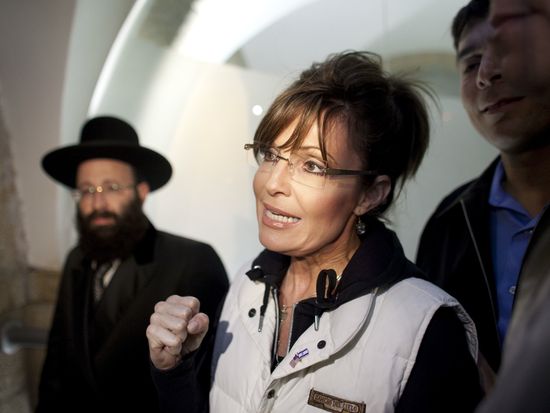
Palin Shores Up The Base

PalinIsrael-UrielSinai-Getty

She's in Jerusalem, having trashed her own president in India:

Palin, who was wearing a large Star of David, told [World Likud chairman Danny] Danon that she had flags of Israel "on my desk, in my home, all over the place" and that she would carry around a flag she bought in Israel.

"She didn't go into diplomatic issues, but I can clearly say from the questions she asked in relation to our conflict here with the Muslims in these holy sites that she knows that we are right and that the Muslims are just claiming things for provocation and they're not right," Danon said.

Bonus Hinderakerism:

Liberals love to insult Sarah Palin's intelligence. It's not a subject on which I have any particular opinion, except to note that, apparently by a remarkable coincidence, her judgment is correct on just about every subject.

Dumb, incurious – but always right! The neocon ideal of a president.

(Photo: Former Alaska Gov. Sarah Palin departs the Western Wall tunnels on March 20, 2011 in Jerusalem, Israel. Palin began a private visit to Israel today, and is planning to meet Prime Minister Benjamin Netanyahu and tour holy sites. By Uriel Sinai/Getty Images)

The Arab League Leaves Obama High And Dry, Ctd

Goldblog fumes:

Does anyone believe that the Arab League, whose members include Bashar al-Assad, the Saud family, Yemen's Ali Abdullah Saleh, Muammar Qaddafi (now suspended for non-payment of dues and an overly-gauche defense of his regime) and until a few weeks ago Tunisia's Ben Ali and Egypt's Mubarak, is a force for progressive politics and humanitarianism? That it would ever stand with the West when it was uncomfortable to stand with the West?

But Donilon has said this was the most important factor in favor of the war.

The Broader Logic Of The Libyan War

Marc Lynch, who has “many, many reservations about the military intervention,” puts the war in context:

Libya matters to the United States not for its oil or intrinsic importance, but because it has been a key part of the rapidly evolving transformation of the Arab world.  For Arab protestors and regimes alike, Gaddafi’s bloody response to the emerging Libyan protest movement had become a litmus test for the future of the Arab revolution.  If Gaddafi succeeded in snuffing out the challenge by force without a meaningful response from the United States, Europe and the international community then that would have been interpreted as a green light for all other leaders to employ similar tactics.

The strong international response, first with the tough targeted sanctions package brokered by the United States at the United Nations and now with the military intervention, has the potential to restrain those regimes from unleashing the hounds of war and to encourage the energized citizenry of the region to redouble their efforts to bring about change. This regional context may not be enough to justify the Libya intervention, but I believe it is essential for understanding the logic and stakes of the intervention by the U.S. and its allies.

My problem with this argument is that it conflates the broad-based peaceful movements in Egypt and Tunisia and Bahrain, with an opportunistic rebellion, fed by tribal rivalries, that was violent from the get-go and initially opposed any Western intervention. But maybe I am misreading this and Libya really is affecting what is happening in Yemen, for example.

We Don’t Command The Rebels

Peter Beinart compares the Libyan War to our interventions in Kosovo, Bosnia, and Afghanistan:

[T]he more successful an air war is, the less control America has over its allies on the ground. The U.S. didn’t want the Kosovo Liberation Army to cleanse the province of Serbs or to declare independence. They did both. We wanted the Northern Alliance to stop short of Kabul when the Taliban fled the city. They ignored us. If we’re lucky, the Libyan rebels will soon be a much more powerful force, and if we’re really lucky, they’ll be a powerful force capable of unifying Libya behind a reasonably humane regime. But the latter will be mostly out of our hands.