I feel his whiplash. One of the most politically damaging aspects of this decision is how it has undermined Obama's rep for coolness under fire. That's a central part of his narrative and I don't think he or his advisers have grasped how damaging this off-message recklessness could be to him. It's compounded by the awful messaging of a simultaneous trip to Brazil.
Month: March 2011
A Mid-Day ’80s-gasm
George Michael covers New Order:
And no, it’s not autotuned, it’s vocoded.
The Right’s New Meme
Most of the GOP leadership is playing it mum or playing it vicious on the Libya madness. Surprise! Obama cannot win because his un-Bush style of intervention is so … liberal. Palin is the most vacuous, of course. Her criticism is entirely of style, not substance: there would be more “decisiveness” under a Queen Esther. What does that mean? If it were anyone serious, it might be worth inquiring. Gingrich returns to the 1990s:
“Iran and North Korea are vastly bigger threats. [Zimbabwe dictator Robert] Mugabe has killed more people, the Sudanese dictatorship has killed more people, there are a lot of bad dictators doing bad things.”
But now, Obama will also feel the force of the neocons, having tasted a smidgen of blood. They will now push for regime change and claim it as vindication for their vision of a world dominated by virtuous American arms. And sure enough, across the the horizon, the sound of little feet running towards us. Yes, ladies and gentlemen, here comes Max Boot:
The only way this crisis will end—the only way we and our allies can achieve our objectives in Libya—is to remove Qaddafi from power. Containment won’t suffice. We must make “rollback” the international strategy.
Such a goal is not compelled, but is permitted, under U.N. Security Council resolution 1973. That resolution “stresses the need to intensify efforts to find a solution to the crisis which responds to the legitimate demands of the Libyan people” and which leads to “a peaceful and sustainable solution.” The Obama administration should argue that the only “peaceful and sustainable solution” would be for Qaddafi to abdicate power … Now we need to muster the will and the resources to oust the dictator.
Hugh Hewitt wants the full Rummy:
Hope that Secretaries Clinton and Gates persuaded the force-averse president that winning with special forces on the ground is preferable to a stalemate enforced from the skies.
I swear I remain in disbelief that we are where we are. President Obama – calm, judicious, even-tempered president Obama – jumped into this lose-lose mess in one Tuesday meeting. And the most significant gain – avoiding a massacre in Benghazi – has already been achieved.
An Imminent End In Yemen?
Al Jazeera reports:
Several top Yemeni army commanders have declared their support for anti-government protesters seeking the resignation of the country's president, Ali Abdullah Saleh. Major General Ali Mohsen Saleh, the head of the north western military zone and the head of the first armoured division, said on Monday that he had deployed army units to protect the protesters. …
Several ministers resigned from the government after Friday's violence. Abdullah Alsaidi, Yemen's ambassador to the United Nations, also quit in protest over the killings.
The leader of Yemen's most powerful tribe – the tribe of President Saleh – has also called for his exit. Enduring America is tracking the rapidly changing news:
1452 GMT: Al Jazeera is reporting that Hakim Al Masmari, editor in chief of the Yemen Post to Al Jazeera, has stated that he does not expect the regime to last another 24 hours.
1511 GMT: Al Jazeera: French foreign minister has declared that Yemeni President Ali Saleh's departure is imminent. The live video of the people celebrating in the streets is breathtaking. The president and his closest advisors are meeting right now, and Yemen's defence minister is expected to make an update in a few moments.
Priorities, Priorities
Goldblog is as mystified by this great Libya distraction as I am.
The Question: Why This Time?
Ezra Klein asks:
Every year, one million people die from malaria. About three million children die, either directly or indirectly, due to hunger. There is much we could due to help the world if we were willing. The question that needs to be asked is: Why this?
Chait counters Klein and me:
I think there are very reasonable arguments to suggest that the operation in Libya could devolve into a quagmire, fail to achieve its objections, or achieve them at unacceptable cost. And, of course, some people — not Sullivan or Klein — think the U.S. has no right to intervene in places like Libya. But that's the question. The question of whether or not we ought to intervene in some other country, or in some other way, is an important foreign policy issue, but not an argument against intervention in Libya.
I think the discussion is focused rightly on whether the costs of intervention should be born when there is no vital national interest involved. I'm not against interventions as such; I'm against dumb interventions, as someone once nearly said. Yglesias counters:
[A]ll this context is relevant as an indictment of the elite leadership class of the United States of America. If everyone cares as much about the political rights of Arabs as Libya interventionists say, then what on earth are they doing in Bahrain and Yemen and Palestine? If everyone cares as much about the loss of innocent African life as Libya interventionists say, then what on earth are they doing ponying up so little in foreign aid and doing so little to dismantle ruinous cotton subsidies? These aren’t really points about Libya. And why should they be? What do I know about Libya? What does Chait know about Libya? These are points about the United States of America and the various elites who run the country and shape the discourse.
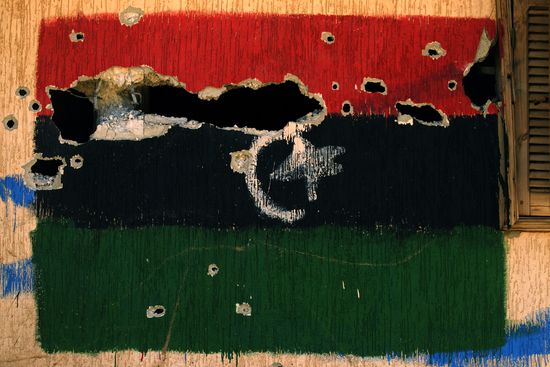
(Photo: ??A shrapnel riddled wall, painted with the Libyan rebellion flag, is seen in Benghazi on March 20, 2011, a day after an international campaign of air and sea strikes destroyed Libyan targets. By Patrick Baz/Getty.)
Our Buddies Vlad And Jake
The African Union is beginning to echo the Arab League:
Jacob Zuma, the South African president [and one of five heads of state on a high-level African Union panel on Libya], said on Monday that his country does not support "the regime change doctrine" in Libya, and called for restraint from foreign countries enforcing a no-fly zone. Zuma said: "As South Africa we say no to the killing of civilians, no to the regime change doctrine and no to the foreign occupation of Libya"
And now this charming quote from a frenemy:
Vladimir Putin, Russian prime minister, said on Monday a UN resolution authorizing military action in Libya resembled "mediaeval calls for crusades" after Western forces launched a second wave of air strikes.
Billboard Of The Day
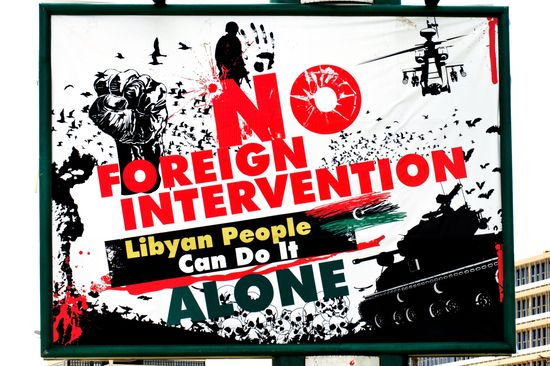
A billboard against foreign intervention in Libya stands in Benghazi on March 11, 2011, a little more than a week before the US-led attacks on Qaddafi's forces. By Dave Clark/AFP/Getty.
The War And Terror Cycle
Many have understandably contextualized this new war with respect to the Arab 1848. But it is also, to my mind, vital to see it in a larger context that really does impinge on national security: the war against Jihadism. Will this new war help or hinder us in that larger generational effort? To my mind, the great achievement of the Obama administration in two short years has been to remove the US from what has been a remarkable moment of Arab popular maturation against the corruption, violence and tyranny they live under. This was an Arab moment, to be seized by Arabs. They were finally to own their own victories and seek their own freedoms, without Western intervention.
Now, for understandable moral reasons, that strategic recalibration is at risk. There's a danger of this intervention, with its inevitable civilian casualties and unknowable future acts by the rebels we barely know, will revive the entire paradigm of the West vs Arabs. Maybe Qaddafi is pariah enough that we will avoid this. But the dangers remain. Greenwald:
As for Brennan's warning that this action may trigger Terrorist attacks on the U.S., I suppose — just as was true for the similar 2003 warnings — that this is a possible repercussion of our intervention. But doesn't that really underscore the key point?
If we really want to transform how we're perceived in that part of the world, and if we really want to reduce the Terrorist threat, isn't the obvious solution to stop sending our fighter jets and bombs and armies to that part of the world rather than finding a new Muslim country to target for war on a seemingly annual basis? I have no doubt that some citizens who support the intervention in Libya are doing so for purely humanitarian and noble reasons, just as was true for some supporters of the effort to remove the truly despicable Saddam Hussein. But the intentions of those who support the war shed little light on the motives of those who prosecute the war and even less light on what its ultimate outcomes will be.
Why So Much Looting After Katrina?
Seth Masket compares Japan to New Orleans:
[W]hile one angle here is that Japanese looting has been underreported, the other is that American looting has probably been overreported.
The media reported many stories about looting and other illegal behavior in the days after Katrina made landfall in Louisiana. However, as Cooper and Block noted in their book Disaster, these stories were often false or grossly exaggerated. Moreover, they point out, these reports tended to ignore another notable human reaction to the collapse of infrastructure: spontaneous community building. The book cites numerous instances of people banding together to create kitchens, shelters, and modes of transportation in New Orleans at a time when local, state, and federal governments failed to do that.
 The Dish