The Sleeping Analyst

Stephen Metcalf explores an emerging pattern in his life:

I have consulted four therapists in my life, and all four have fallen asleep on me. The ritual—forms, waiting rooms, Kleenex—starts up again, only each time with my own special twist: I pay someone to explore my unconscious mind and instead they sink into theirs. So consistently did I lose wakeful contact with my shrinks that I began to suspect—honest to God—that feigning sleep was a technique for provoking patients to confront their fears of abandonment. “Once in a 40-year career,” said a friend’s shrink, an ancient and cheerful Jungian, when I asked him if he’d ever drifted off while on the clock—making me, I suppose, the Ted Williams of narcissistic monotony.

Snark Is The Best Medicine

 Tumor

A beautiful and hilarious girl chronicles her brain tumor, under the heading, "Brain tumors are funny, but they're not hilarious":

I think I’m going to stop calling it a “mysterious brain thing” and call it an “exotic brain sculpture.” It seems to work for strippers.

Her advice for precautions you should take before having massive seizures and losing control of bodily functions:

There is a good chance that the EMTs will cut your garments off of your body to get you naked and into a gown as quickly as possible. Now, right off the bat this sounds like a regular Friday night, but instead of restraining you and ravaging your naked body, the EMTs plan on restraining you and loading your seizing body with Dilantin. And because it’s probably inappropriate to let a hot-bodied 25 year old female seize naked in restraints, they’ll get you into the gown pronto. My favorite red dress was cut right off of my body without my consent (again, it starts out hot) and that dress was irreplaceable. So, if you feel that massive, uncontrollable seizures are on the way, please throw on some dude’s tighty-whities, some old black sweatpants, and whatever hideous tee shirt you can find lying around. I have a very patriotic “These Colors Don’t Run” tee shirt that I wouldn’t mind shitting on.

(Hat tip: Edith Zimmerman)

Free Will At The Movies

Jay Michaelson analyzes the zealous individualism of The Adjustment Bureau:

Fate is supposed to be fate: it’s final, and it’s the way it is. In religious and spiritual systems that subscribe to it, the best thing a religious person can do is resign oneself to it, to cultivate the serenity to accept the things one cannot change, to paraphrase theologian Reinhold Niebuhr.

But not in Hollywood, where human agency knows no bounds.

Of course Norris should follow his heart, disobey God’s plan, and marry the girl of his dreams. And of course he can; while Norris frets about free will, it’s obvious that he does have it. He’s up against some powerful adversaries, but he calls the shots. We know all this because we know Hollywood’s sentimental religion, which is indeed a kind of neo-Romantic fanatic narcissism. And it is fanatic: once Norris makes his decision, he risks his own life, her life, and the life of countless collateral damage casualties.


Idle Time

6a00d83451c45669e2014e86c8d092970d-550wi

Sven Birkerts contemplates it:

We open our eyes in the morning and for an instant—more if we indulge ourselves—we are completely idle, ourselves. And then we launch toward purpose; and once we get under way, many of us have little truck with that first unmustered self, unless in occasional dreamy asides as we look away from our tasks, let the mind slip from its rails to indulge a reverie or a memory. All such thoughts to the past, to childhood, are a truancy from productivity. But there is an undeniable pull at times, as if to a truth neglected.

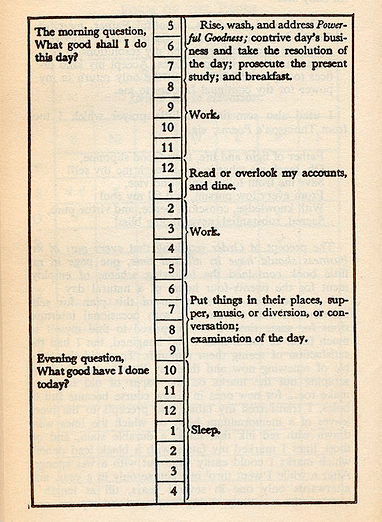
(Image of Ben Franklin's daily schedule, via Nick Bilton)

Read The Classics

Robert Pasnau penned an open letter (pdf) to prospective PhD students on why the history of philosophy matters:

[M]any philosophers today are presentists – they think that the only philosophy worth reading has been written in the last 100 years, if not the last 30 years. This attitude is hard to justify.

The historical record shows that philosophy – unlike science and math – does not develop in steady, linear fashion. Perhaps the very best historical era ever came at the very start, in Socrates, Plato, and Aristotle. If that was not it, then one has to wait some 1600 years, for the century from Aquinas to Oresme, (Who’s Oresme?, you may ask. Exactly.) or wait 2000 years, for Descartes through Kant. I’m leaving out important figures, of course, but also many quite fallow periods, even in modern times. Maybe subsequent generations will judge 2011 and environs as the highpoint up until now of the whole history of philosophy, but I wouldn’t bet on it. Every generation of philosophers has been equally prepossessed by its own ideas.

(Hat tip: Brian Leiter)

Can Science Console?

110289025

Adam Frank responds to a commenter who wrote of the earthquake, "Somehow the science of it all has suddenly lost its appeal":

In those moments, when we are numb with the immediacy of great suffering, explanations can become clay on the tongue. In that shattered place, our other human talents often find their place. In poem or paean, in music or metaphor, in silent homage to whatever powers make sense to the heart in that moment, we may (or may not) find our way.

What those moments teach is that all existence is, for us, provisional. They show that we are as much creatures of experienced feeling as we are of rational thinking. They show us the full range of what it means to be human, all too human, in a world alive with tremendous power, unspeakable beauty and, sometimes, shattering terror.

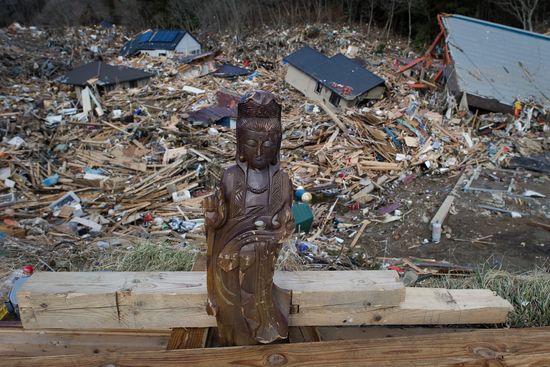
(Photo: A religious statue placed by local residents stands among the rubble in Kesennuma, Miyagi prefecture on March 17, 2011 after the March 11 earthquake and tsunami. By Nicolas Asfouri/AFP/Getty Images.)

Obama And R2P

A reader writes:

Your depiction of 2008 Democratic politics and the Obama administration's divide on the question of intervention in Libya strikes me as misguided or, at the very least, incomplete. You note that, for those who supported now-President Obama in the presidential primaries, his consistent opposition to the Iraq war was a critical policy distinction from now-Secretary Clinton's initial support.

However, if one surveys President Obama's foreign policy advisers during the presidential campaign–that is, the types of ideas and ideological frameworks he surrounded himself with–it seems obvious that then-Senator Obama's foreign policy priorities did not necessitate a decline in the use of American military power, but rather a shift in the ways in which it is used.

The National Security Council advisers who supported the full spectrum of Libya operations earlier this week–Samantha Power, Susan Rice, and Gayle Smith–have been adamant and public supporters of the implementation of the third pillar of the "responsibility to protect" doctrine, which includes the use of military force, if necessary. All three maintained close relationships with then-Senator Obama, particularly as a result of his active engagement in the Darfur advocacy movement.

The actions of the Obama administration's foreign policy agencies–particularly the prioritization of mass atrocities prevention in the recent Quadrennial Development and Diplomacy Review and the creation of Rosa Brooks' Office for Rule of Law and International Humanitarian Policy at DoD–have indicated the Obama administration's interest in altering his administration's use of American power in the international sphere.

This new notion of American power's role in the world necessitates the multilateral application of military force, though, importantly, as a last resort. For observers of President Obama's actions, from his selection of foreign policy advisers to the institutional shifts that have occurred in the past 26 months, the prospective (and now real) use of military force to halt Qaddafi's mass targeting of Libya's civilian population should hardly as a surprise. If it does, those observers should pay more attention.

An Email From France

A reader writes:

Just a quick note on context, and why France would take such an active role in this operation:

Sarko has a lot to make up for, especially after his government's unseemly support for Ben Ali up until the very end (France's then foreign minister spent her winter break with members of Ben Ali's clan, who generously provided luxury accommodations, private jet etc… she was dismissed in shame a couple of weeks ago). Sarko is in a very tough spot, electorally speaking: he trails both the infamous Marine Le Pen and Dominique Strauss-Kahn (the socialist who heads of the IMF) in the most recent presidential polls. So I think he's taking a calculating risk here, hoping to regain some popularity. I'm not saying he's using the Libyan tragedy as a way to bolster his flagging presidential hopes, but that has to be part of the calculation. Contrary to a lot of my countrymen I don't doubt his intentions – his heart is probably in the right place, which is not necessarily a recipe for success – I just think he's very flighty and unfocused. In two weeks, Libya might not hold his interest any more.
That's reassuring, isn't it? I wonder what the Liberal Democrats in Britain are thinking.