Where’s Joe?

Joshua Keating considers the curiously missing figure of Joe Biden in the lead up to this war:

I may have missed it, but I don't think he figures in any of the accounts and, come to think of it, he does not feature prominently in the reporting on the issue for the past several weeks. This is very curious because, of course, the whole reason President Obama picked Biden as VP was for precisely these sorts of moments when the entire foreign-policy establishment is strained to the breaking point by the accelerated crush of world events. But Biden seems to have been a non-player in all of this.

Quote For The Day II

"This is not going to be a short-term, two-day operation. Even if Ghadafi throws up his hands and gives up, I think it's going to be a long-term event," – the Republican Chairman of the House Intelligence Committee, Mike Rogers.

Rogers doesn't think the Congress needs to be disturbed by something as disruptive as a debate or vote. The president gets to determine alone what what US forces do – even for a long-term commitment, in Rogers' view.

Obama's ratification of this principle is a big deal. It's not that this kind of presidential adventurism is new; but the candidate who vowed to restore America's constitutional balance represents the most powerful example of the resilience of the imperial presidency to date – even after the debacles in Iraq and Afghanistan. McCain's endorsement of presidential war-making would have been totally predictable. Obama's legitimation of it, after explicitly rejecting it in the campaign, is pretty solid proof that it's now an indelible part of the way this country operates.

The Internet Is Everywhere

J.M. Ledgard is amazed by the impact in the Middle East:

According to a recent intelligence estimate by a defence contractor, 24% of residents in Mogadishu access the internet at least once a week. This in a city in a state of holy war, too dangerous for foreigners to visit freely, where a quarter of the 1.2m residents live under plastic sheeting, infested, hungry, and reliant on assistance brought in on ships that are liable to be attacked at sea by pirates. Half the population of Mogadishu is under 18. Some of these teenagers end up uploading and downloading ghoulish martyrdom videos and tinkering with websites celebrating the global jihad. But far more spend their time searching for love, following English football teams, reading Somali news sites uncensored by the jihadists, and keeping track of money transfers from relatives abroad. It takes more than violent anarchy to extinguish the desire of the young to stay connected, and to keep up with the contemporaries they see on satellite television.

Operation Odyssey Dawn: “Everyone’s Just Waiting”

Al Jazeera summarizes the day's events in Libya:

They link to new audio from the Voices of Feb 17 website; a Tripoli resident recounts crackdowns by security forces and "a city with an air of expectancy":

EA liveblogs:

1950 GMT: Back from a break to find that US warships, in Operation Odyssey Dawn, have launched Tomahawk cruise missiles on regime targets in Libya. There are reports of explosions in east Tripoli, where air defence systems have been targeted by the coalition. Houses 20 km (12 miles) away shook from the force of the explosions.

2005 GMT: Libyan State TV has reported the coalition attacks by saying civilian targets are being hit by "crusader enemies".

2010 GMT: The no-fly zone declared by the coalition covers Tripoli, Sabha, Natoura, Misurata, and Benghazi.

Al Jazeera recounts a recent Pentagon briefing:

10:12pm The Pentagon says that the UAE and Qatar will also be involved in military operations in Libya, but will announce their involvement themselves. … Off the coast of Libya, there are: 11 vessels from Italy, 11 from the US (including three submarines, each with 100 missiles on board), one from the UK, one from France and one from Canada.

A Clarification

Many readers have said that the War Powers Act does indeed give the president the legal right to initiate a war without Congressional vote. Maybe I wasn't clear enough. I do not doubt that, even though it seems to me that that Act makes a mockery of the separation of powers. But I don't want to get into that debate, since it has largely been settled. My point is that Obama made a specific distinction on this in the campaign. And I quote again:

"The President does not have power under the Constitution to unilaterally authorize a military attack in a situation that does not involve stopping an actual or imminent threat to the nation."

My only point on this is that the decision to commit military forces in North Africa – made on a dime in one Tuesday meeting – is a direct breaking of that campaign promise.

There is no actual or imminent threat to America from Libya. I supported Obama against first Clinton and then McCain because I knew full well that both Clinton and McCain were unrepentant fans of presidential war-making powers and had both supported almost every war in their political lives. I wanted someone with more restraint. But the president we supported is not, it is now clear, the president that we have. In the stingingly smug words of uber-partisan Glenn Reynolds:

They told me if I voted for John McCain, we’d be bombing Arab countries while the supporters of the bombing promised that we’d be greeted as liberators. And they were right!

It's just brutal to have supported Obama's foreign policy for so long, only to see it morph into a multilateral version of McCain's so swiftly. The whiplash is jarring.

The U.S. “On The Leading Edge” Of Operation “Odyssey Dawn”

The Pentagon statement:

U.S. military forces are on the leading edge of the coalition operation, taking out Libya’s integrated air and missile defense system, Defense Department officials said. The ordnance is aimed at radars and anti-aircraft sites around the capital of Tripoli and other facilities along the Mediterranean coast.

Operation Odyssey Dawn is commanded by U.S. Navy Adm. Samuel J. Locklear aboard the command ship USS Mount Whitney. The Mount Whitney joins 24 other ships from Italy, Canada, the United Kingdom and France in launching the operation. Cruise missiles from U.S. submarines and frigates began the attack on the anti-aircraft system. A senior defense official speaking on background said the attacks will “open up the environment so we could enforce the no-fly zone from east to west throughout Libya.”

In addition to the cruise missiles, the United States will provide command and control and logistics. American airmen and sailors also will launch electronic attacks against the systems. The United Kingdom, France, Italy and Canada already have announced that they are part of the coalition. Officials expect Arab countries will publicly announce their participation soon.

Yes, we all expect profiles in courage from the Arab nations. But why have they been so silent so far? And what forces will they bring to bear? I am holding my breath.

Ironies Of The Day

Al Jazeera has one:

Now not to suggest any sort of conspiracy theory, but here's quite a coincidence: on March 19, 2003 (i.e. exactly eight years ago), US forces began military operations in the second Iraq War.

And Mark Thompson reminds us:

The operation is taking place under UN Resolution No. 1973, which is interesting: 1973 was the year Congress passed the War Powers Resolution, demanding that a President consult with Congress before deploying forces for any extended military operation. In this case, the Obama Administration consulted far more extensively with its allies in foreign capitals than it did with Congress. That's one key reason why the U.S. will hang back, militarily: Obama could end up in real trouble, politically – perhaps mortally — if any U.S. military personnel gets killed or captured in the Libyan operation.

Domestic Politics And Obama’s New Mid-East War

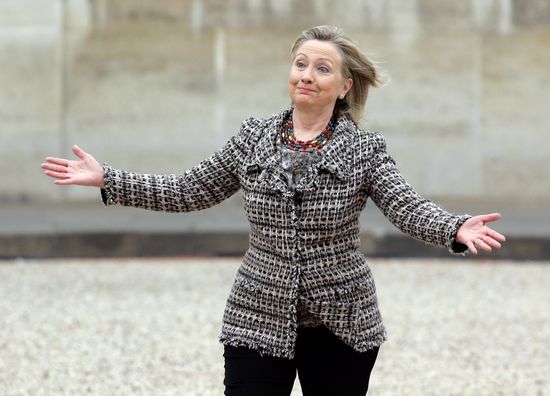
CLINTON0319FranckPrevel:AFP:Getty

I wonder if they have even factored into the administration's thinking. Let's look at the bright side. If this is all over within days rather than weeks, as Obama apparently believes, and Qaddafi leaves the country, and the rebels take Tripoli, then it will be a major feather in Obama's cap, a defeat of a murderous madman, and a new paradigm in coalition warfare, in which other countries take the lead, and a statement of America's support for those seeking freedom in a crazed, tribal and totalitarian state.

But the downsides are far more worrying. The reason this is worth considering is because without solid domestic support, wars can unravel very quickly. But this war is actively opposed by huge majorities already:

65 percent oppose the U.S. military getting involved in Libya. Opposition cuts across party lines.  Seven in 10 Democrats (70 percent) and independents (70 percent) oppose it, as do 59 percent of Republicans.

Going to war with only 25 percent public support, with no Congressional buy-in, and opposition from the defense secretary is, to my mind, a form of madness. Even the war-hungry neocons will never give Obama any credit; they will insist, even if this succeeds, that Obama should have gone in earlier; and they will mock him for following the lead of the French. The more opportunistic Republicans will exploit every failure and misstep in the war, and ask questions similar to my own. Heritage has already gone there.

Among the Democrats, there may be a faction that is thrilled with this kind of humanitarian intervention and believes in it. But one also suspects that a war launched so suddenly, without any consultation, and with no clear end-game will alienate many of those who voted for Obama precisely because he promised to end the pattern of what he once called "dumb wars," and because he promised that he would start no new wars without Congressional approval.

Moreover, the fact that this is clearly the Clintons' war – egged on by Bill, pushed through by Hillary – could exacerbate tensions between the two primary rivals. After all, why did Democrats vote for Obama over Clinton? In part because they specifically wanted less war, not more; and Clinton has never seen a war she didn't support. Her consistency from Iraq to Libya places her closer to McCain than Obama. Things are at a very early stage as the bombing begins, and these are provisional worries. But unless something miraculous happens quickly, I see this as a lose-lose proposition for the president.

And the initial optics are terrible. A president solemnly sends America's troops into action and then spirits off to Brazil to talk about jobs. How often does a president announce a war at 2 pm so he can catch a flight out of the country? And as public doubts and fears multiply, the president will be in a foreign country thousands of miles away. This is recklessness on a Bush-Cheney level.

(Photo: U.S. Secretary of State Hillary Clinton arrives before a crisis summit on Libya at Elysee Palace on March 19, 2011 in Paris, France. Britain and France took the lead in plans to enforce a no-fly zone over Libya on Friday, sending British warplanes to the Mediterranean and announcing a crisis summit in Paris with the U.N. and Arab allies. By Franck Prevel/Getty Images)

Dissent Of The Day

A reader writes:

I don’t see what you do in Obama’s action regarding Libya. Yes, the Congress is being ignored, for now, but for the first time since perhaps the 1956 invasion of the Sinai by European forces the US is not taking the lead in a military intervention. Obama’s Libya action is such a limited commitment of US military power that it may mark the end of singular American leadership, not a new military quagmire.

Ironically, Libya marked the first free lance foreign military intervention in US history and may mark the last, fitting bookends for the rise and fall of the American empire. We may be witnessing the re-emergence of a multi-polar world in the military sphere just as we have witnessed the emergence of a multi-polar economic and financial world since the start of the great recession. Good or bad, I don’t know, but to me this is the real meaning of Obama’s actions. The issue of the imperial presidency may turn out to be parochial by comparison.

This is also David Corn's point. My main concern is whether France and Britain, let alone, er, Qatar, will be able to do this without, in the end, requiring the US taking up the slack. And whether, from that point on, it becomes America's war – against a crazy regime capable of anything. And a war that may be restrained by its legal parameters from even toppling Qaddafi. But I hope to be proven wrong. And will celebrate if I am.