These are directed only at Libya's air-defenses, which is, at this point, a relief.
Month: March 2011
This Is Not A “No-Fly Zone”
It's a war to be enagaged from the air on Qaddafi's ground forces, with no guarantee of success. The Highchair Analyst:
I too was initially caught up in an emotional moment, but it became evident over the past several weeks that a No-Fly Zone would have a limited effect, especially since the largest threat to civilians has been what is on the ground and not in the air. During that time the mood shifted, particularly in Washington, from sanctions to cruise missiles.
Part of that shift may have been a concern that failing to act in Libya would be seen as a failure to support Arab democracies and would scuttle continued regional movements in that direction. However, the likely outcome from this is that events in Bahrain, Yemen, Syria, and other states will be sidelined until Libya is resolved, however long that may be. If anyone thought that Japan's disasters were a distraction from MENA's democratic movements, an expanded Libyan war will be only more so. Don't forget that within hours of Resolution 1973, dozens were killed in Yemen and Emergency Law was declared.
In the grand scheme of things, this new war could even risk derailing democratic movements elsewhere, by turning the Arab 1848 into a Western intervention question.
By changing the narrative, by not letting the Arab world find its own equilibrium, the administration may have unwittingly done damage to the revolutionary momentum.How many time can one insist: this is not about us. But Clinton, reared in the 1990s, cannot resist interjecting the US where it does not belong. And Obama's alleged remark – "days, not weeks" – is a hostage to fortune. Let me just say I will hold the president to his word. After a week, if the US has not withdrawn its forces from the Mediterranean, we should ask Obama: why not?
The cynical part of me wonders if Clinton's war is also a means of distracting the American public as the administration continues to back regimes in the region that are brutally repressing their populations – in Yemen and Bahrain – because in those other cases, the administration prefers to advance its war against al Qaeda and its isolation of Iran, rather than promote democracy.
I know they're in a tough spot. But it is because I support the Obama administration's profound shift in US foreign policy that I worry so much about this massive, misguided, and increasingly chaotic step backward.
Just Another Day In Culture
Paris Review features a weekly cultural diary from a notable figure. A sample from editor Jacques Testard:
I have a mild headache and I am only on life number three of Dalrymple’s Nine Lives. I’m beginning to think that it’s quite difficult to get any reading done at a literary festival. When we got home last night I asked Forty to pick me up at 9:30 A.M. He asked me for two cigarettes as a token of goodwill. I complied. He never turned up.
David Orr spoofs the feature:
4:20 p.m.: Realize I’m a bit drunk. Decide to call on my friend Laurence, a philosopher cum structural engineer whose father invented the ounce. We debate the merits of capitalism in light of Dior’s recent scandals and the existence of Canada. I collapse on a settee and accidentally write three erotic short stories that will be falsely attributed to Michel Houellebecq by Le Monde.
Benghazi’s “Face Of Citizen Journalism”: Dead
The Guardian reports:
Nabbous was apparently shot dead by Gaddafi forces in Benghazi on Saturday. Known as "Mo", Nabbous set up Libya al-Hurra TV, which broadcast raw feeds and commentary from Benghazi, on Livestream. … His death comes after the shooting of Al-Jazeera cameraman Ali Hassan Al Jaber in an ambush outside Benghazi earlier this week.
(Video of his last report)
Quote For The Day
"There will be unforeseeable consequences of taking action, but better take action than risk the consequences of inaction," – David Cameron, sounding eerily like Tony Blair before Iraq.
Let me acknowledge that my support for the disaster in Iraq has made me much more jittery when I hear the same kind of rhetoric I once engaged in rise through the current clamor. I may be over-reading from history and not seeing this de novo. This time it may be different.
We have ruled out ground troops and allegedly restricted US involvement to "days, not weeks." The coalition is definitely one of the willing and the US only really pushed for this in the last week.
I just hope that Cameron and Sarkozy continue in a few months' time to be as adamant on this as they are now, and that they will tax their own citizens to pay for this – for as long as it takes to win a civil war in a distant land. And that, it seems to me, is what this logically implies. Are Cameron and Sarkozy really going to be content to leave Qaddafi in power in a possible stalemate and a divided Libya? And if the part that the West controls has the oil, I hope they can demonstrate that this was not the core objective – to the satisfaction of Arab public opinion. But one suspects they haven't really thought about that yet – or dismissed it in the desire to prevent the imminent slaughter of innocents.
Boys Becoming Lonely Men
Vanna Le interviews Niobe Way, author of Deep Secrets: Boys’ Friendships and the Crisis of Connection:
During late adolescence … boys begin to lose their closest male friendships, become more distrustful of their male peers, and in some cases, become less willing to be emotionally expressive. They start sounding, in other words, like gender stereotypes.
When they talk about intimacy that might remain in their closest male friendships, they use the expression “no homo” to underscore their heterosexual status. Questions about close friendships from the interviewers become, for the boys during late adolescence, questions about sexuality. Many of the boys in our studies spoke about feelings of loneliness and isolation during late adolescence and how they missed their formerly close male friendships. We heard these patterns of loss and distrust right at the moment in development that the rates of suicide among boys in the United States jumps up to become four times the rate of girls.
Face Of The Day

“You Are Listening To Los Angeles”
A soundscape of ambient music overlaid on top of live police reports. Nicola Twilley glimpses the larger picture:
To listen to it is to be plugged into the pulse of the city; lost in fragments of someone else's story. Urgency alternates with frustration and low-level routine; some incidents are reported while others are resolved; and jaywalking tickets are issued in the same breath as lives are lost.
Eric Eberhardt, the creator, explains the project here and a guide to the police acronyms is here.
Standing By As Massacres Occur
The regime is shooting unarmed civilians at will – killing scores. We must surely stop this. Oh, wait. It's Yemen, and we support the regime. Meanwhile, the Bahrainian autocracy, backed by the Saudi theocracy, "cleanses" its capital city of the symbols of democratic hope, with the assistance of foreign troops. But we are somehow able to resist the impulse to intervene – and maintain diplomatic relations with the royal family there.
The trouble with intervening somewhere is that it begs the question of: why not somewhere else? If the motive is entirely humanitarian, and involves no "vital national interest", then how can it be compatible with allowing, say, the Iranian dictatorship to kill, shoot dead, torture and disappear countless Iranians who peacefully sought real change?
Yes, the Obama administration has now interjected American power into what was a few days ago a revolution entirely for the Arab world to resolve itself. My fear is that this decision was made without a thorough public airing of all the unanswered questions about unintended consequences. I worry that the West's involvement will merely reignite the paradigm in which the Arab world is incapable of reforming itself without meddling from the West, and revives the danger of changing the subject from the malfeasance and incompetence of the various regimes to the broader argument about the Arab world's relationship with the outside world. I remain of the view that, for reasons of prudence and constitutional propriety
The President does not have power under the Constitution to unilaterally authorize a military attack in a situation that does not involve stopping an actual or imminent threat to the nation.
In the not-so-distant past, the president agreed.
Your Brain After An Earthquake
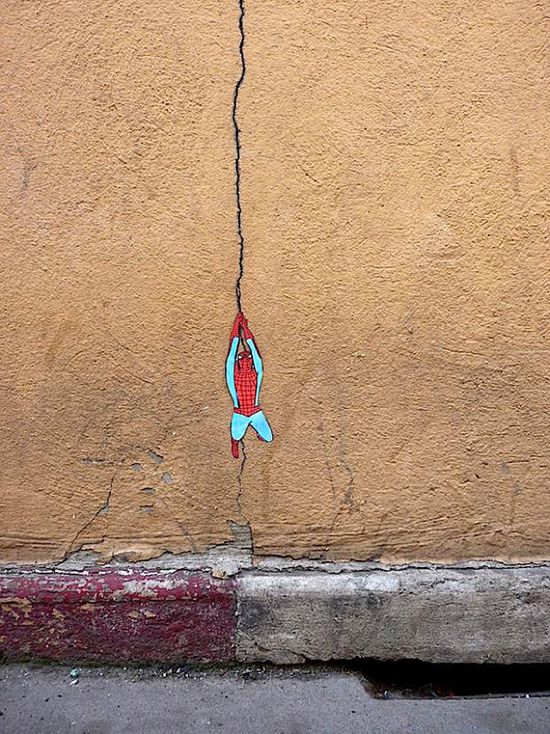
Susan Krauss Whitbourne explores empathy and coping after disasters:
Research shows that when we see others being harmed, our brains react in similar ways as if we were being harmed. The areas of the brain involved in this reaction extend beyond the amygdala to regions of the cortex involved in analyzing and interpreting the behavior of others, the so-called "theory of mind." These events also stimulate us to think of our own experiences of pain or trauma; in other words, our "autobiographical memory" … We remember the times when we were in danger or in pain and our brain, in a sense, reaches out and imagines how the actual victims are thinking and feeling.
(Photo via LikeCool)
 The Dish