The first engagement in this alleged "no-fly zone" is a direct attack on the ground forces of Qaddafi by a French warplane.
Month: March 2011
Clinton’s Triumph Over Gates
I wonder what the precedents are for a war pushed by a secretary of state against a defense secretary who explicitly and public opposes it? In some ways, of course, that may be a mercy. Gates may be our surest bet that we won't over-reach militarily and that the trigger-happy French and Brits and Italians will bear the brunt of the fighting. But I wonder how many wars the US has fought against the clear advice of its own secretary of defense?
Who Are The Rebels? Ctd
They couldn't have among them a bunch of al Qaeda enthusiasts, could they?
Gallows Humor In Japan
An instant classic:
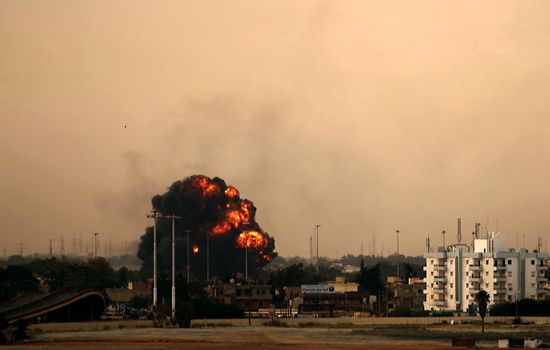
The Downed Jet
The Guardian confirms that it was the rebellion's only jet – shot down by Qaddafi's forces. Meanwhile, an impressive variety of European airforces are revving their engines:
Spanish and Belgium fighter aircraft are due to arrive in Italy before taking part in operations over Libya, a source in Italy said on Saturday. Spain would likely send F-18 aircraft, Belgium F-16s.
Six Danish F-16 fighters have landed at the Sigonella airbase in Sicily… The Italian air force has dispatched Tornado and Eurofighter aircraft to its Trapani air base in western Sicily in readiness, although Italian prime minister Silvio Berlusconi said on Saturday that Italy was supplying bases only for now.
But Qaddafi's forces appear to have penetrated some of Benghazi's defenses as the city's residents are already voicing anti-Western thoughts:
[Correspondent Chris McGreal in Benghazi] says there is a real wariness among the rebels that Gaddafi's forces were able to penetrate the city's defences and take over areas of what has been the main rebel stronghold in Libya since the uprising began. Many residents also feel let down by the West because it delayed taking military action after the UN resolution was passed. They believe they will not be safe until Gaddafi is deposed or dead.
And so the mission creep begins – even before the war has started.
This Is Not A War
P M Carpenter makes the case:
Here, though, to somewhat repeat myself, is the overarching point: I don't know how to change the real world, and neither does Obama. There are domestic politics in play, like it or not. There are diplomatic politics in play, like it or not. There are regional transformations to be pondered and weighed together and separately, like them or not. There are some bad friends to be protected and many good allies to be assuaged, like it or not. And there is the stupidity of ideology and uniform answers and the nimble flexibility of pragmatism and nuance, the first of which Obama rejects, the second of which he embraces.
Does that guarantee a splendid outcome? Of course not. But that's the real if regrettable world in which Obama operates, and most blogospheric commentators do not.
Let me say two things in response. My terrible judgment on Iraq can legitimately be used to ignore whatever I might have to say on Libya. Fine. And there is no doubt that it is easier to be a blogger than a statesman, reacting to complex events and sudden crises in real time. And I do not question the integrity of the process that led to this fateful decision, or the good intentions of those, from Samantha Power to Susan Rice, who pushed for it. I know there is no clear linear path through this riveting and unnerving period in Arab history.
My fear is the following: that, when push comes to shove, there will be no real Arab cover for this action, by which I mean Arab arms openly engaged against Libya under an Arab flag. I also suspect that Britain and France don't have the depth of military resources to do this over the long haul, and their publics, like the American one, may balk if or when the war becomes more complex or Qaddafi outlasts it. The US is the final guarantor here. And it is a heavy obligation with unknowable consequences. That's why this is so unnerving:
The president had a caveat, though. The American involvement in military action in Libya should be limited — no ground troops — and finite. “Days, not weeks,” a senior White House official recalled him saying.
So lets take him at his word, shall we? The US commitment will be "days, not weeks." How long before we hear the phrase "weeks, not months"? And how, in this bankrupt country, will this be paid for? What will be cut to budget for this? Or is this new war – begun without even the pretense of consulting the Congress or the country – going to be "off-budget" like the last two?
(Photo: Smoke billows after a Libyan jet bomber crashed after being shot down in Benghazi on March 19, 2011 as Libya's rebel stronghold came under attack, with at least two air strikes and sustained shelling of the city's south sending thick smoke into the sky. By Patrick Baz/Getty.)
A Math Genius In The Dugout
Sean Gregory attended the 5th Annual MIT Sloan Sports Analytics Conference. He envisions the future:
[S]itting next to your team's manager, a scruffy baseball lifer, in the dugout is not just another scruffy baseball lifer, spitting tobacco. Instead, by his side is a guy with a Ph.D. in theoretical physics, a beautiful mind who can calculate complex probabilities, in real time, in his head. He can tell you the odds of so-and-so throwing such-and-such a pitch to so-and-so on such-and-such a count.
In Libyan Airspace
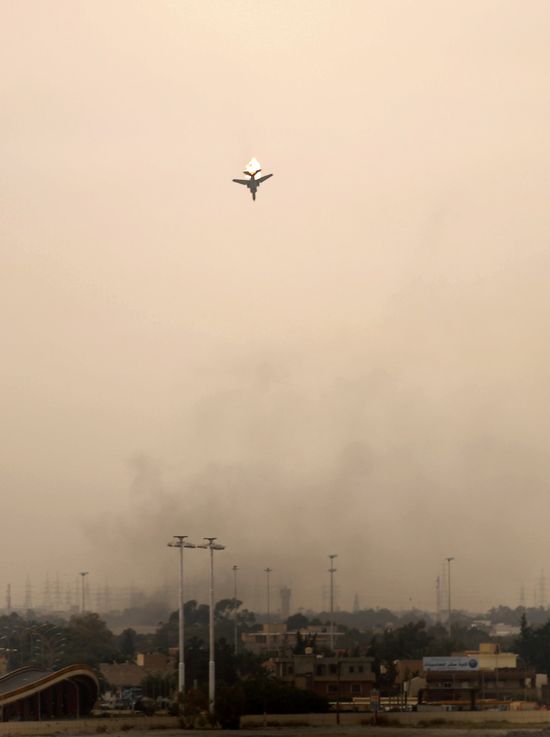
The French airforce is apparently in the skies over Libya:
French Mirage and Rafale fighters are flying over Benghazi and could strike at Gaddafi's tanks, AP quotes an official from Sarkozy's government as saying.
And the battle for Benghazi rages on:
In a telephone interview from Benghazi on Saturday morning, a rebel fighter who gave his name as Monsour said there was heavy fighting in the west of the city. He said he had seen 12 tanks from the Qaddafi forces moving through the city. Qaddafi snipers were atop the Foreign Ministry building, not far from the courthouse that is the de facto rebel headquarters, and there was fighting along Gamel Abdul Nasser street nearby as well. The government spokesman, Moussa Ibrahim, denied in Tripoli that pro-Qaddafi units were attacking in Benghazi and said that only the rebels had an incentive to break the cease-fire.
Earlier, the BBC also reported that tanks were in the city on Saturday morning. After the report, the BBC Web site was inaccessible in Tripoli, suggesting that it may have been blocked.
The photograph above shows a downed fighter plane. No one knows which side the plane was on, who shot it down, or how. Meanwhile, in Paris, the UN communique reveals:
Our commitment is for the long term: we will not let Colonel Gaddafi and his regime go on defying the will of the international community and scorning that of his people.
My italics. My fear is that interventions that promise to follow through for the long term essentially mean Western ownership or protection of an entire country. This is a vast responsibility, which now cannot be abandoned.
Welcome to the latest addition to the US's set of global responsibilities: Libya. Yes: Libya.
(Photo: Patrick Baz/AFP/Getty.)
The View From Your Window Contest

You have until noon on Tuesday to guess it. City and/or state first, then country. Please put the location in the subject heading, along with any description within the email. If no one guesses the exact location, proximity counts. Be sure to email entries to VFYWcontest@theatlantic.com. Winner gets a free The View From Your Window book. Have at it.
How We Donate
The Freakonomics blog weighs in on the charity for catastrophe debate, by excerpting from their chapter on altruism in SuperFreakonomics:
One recent academic study found that a given disaster received an 18 percent spike in charitable aid for each seven hundred-word newspaper article and a 13 percent spike for every sixty seconds of TV news coverage. (Anyone hoping to raise money for a Third World disaster had better hope it happens on a slow news day.) And such disasters are by their nature anomalies— especially noisy ones, like shark attacks— that probably don’t have much to say about our baseline altruism.
 The Dish