Do Romney, Palin, And Huckabee Support The War?

Crowley asks:

The 2012 presidential campaign is just getting underway, and the likely Republican candidates–who have generally been slippery on the Libya question thus far–will not be able to dodge this one. GOP foreign policy elites, whom the top candidates either know well or have an incentive to impress, have mostly supported a forceful intervention. (See Bill Kristol's latest.) But polls are mixed, showing public support for a no-fly zone but not for actual military strikes, which now seem a real possibility ("all necessary means…"). This could also be a defining moment for Tea Party Republicans, who have alternately shown streaks of isolationism and hawkishness. Finally, what will we hear from Obama's Democratic allies in Congress–many of them exhausted by the foreign interventions of the past decade?

We need to get all of these on the record as soon as possible. A congressional vote is a good place to start.

What If Qaddafi Survives?

Greg Scoblete picks apart Shandi Hamid's case for intervention in Libya:

From where I sit, it looks like we're moving precisely in the direction Hamid says he wants to avoid. Gaddafi is already an international pariah. If the U.S. simply adheres to the letter of the UN Resolution, which limits international action to protecting Libyan civilians but does not commit to regime change, Gaddafi may hang on, effectively partitioning Libya much as Iraq was split following the first Gulf War. In such an environment, it's quite likely that Gaddafi will turn to terrorism to seek revenge against his rivals. 

A Limited War

Dov Zakheim calls for a minor American role:

 What should Washington do now? Calling for Arab participation in military action is not enough; it will not get the U.S. off the military hook. The administration should make it clear that America's role will be limited to providing logistical and intelligence support, and enforcing a no-fly zone, while its allies attack Qaddafi's troops on the ground. The Arabs could do this, or the British, or the French, or some combination of all three and of others who wish to join in. At most, the U.S. should take out Libya's air defenses, which stand in the way of an effective no-fly zone. Even that operation could be conducted by the NATO allies.

Unless the administration specifies exactly what it is prepared to do, and not prepared to do, it will get called upon to do more than it should. 

Here's hoping we play as limited a role as possible. But one fears that the military superiority of the US will drag us further in.

The Arab “Partners”

Ah, yes. The Arab League was, according to Clinton, a "game-changer". So which members are shouldering the military and political burden of this new war? Heather Horn has a first stab here. Egypt wants its alleged military aid kept secret. But why? It couldn't be that they want the US to take the blame for attacking another Muslim country, could it? Jordan won't help militarily. Tunisia is a no-no. Syria and Algeria? Nope. Lebanon: yes, but only because of the following:

The Lebanese still want to know what happened to Imam Musa al-Sadr, "a hugely influential Shia cleric who disappeared [in Libya] in 1978. Last month a former colonel in Gaddafi's army said Libyan agents had assassinated Sadr and buried him in the southern city of Sabha." Yet at the same time, "a Libyan opposition activist … claimed Sadr was still alive," while Sadr's son believes he is "being held captive."

Well that's a good reason for a third US war. The Saudis? Too busy murdering people on the streets of Bahrain to stop another tyrant from doing the same thing. The Yemenis? Ditto. Iraq? C'mon.

Forget History (Or Not) Ctd

110111709

Thoreau thinks the comparisons between Libya and Afghanistan and Iraq aren't totally irrelevant:

[Y]ou know that narrative of a quick aerial campaign while locals on the ground take charge of the situation?  We’ve heard it before.  We enforced a no-fly zone in Iraq in support of the Kurdish uprising, as part of an ostensibly international force, and look how that worked out.  In Afghanistan, we were supposedly just providing air power and special forces trainers while the Northern Alliance rolled into the capitol city.  Nearly 8 years, 1 Nobel Peace Prize, and way too many corpses later, well, we still have ground forces in Afghanistan, and generals are still performing their annual ritual of lying to Congress about how many objectives have been accomplished.

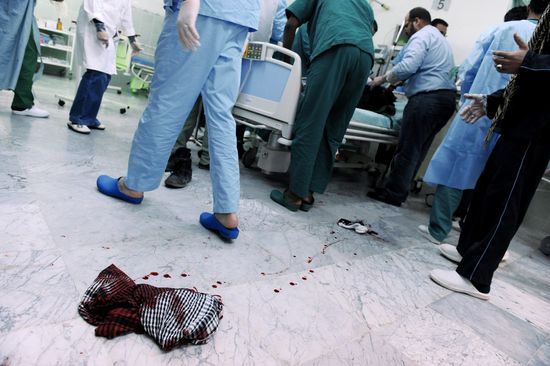
(Photo: A bloody checkered keffiyah is seen on the floor of a hospital as medics tend to a wounded rebel fighter who was wounded during clashes with forces loyal to strongman Moamer Kadhafi at the front line near the eastern town of Ajdabiya on March 15, 2011. By Roberto Schmidt/AFP/Getty Images)

The Questions To Which Obama Has No Answers

Goldblog:

Are we seeking to depose Qaddafi, who, we are informed by various American officials, has "lost his legitimacy" to rule (as if he didn't lose it when, for instance, he blew up Pam Am 103) because we just hate him more than run-of-the-mill dictators? Is it because he has committed crimes that are so unique? He's a satanic figure, of course, but he has never committed atrocities on the scale of, say Saddam Hussein, or Hafez al-Assad. Are we offended because he has launched aerial attacks against his own citizens? Of course we are, but is this really so unusual in the Middle East?

And another question: Is the goal to remove Qaddafi from power? To limit his running room? How long will the West be engaged militarily in Libya? What is the strategy here? Is there a strategy?

There is no strategy and no coherence. This is Clinton's war, launched on entirely emotional and irrational grounds.

A Slaughter In Yemen, Ctd

Ackerman targets the US partnership with Yemen:

Does the international community have a “responsibility to protect” civilians in pariah-state Libya but not counterterrorism partner Yemen?

President Obama issued a statement saying he “strongly condemn[s]” today’s violence and says those responsible for it “must be held accountable.” Huh? He’s giving those very people cash and weaponry in the name of fighting terrorism. It’s doubtful that the helicopters and night-vision goggles the U.S. supplies Yemen was used on the demonstrators. But in the case of Yemen, the least the U.S. could do would be to threaten to turn off the money spigot. Obama stopped well short of that.

But the government of Ali Abdullah Saleh is disinclined to show similar restraint. Saleh declared a state of emergency, the typical regional prelude to mass detentions, torture and killing. Unless the Obama administration does something to stop Saleh, al-Qaida’s Yemeni branch will have its next wave of propaganda footage written for it. If Egypt demonstrated that nonviolent revolution can undercut al-Qaida by rendering it irrelevant to social change, Saleh is all but inviting the terrorists back into the game.

The Imperial President

The president's speech was disturbingly empty. There are, it appears, only two reasons the US is going to war, without any Congressional vote, or any real public debate. The first is that the US  cannot stand idly by while atrocities take place. Yet we have done nothing in Burma or the Congo OBAMA0318AalexWong:Gettyand are actively supporting governments in Yemen and Bahrain that are doing almost exactly – if less noisily – what Qaddafi is doing. Obama made no attempt to reconcile these inconsistencies because, one suspects, there is no rational reconciliation to be made.
Secondly, the president argued that the ghastly violence in Libya is destabilizing the region, and threatening world peace. Really? More than Qaddafi's meddling throughout Africa for years? More than the brutal repression in Iran? And even if it is destabilizing, Libya is not, according to the Obama administration itself, a "vital national interest". So why should the US go to war over this?

None of this makes any sense, except as an emotional response to an emergency. I understand the emotions, and sympathize with the impulse to help. But I can think of no worse basis for committing a country to war than such emotional and moral anxiety. One fears this is Bill Clinton's attempt to assuage his conscience over Rwanda, rather than Obama's judicious attempt to navigate the Arab 1848. And as Obama said things like "Qaddafi has a choice," did you not hear echoes of Bush and Saddam?

At least Bush argued that Saddam posed a threat to the US. No one can seriously argue that Qaddafi poses such a threat. To launch a war on these grounds is to set a precedent that would require a kind of global power and reach that not even the most righteous neocons have pushed for. And I look forward to the actual Arab contributions to the military action. Presumably Egypt and Saudi Arabia will be involved. Or will it be what we now have – Qatar and, er, that's it? The Arab League has no real skin in this game. And one suspects, in the end, the narrative will be America bombing the Arabs again. How many civilians might the US kill in such an action? More civilians than we are currently killing in Pakistan and Afghanistan? Have we learned nothing?

The proper response to this presidential power-grab is a Congressional vote – as soon as possible.

That will reveal the factions that support this kind of return to the role of global policeman, and force the GOP to go on the record. I also look forward to the statements of the various Republican candidates in support of this president.

But it seems clear enough: exactly the same alliance that gave us Iraq is giving us Libya: the neocons who want to see the US military deployed across the globe in the defense of freedom and the liberal interventionists who believe that the US should intervene whenever atrocities are occurring. What these two groups have in common is an unrelenting focus on the reason for intervention along with indifference to the vast array of unintended consequences their moralism could lead us into. I do not doubt their good intentions and motives. No human being can easily watch a massacre and stand by. Yet we did so with Iran; and we are doing so in Yemen and Bahrain as we speak, and have done so for decades because we rightly make judgments based on more than feeling. 

A congressional vote is also important to rein in the imperial presidency that Obama has now taken to a greater height then even Bush. No plane should lift off, no bomb released, until the Congress has voted. I don't see why Obama should oppose this. He needs some Congressional support in an open-ended military commitment to ensure the protection of civilians in Libya.

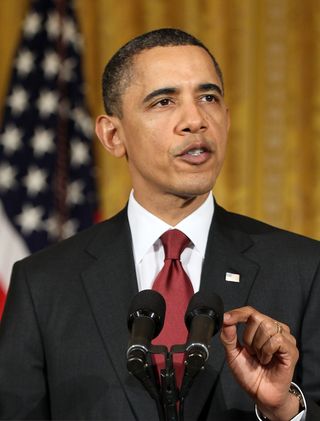
(Photo: Alex Wong/Getty.)