In Defense Of Tasteless Jokes, Ctd

A reader writes:

Much as I hate to bring the room down, I think I have some perspective to add to this whole Gilbert Gottfried episode.

My sister very recently died after a prolonged battle with AML (a form of leukemia). The last week-and-a-half, when we all knew she was dying, was incredibly traumatic for everyone in the family (my sister, probably fortunately, was largely unconscious and  unaware).  She was only 40 and has two young children, so it was really pretty horrible all around. But through the entire agonizing mess, amidst all the weeping, we were joking with one another constantly.

I don't know how tasteless our jokes were, but we would have laughed at anything. We even made dark jokes over her dead body literally minutes after she breathed her last. It sounds sickening to say it, but that's what happened. I've never experienced anything of this sort before so I don't know if this is how it normally goes, but it felt normal and natural and not at all disrespectful to me.

So I say let people tell all the damned tasteless jokes they want and let the propriety police go to hell.

Libya Reax II

LibyaLoyalistDeadGetty

I'm waiting for the president to make the case for a third war in a Muslim country, and taking sides in a civil war in a chaotic non-state. For me, the salient precedent is Somalia – a humanitarian intervention that became a nightmare. Meanwhile, a trip around the blogosphere: Jonathan Chait:

[T]he neocon model of standing up to aggression, while frequently wrong, is not always wrong. The model holds that dictators are like bullies, and if you make clear you'll stand up to them, they'll back down. … Opponents of intervening in Libya all seemed to assume that the threat of force would automatically mean employing force. This may not turn out to be a correct assumption.

So Qaddafi will immediately give up? Who is Jon kidding? Ryan Avent:

[H]aving involved itself here, it's not clear how the mobilising powers will be able to avoid action elsewhere in the Middle East. It is also being reported today that the Yemeni government fired on protestors, killing at least 26 of them. UN action could conceivably empower other protesters in other countries to take a more vocal and aggressive line against oppressive regimes. Which could be a good thing, but only to the extent that UN members are actually prepared to intervene to prevent massacres.

Exactly. This precedent, based on pure emotionalism, begs many questions. Why do we not intervene in Bahrain, where the government is shooting protestors at pointblank range? Why are we standing by while massacres occur in the Congo? Or the current atrocities in the Ivory Coast? There is no logic here – just emotion. Larison agrees:

An arbitrary, rather odd decision to treat the Libyan civil war as the greatest political crisis in the world will create the expectation of foreign support in other internal conflicts. That is likely to encourage rebellions and civil conflict. If a group believes it can win foreign support and political concessions by provoking a sufficiently brutal crackdown, that will make it more likely to rise up against its government, which may lead to humanitarian catastrophes that the “responsibility to protect” is supposed to prevent.

Kori Schake:

Stepping back and letting others do the work certainly isn't a bold or brave moment for American foreign policy, and it will have consequences that our government has been so stingy in support of the cause of freedom. But President Obama just isn't willing to bear much freight for other peoples' freedom. The only thing worse would be him committing our military forces to a fight he has little real interest in.

Ross Douthat:

In a sense, David Frum is quite right that “to a war-weary US public, there is only one argument that will be persuasive re Libya: rapid success.” But the difficulty is that nobody has even defined what success would mean. The survival of the rebellion? Qaddafi’s ouster? Complete regime change? A democratic Libya at peace with its neighbors?

Exactly. Lets say the no-drive zone somehow halts Qaddafi's progress toward Benghazi. What then? Are we obliged to maintain the intervention indefinitely? Are we supposed to stay in the fight until the rebels win and retake Tripoli?

Peter Feaver tries to get inside Obama's head. The most hopeful possibility:

Perhaps the Obama administration has cleverly figured out a way to bring about the neoisolationist fantasy of the 1990s: making the rest of the world shoulder the load of global policeman. Many of the critiques of U.S. military intervention over the past twenty years have been critiques of U.S. involvement, not military intervention, per se. The cases in Somalia, Haiti, Bosnia, Kosovo, and so on were deemed not to be in our interest. Perhaps they required military intervention, but let someone else bear the costs.  

I look forward to the Arab countries (so far totally unspecified) really contributing to the fight when the going gets tough. Ditto the French and British. Do these former imperial powers really want to establish a protectorate in Northern Africa again? Why not just get Italy involved and be done with it?  Andrew Sprung:

The closest analogy from our history in Iraq is not Bush's all-but unilateral invasion in 2003 but the Shiite uprising in the immediate aftermath of the first Gulf War. … That doesn't necessarily make the planned action in Libya less fraught with unknowns than moving against Saddam would have been in 1991 (though the scale of risk is less, since Libya has about 1/5 of Iraq's population and far less military capability than Iraq had in 1991).  But it's not the repeat-folly of 2003 that some are making it out to be, either.

Kevin Drum:

I doubt that Qaddafi has simply folded his tent in the face of a UN resolution. More likely, he's taking a breather to figure out how to continue prosecuting the war in a way that's relatively safe from air power alone. If that's the case, what's Plan B?

We'll see if there is a Plan B. But this kind of impulsive interventionism never has a Plan B. There is barely a Plan A.  Adam Serwer:

The problem is that we still don’t know very much about who the rebels are or what they ultimately want. Libya’s internal politics were opaque to the West even before the war. We don’t know how much international involvement will be required to ensure Gaddafi falls, or what level of commitment the United States, as the world’s only superpower, will ultimately be forced to make. In other words, none of the key questions looming over the crisis have been answered — even though we’ve already learned the hard way in Iraq what happens when we fail to plan for the peace before we start a war. All we really know right now is that America is destined to own the outcome in Libya.

Does anyone believe for a second that Obama was elected first over Clinton and then over McCain in order to perpetuate exactly the policies McCain and Clinton support. Has Hillary ever opposed any war in the last twenty years? Tom Ricks supports intervention. Still, he asks:

[W]hat do we do when Qaddafi puts anti-aircraft batteries in mosques, orphanages and chemical weapons depots?

I welcome the fact that the world at last seems willing to exercise its so-called "duty to protect" people at risk from their own governments. The failures to do so in Rwanda and Darfur and so many other charnel houses is a blot on its conscience that will never be erased. But there is no escaping the fact that this new entanglement was decided upon behind closed doors at the UN and with very little public debate here in the United States. None of this will matter if the end comes quickly. But if things go wrong and America is drawn deeper in, the domestic consequences for the president could be far-reaching.

Philip Gourevitch:

[W]hat about American public opinion? What about Congress? Is the Security Council the only place where this should be deliberated? What about some attempt by our Commander-in-Chief to advise and seek the consent of the electorate before we march into battle overseas? What we know about these rebels is that we have a common enemy, and that they cannot fight for themselves. That is how our newest war begins. Nothing about it may ever be so clear again.

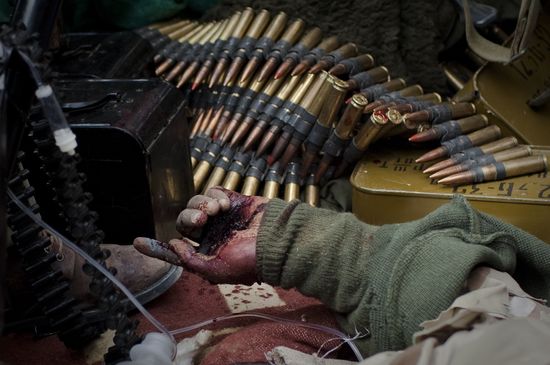
(Photo: A captured dead Libyan government fighter is brought by the rebels to the center of Benghazi, eastern Libya, Friday, March 18, 2011. A rebel spokesman said Moammar Gadhafi's forces were still shelling two cities. By Anja Niedringhaus/AP)
A Slaughter In Yemen

Al Jazeera reports on the worst violence to come out of that country since the Arab 1848 began:

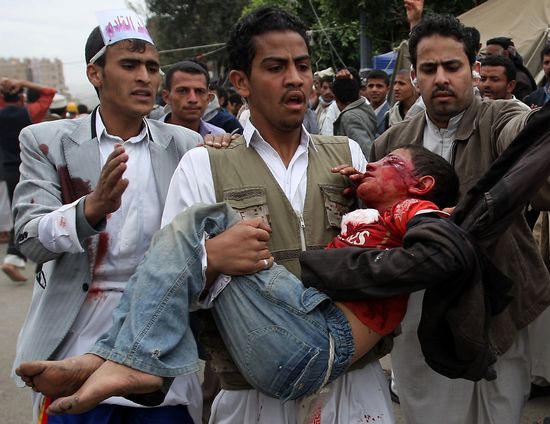
At least 41 people were killed and scores wounded after the Yemeni security forces opened fire on protesters at University square, in the capital Sanaa. Security forces opened fire in attempts to prevent protesters from marching out of the square where they were gathered, sources said. Medical sources said the death toll was likely to rise. Pro-government "thugs" also opened fire on protesters from houses close to University square, witnesses told the AFP news agency. Muttahar al-Masri, the country's interior minister, put the death toll at 25, and said that a curfew was being imposed as part of the state of emergency.

More details:

Shooters in plain clothes fired down on the demonstration from rooftops and windows straight after the protesters rose from their noon prayers. … Xinhua reported that children were among the casualties. "The child was hit by a bullet in his head," an eyewitness named Twific al-Yaziday told Xinhua, adding that there were more than 20 others were wounded in heads and necks.

A graphic image of one of those victims after the jump:

110404973

President Obama has issued his "strongest statement yet" against the regime. Check for updates at Armies of Liberation.

(Photo: Wounded Yemeni anti-government protesters rush a wounded youth to get medical treatment during a demonstration in Sanaa on March 18, 2011 as more than 30 anti-regime protesters were shot dead and over 100 wounded, medics and witnesses said. By Ahmad Gharabli/AFP/Getty Images)

Rebecca Mansour: The Big Reveal, Ctd

A reader writes:

That LAT profile was not quite the "big reveal" concerning where this woman is coming from. I am 42 and grew up in Royal Oak, Michigan and attended Bishop Foley Catholic High School in Madison Heights, probably five or six years ahead of Rebecca. I did not know her, but was very familiar with the extended Mansour clan throughout primary and high school. There were always Mansours in my grade, the grades ahead of me, and the grades behind. The network of siblings and cousins was a force unto itself.

Southeast Oakland County, directly north of central Detroit, is the product of the white flight that peaked in the sixties and seventies. Whole parishes from Polish, Irish and Italian neighborhoods reconstituted and interbred with the "non-ethnic" Catholics in Oakland County as development boomed. In retrospect, it is amazing that I remember no ethnic tension whatsoever (other than occasional "Polack" jokes) in this lily-white environment. Few of my classmates were ever likely to encounter a black face; they were safely confined south of the mysterious and dangerous "Eight Mile."

The Mansours were the closest thing we had to "negroes." Some of them integrated better than others, but they were known as the "Arabs" and were outsiders in a precarious environment. I remember when my classmate's uncle was killed; the common understanding in our high school was that we was the kingpin in a drug deal gone bad. If anything, it increased the Mansour "cred" at the time (mid-eighties) when gangsta rap was first making headway in the suburbs.

The funeral was staggering, as the huge extended family took up the front third of the large church. It was the first time many of us realized that Catholicism was their traditional faith from Lebanon and not an attempt at assimilation. But the strength of their family as a community was unlike any of our own experiences as atomized modern suburbanites.

Rebecca Mansour grew up in a legitimate variation on the values mouthed as slogans by the Palin ilk (community, family, strength in adversity, overcoming the "haters," etc.). The amazing irony is that the undertone of the Palin rhetoric ("real Americans," homogenous, white and leary of the "other") is the very undertow the Mansour family swam against during her childhood.

Face Of The Day

LibyaRAF-JeffJMitchell-Getty

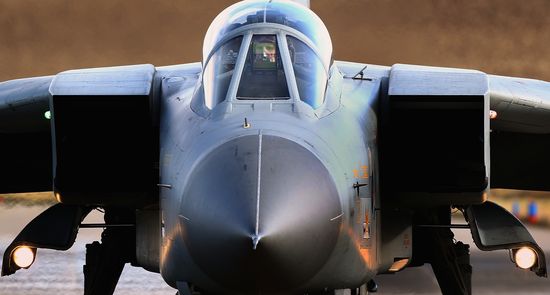
A pilot lands a RAF Tornados at Lossiemouth air base on March 18, 2011 in Lossiemouth, Scotland. UK defence forces will help to enforce a no-fly zone over Libya after the UN voted in favour of a resolution that backed "all necessary measures", except a foreign occupation force, to protect Libyan civilians. By Jeff J Mitchell/Getty Images.

Who Would Give Up A SWAT Team?

A reader writes:

Surely rhetoric plays a role in the way drug arrests are carried out, but there's another reason. During the hysteria over the crack epidemic in the 1980s, more and more money flooded police forces to create SWAT teams. This wasn't just in the big cities dealing with what was a really big problem. In small cities and towns across the country, police departments created elite militarized forces.

My first newspaper job was in a small town in Colorado in the late '90s that was as far from the problem as you could imagine. They had a SWAT team there, and rather than draw it down once everyone realized crack would never be a problem there, the police started deploying it for pot busts, domestic abuse cases – basically anything more than a traffic stop.

As I worked around the country, moving up to bigger papers and cities, I found the same thing. No matter the drug threat, the police had elite tactical units. After 9/11, those became terrorist-fighting forces. A friend of mine lives in Boise, Idaho, one of the last places anyone would expect terrorists to strike. Yet, money flowed there, just as it did around the country, to beef up preparedness, and often, to buy really big guns for the cops.

The goal for any government bureaucracy is to turn "temporary" funds into a permanent line item in the budget. So again and again, these SWAT forces get deployed; police brass make a big show of it and increase their level of rhetoric to match the threat they want to communicate.

There's an old saying: Use it or lose it. I get the sense that police across the country have taken this to heart.

Why Libya?

Evan Levine points out how we've ignored Ivory Coast:

The case of Libya is not the same as Ivory Coast, but it is another example of situation where a leader has lost his legitimacy, has refused to leave office, and has engaged in an armed conflict to protect his status. Sure, we are yet to see a full resumption of civil war in Ivory Coast and no planes or helicopters have been used during recent events, but I also don't see anyone clamoring for an expanded role for the US or even the UN either, at least not above and beyond the UNOCI's mission. And there have definitely not been calls for airstrikes.

The NYT And The Blogosphere, Ctd

Dave Winer thinks the NYT has focused too much on itself:

They're not offering anything to readers other than the Times' survival, and they're not even explicit about that. Wouldn't it have been wise to, at this juncture, offer something to sweeten the deal. Something truly exciting and new that you get when you pay the money. Something that makes your palms sweat and your heart beat faster?

I put down $700 last week to get a few minor improvements to my iPad. If they had said "Give us $700 so we can survive," well, I might have done it. But I feel better about getting the new features.

Darrell Etherington finds the new plan myopic when it comes to apps:

[A]pp users will be most affected by the new subscription plan. Apps will still work for iPhone and iPad readers, but they’ll only provide access to the Top News section (remember the Editor’s Choice app? Like that.) and all other content will require a digital subscription. No monthly limit will apply in either app.

This, I suspect, might be where the Times sees its biggest decline in readers. Light to moderate app users faced with the choice of becoming a digital subscriber or going back strictly to the web with its broader access, I think most will choose the latter, which could hurt the Times’ ability to attract lucrative advertising deals to the apps.

Nieman Journalism Lab rounds up more reactions to the new pay-fence.

(Hat tip: Chris Rovzar)