Our Libya Gamble

LibyaFlagGetty

Marc Lynch's view of Libya is worth reading in full. Two key paragraphs:

 The intervention is a high-stakes gamble. If it succeeds quickly, and Qaddafi's regime crumbles as key figures jump ship in the face of its certain demise, then it could reverse the flagging fortunes of the Arab uprisings.  Like the first Security Council resolution on Libya, it could send a powerful message that the use of brutal repression makes regime survival less rather than more likely. It would put real meat on the bones of the "Responsibility to Protect" and help create a new international norm.  And it could align the U.S. and the international community with al-Jazeera and the aspirations of the Arab protest movement.  I have heard from many protest leaders from other Arab countries that success in Libya would galvanize their efforts, and failure might crush their hopes.  

But if it does not succeed quickly, and the intervention degenerates into a long quagmire of air strikes, grinding street battles, and growing pressure for the introduction of outside ground forces, then the impact could be quite different. Despite the bracing scenes of Benghazi erupting into cheers at the news of the Resolution, Arab support for the intervention is not nearly as deep as it seems and will not likely survive an extended war.  If Libyan civilians are killed in airstrikes, and especially if foreign troops enter Libyan territory, and images of Arabs killed by U.S. forces replace images of brave protestors battered by Qaddafi's forces on al-Jazeera, the narrative could change quickly into an Iraq-like rage against Western imperialism.   What began as an indigenous peaceful Arab uprising against authoritarian rule could collapse into a spectacle of war and intervention.   

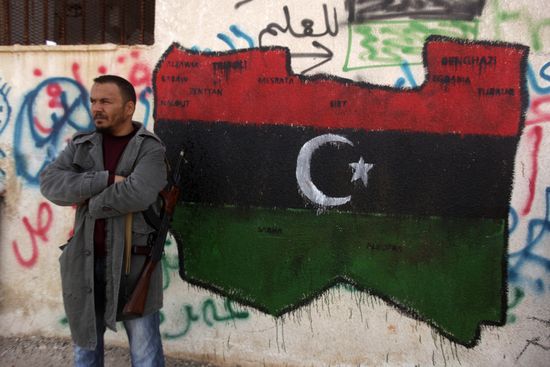
(Photo: A Libyan rebel stands next to map of Libya painted on a wall in the center of Benghazi on March 18, 2011. Patrick Baz/AFP/Getty Images)

The Future Of Earthquake Alarms

Richard Allen says that within "seconds of an earthquake’s first subtle motions, scientists can now predict with some certainty how strong and widespread the shaking will be." How this could save lives:

If an earthquake early-warning system had existed [for the 1989 Loma Prieta quake in the San Francisco area], it could have provided perhaps a 20-second warning to the heart of the region. This is enough time to slow and stop trains, issue “go around” commands to airplanes on final approach and turn street­lights red—preventing cars from entering hazardous structures such as bridges and tunnels. Workers in hazardous work environments could move to safe zones, and sensitive equipment could enter a hold mode, reducing damage and loss. Schoolchildren and office workers could get under desks before the shaking arrived. The region would be ready to ride out the violence to come.

Libya Dissents

A reader writes:

Thanks for posting my email, but I think you misrepresent it slightly.  You still do not acknowledge that the U.S. has not yet committed itself to anything.  It has only supported a UN resolution that authorizes, but does not require, us to do anything.  There is still plenty of time for Congressional and public debate about how the US should get involved in this, if at all.  We have not declared war on anyone. 

Another writes:

I think you should slow down on suggesting that Obama is more imperial than Bush. Legally, Obama can introduce the American military into hostilities so long as he submits a report to Congress within 48 hours. In this situation, the onus is on Congress to check the executive. I'm not saying going into Libya is the right thing to do, but it's not illegal – yet.

Another:

It seems to me that your concerns about U.S involvement in Libya, while well-founded, are built on a major flaw. This is not the U.S. declaring war on Libya; this is the UN authorizing intervention in a failing state in order to prevent massive loss of life. This is the purpose of the UN. What you're suggesting is that the UN has no authority to try and halt conflicts and bring an end to Crimes Against Humanity simply because the US may be involved. That's not just wrong; it's ridiculous.

Another:

It is astonishing to see all the arguments that many of us tried to make prior to the Iraq War, but which were contemptuously dismissed by hawks such as yourself, being trotted out to justify total inaction in Libya.

The two situations are not in the least bit analogous. In Iraq there was no uprising; there was an invasion. What we are talking about in Libya is an essentially humanitarian intervention; there is a one-sided massacre taking place, with a despicable regime crushing a legitimate resistance with massive military superiority. Why should we not have a moral responsibility to take what actions – within reason, good sense, and sound strategy – that we can in order to ameliorate the human tragedy that is unfolding before us?

No one is asking Obama to invade Libya and create a resistance where there wasn't one to begin with. That would be a foolish thing to do. But it is really galling when the very same people who argued so vociferously for invading Iraq now oppose an exponentially more limited engagement with a clear humanitarian goal – and use Iraq as their justification!

Another:

It is interesting how quick you were to support Bush when there were numerous fallacies, inaccuracies and fear-mongering. We engaged in a pre-emptive strike (a war of aggression) pretty much on our own. This is not the same. Not even close. The hypocrisy of rationalizing a war of aggression with NO support from civilians in Iraq or the region (and support of US citizens garnered only from outright lies by the Bush administration) versus being begged to intervene, along with the UN, and promising not to put boots on the ground but primarily protect civilians. How do we look to the world when we refuse the pleas of a genuinely democractic uprising and a certain impending massacre by a truly certifiably insane dictator?

Sometimes, sir, I think you try to hard to vindicate your previous mistakes. Unfortunately, I think your lack of support here will be another mistake on your part.

Another:

We so often agree that I'm actually emotionally moved by my level of disagreement with your almost hysterical reaction to the UNSC vote. The vast majority of an Arab nation decides it will no longer tolerate a life under tyranny and undertakes a revolution that calls for greater freedoms – a revolution that has so far been unmarred by Islamism. The tyrant responds by murdering civilians, indiscriminately, including from the air, crushing the movement almost completely. The UNSC then, in a 10-0-5 vote, authorizes multilateral action. And at this you go into paroxysms of outrage?

Another:

I have a hard time believing that the Obama administration is enthusiastic about committing U.S. forces to this exercise. The alternative would have been to abstain from the U.N. resolution … with China and the Soviet Union. This could prove disastrous, but it may also prove an example of a new American disposition to be followers in such ventures, rather than leaders.

And the crowds in Benghazi sure don't feel like we've declared war on them.

Another:

Look, I understand that the way the administration is going about this is eerily reminiscent in a number of ways to the planning-and-execution debacle that was the Iraq War: moralistic proclamations of needing to fight for liberty in a distant Arab country that doesn't want us physically there, an unfunded and undeclared military expedition (putting it generously), and no real answers yet as to exit plan. Again, I get where you're coming from.

But isn't it a little unreasonable to say that, pace Senator Lugar, "U.S. interests would [not] be served by imposing a no-fly zone over Libya"? Sure, it's fraught with risks. But unlike Iraq, there's actual evidence to back up the Bush-esque rhetoric about "the people over there" wanting our help. I'm sure you believe, as any reasonable person following the Middle Eastern protests and uprisings right now would, that preventing the stillbirth of the "Arab spring" in Libya will ultimately help suffocate the fires of violent extremism against the United States. Isn't that worth protecting? Viewed through that lens, I don't see how it's not ultimately a vital U.S. security interest.

Another:

Wouldn't it be fair to say that while the invasion of Iraq was a disaster, the earlier decision to impose a no-fly zone on Saddam Hussein after the Gulf War saved the Iraqi Kurds from a genocide, and did not even come close to overstreching the resources of the US?  It was the right thing to do.

Another:

Andrew, take a deep breath and relax for a second. This is not Iraq – and I should know, because I fought against that war for years and years while people like you were championing it for reasons I still find mindboggling.  It's not Afghanistan either, in so many ways that the comparison seems positively daft.  Muslims live in both places, but what of it?  Compose an argument against this intervention if you must, but leave the guilt in the margins.

It's not a war against Libya; it's an intervention against a crazy person who used to, but can no longer, represent or control Libya.  Remember: Gaddafi was down to one city at one point, a city being put down not by a loyal, valid Libyan faction but by foreign mercenaries indiscriminately firing automatic rounds into people and houses.  Right now, Benghazi is the only actual part of Libya, and we are acting to protect it.

This is an international humanitarian intervention, not a war.  Congress doesn't need to approve – but more importantly, it would approve.  And Americans will approve.  Iraq was sympathetic because it had been lied about, smothered, and used from day one. Diplomacy was never really tried.  That is not what we're seeing and smelling here.

The Libyan people have been begging for weeks.  The only thing we did wrong here was wait so damned long to get involved.  If you don't think one city can speak for Libya, think back a couple weeks and re-run the math.

Iraq and Afghanistan are terrible wars of exploitation and misintention.  Intervention in Libya is the right thing to do, done out of generosity and with no particular self-interest.  More importantly, it is an ACCOUNTABLE ACT, whereas Bush's wars were made without consideration for anyone else's opinions or goals.

When I say it's accountable, I mean this: it's not our idea.  This isn't American over-reach with a vast set of selfish ideas behind it; it's an act that a) was requested by the people of Libya and b) is fairly universally supported around the world.  This is Obama being accountable to the world community on behalf of the United States.  To have acted on Hussein, and not to act on Gaddafi – that would be the truly backwards and wrong thing. 

This is accountable to Libyans, to universal values and to human rights.  It's also accountable to those like me who can't stand the idea of the US not stepping into a relatively predictable conflict in a nation that will have few of the challenges of Iraq and Afghanistan in getting back up afterwards, and none of the major ones.

Here's where I go out on a limb, and you can hold me accountable for this if it turns out I'm wrong and you're right: this is going to be no more than two months, and probably much shorter.  We will bomb Gaddafi's forces and their air support, and once the mercenaries realize they are no longer with such an advantage, they will quit Libya and leave Gaddafi to the mercy of Libyans. Libyan rebels will be greeted as liberators by Libyan cities one by one.  This will be Obama's Kosovo.
Why Punish The Young?

Frum asks:

For the under-40s who will be exposed to the fullest impact of entitlement reform, the past half decade has been an economic disaster. Now we are about to load an additional burden on a generation already struggling with under-employment and (in many cases) heavy student debt. We also are about to ask them to simultaneously pay the taxes to support current retirees and save for their own retirement, while receiving less help from later generations than earlier generations will receive from them.

Douthat agrees.

Palin In India

Different country, same contempt for the press:

It appears that our coverage from yesterday has been a source of great consternation in the Palin camp – which was not the intended result of our reportage. Since last evening there has been a virtual blackout of all information about her movements.

IRTV would want Ms. Palin to enjoy India to its fullest and would like her to know that we wish her well. And since we have established that someone from their team is actually viewing this blog, as no other media outlet is covering Ms.Palin (they are, it appears, not interested), we are confident that this message will get passed on to her.

NOM FAIL

The headline news today is that the case for same-sex marriage – once a pipe-dream of a minority even within the gay community – is now a majority opinion in America. The shift remains one of the swiftest in social and political history. Look at this:

Compared with five years ago support for gay marriage has grown by 10 points among women, but by 18 points among men; it’s now at parity. Support has grown by 17 points among Democrats, but also by 13 points among independents, to a clear majority, 58 percent, in the crucial political center. And it’s 63 percent among moderates, up 21 points.

Support is up by a striking 23 points among white Catholics, often a swing group and one that’s been ready, in many cases, to disregard church positions on political or social issues. But they have company: Fifty-seven percent of non-evangelical white Protestants now also support gay marriage, up 16 points from its level five years ago. Evangelicals, as noted, remain very broadly opposed. But even in their ranks, support for gay marriage is up by a double-digit margin.

I’m struck but not surprised by the huge swing among white Catholics. The one thing I can say as a gay Catholic is that my fellow Catholics have never felt hostile to me or my kind. I have experienced not one ugly incident or statement from my peers. Only the Pope and his acolytes wound and wound again in their misguided panic. But the Holy Spirit lives on – in the pews, if not in the Vatican.

Solidarity Is The Norm

110264753

Jesse Walker draws lessons from the quake:

Disaster movies and disaster research might as well come from different planets. When Hollywood shows you an earthquake, an eruption, or a towering inferno, you see mass panic, stampeding crowds, maybe a looting spree. When sociologists study real-life disasters, they see calm, resourceful people evacuating buildings, rescuing strangers, and cooperating nonviolently.

… These patterns shift somewhat from culture to culture, and if a disaster coincides with certain conditions—severe class distinctions, a serious pre-existing crime problem, a police department that's especially corrupt—a post-disaster riot may break out. But that's the exception, not the rule. On Monday, Ed West of the London Telegraph asked with awe, "Why is there no looting in Japan?" A better query would be, "When people do loot, what prompted the plunder?"

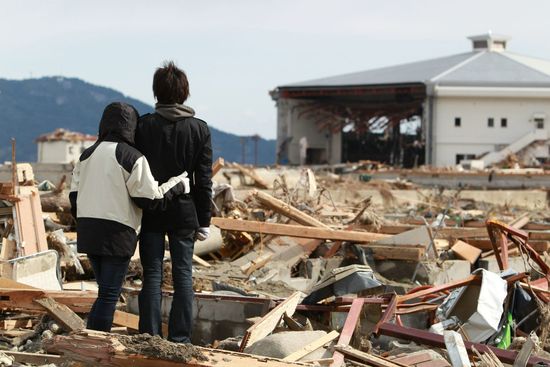
(Photo: A man and his sister stand before their broken house, destroyed by the tsunami at Rikuzentakata in Iwate prefecture on March 17, 2011. The official number of dead and missing after a devastating earthquake and tsunami that flattened Japan's northeast coast has hit 14,650, police said, a rise of nearly 1,000 in just a few hours. By Jiji Press/AFP/Getty Images)

Libya Reax

LibyaCelebratesGetty

[Re-posted from late last night.]

Greg Scoblete:

When the Bush administration wanted to wage a war of choice against Iraq, it at least spent several months building a public case. The Bush administration had to resort to some wild rhetoric about the possibility of the United States getting nuked, but at least it was making a case built (however absurdly) on American security interests. What has the Obama administration said? What interests are at stake? Why is American security at risk if we do nothing? 

Shadi Hamid:

For realists, I would love to hear how doing nothing in Libya was going to help U.S. security interests. Having an oil-rich pariah state that could very well return to supporting terrorism and wreaking havoc in the region would be just wonderful, creating Iraq part 3 and making it more likely we'd have to intervene sometime further into the future, at much greater cost and consequence.

Alex Massie:

Like it or not we are now in it for the long-haul. The history of UN-mandated missions does not support the notion that this will be a quick or easy campaign. The UN is still present in Bosnia and Kosovo and it seems quite possible, even if this mission achieves its stated goals, that it will be in Libya for years to come. That's probable, surely, even if or perhaps especially if the end result is the partition of Libya. Indeed,a Kosovan-style outcome may now be the best available.

Spencer Ackerman:

The question naturally becomes: what’s victory? How does this end? The United Nations has approved a tactic. It hasn’t set out a strategy. The fact that France showed more enthusiasm than the U.S. for the no-fly zone underscores the lack of agreement about just how far this intervention will go. Logically, the endstate implied by the U.N. vote is the end of Gadhafi’s rule over Libya. But it’s far from certain that’s what nations signing on to a no-fly zone are committed to bringing about, especially if Gadhafi proves to be resilient.

Daniel Larison:

[T]he resolution is going to put the U.S. on the path to regime change in Libya, but one problem is that the path is still anything but clear. As of right now, the Security Council hasn’t authorized anything like a campaign to destroy Gaddafi’s forces in the rest of Libya, except insofar as it involves enforcing a no-fly zone. This won’t involve a concerted attack on the centers of his power in Tripoli and elsewhere. The war that many Libya hawks want is apparently not the one they’re going to get, at least not yet, but it raises the question of why the U.S. and our allies are going to start a war with Libya for the sake of essentially freezing the conflict more or less as it is and turning rebel-held zones into our protectorates. It’s as if the entire thing were designed to play into Gaddafi’s propaganda that outside governments want to divide Libya.

Kevin Drum:

[I]t strikes me that if the United States had aggressively endorsed action against Libya from the start, this would have created a tremendous amount of suspicion around the world about our intentions, and that might have been enough to derail global support. It would have been, yet again, America plus a few allies vs. everyone else. As it's played out in real life, however, other countries have taken the lead, which forces them to be truly committed to this operation, and opposition has been muted because the whole thing didn't turn into yet another big power pissing match.

David Frum:

[T]hree wars is a lot even for America. It makes even a hawk like me wonder: has the US gone too long on Afghan futures? If Libya (an oil-producing country 300 miles from Sicily) is deemed not a vital interest of the US, how much less vital is Afghanistan?

(Photo: Libyan rebels celebrate in Benghazi on March 17, 2011, the United Nations Security Council's resolution to impose a no-fly zone over Libya. By Patrick Baz/AFP/Getty Images)

The Normalization Of The Surveillance State?

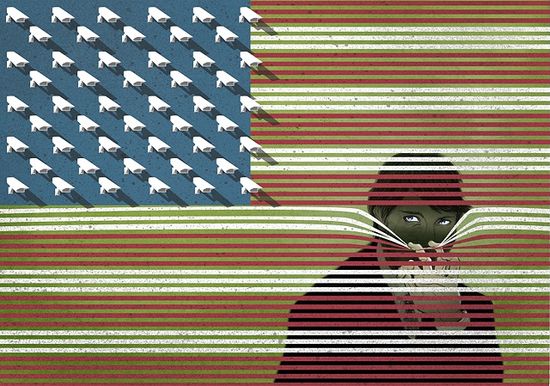
SurveillanceFlagWillVarner

Jack Balkin is appalled by the treatment of Bradley Manning. His view of the bigger picture:

[My view] is that Obama has played the same role with respect to the National Surveillance State that Eisenhower played with respect to the New Deal and the administrative state, and Nixon played with respect to the Great Society and the welfare state. Each President established a bi-partisan consensus and gave bi-partisan legitimation to certain features of national state building.

After the Obama presidency, opponents of a vigorous national surveillance state will be outliers in American politics; they will have no home in either major political party. Their views will be, to use one of my favorite theoretical terms, "off the wall."

(Image by Will Varner)

Learning How To Disagree

Ursula Lindsey eagerly awaits Egypt's constitutional referendum:

However the vote goes (and I do hope that it is at least generally organized and clean), it's been fascinating to watch this debate explode, and to see the level of political awareness and curiosity after so many years of cynicism and resignation. It strikes me that there is quite a bit of discomfort not just with challenges to authority but with differences of opinion in Egyptian society today, and part of the road ahead is learning to publicly, forcefully but civilly disagree. Unfortunately, the army is proving that it doesn't really get democracy and public debate by issuing an order that nobody discuss the referendum for the next 48 hours.