“The Nuclear Renaissance Is Stone Dead”

110121515

Euan Mearns opines:

This is already the worst civil nuclear power accident in recorded history – Chernobyl was a military reactor and the Windscale reactor fire in England in 1957 was never properly recorded. The social and economic costs I believe will already exceed Chernobyl given the location of this event close to the heart of the world’s third largest economy. … Decisions made now in the wake of an emergency in Japan may sow the seed of energy poverty in countries like the UK for decades to come.

Josh Green differs. In America, he thinks "the prospects for a deal on more nuclear power may yet survive."

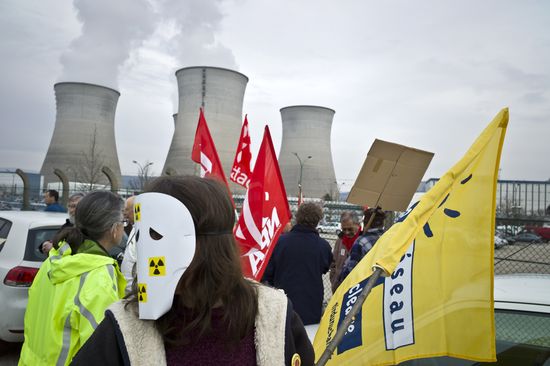
(Photo: People demonstrate in solidarity with Japan and to call for the halt of the production of nuclear energy in front of Bugey's nuclear plant on March 15, 2011 in Saint-Vulbas near Lyon, France. By Jean-Phillippe Ksiazek/AFP/Getty Images)

Why Some Revolutions Fail

Hisham Melhem outlines a major reason:

In homogeneous societies it is relatively easier for an opposition or a reform movement to articulate and agree on a set of grievances and political demands. It is more difficult to do so in heterogeneous societies, where the various groups have different pressing priorities and different visions about their society and the future. Also, it is easier for the rulers in heterogeneous countries to dilute and undermine demands for political change and reform by exploiting the various cleavages that exist in their societies.

These options were not available for former presidents Ben Ali and Mubarak.

In Lebanon, all politics is reduced to sectarianism. In Jordan, political and economic problems are viewed through the prism of Jordanian-Palestinian cleavages. In Yemen, where the population is heavily armed, political demands are undermined by the exploitation of tribal, sectarian and regional differences. In some Arab countries, significant religious and ethnic groups are disenfranchised; for example, the Shia in Saudi Arabia, Kuwait, and particularly Bahrain, where they constitute the majority; the Kurds in Syria; and the Berbers in Algeria. The legitimate grievances of these groups cannot be denied any more. In Bahrain, where the Shia majority has long complained of systematic discrimination in the political and economic spheres, calls for political and economic reforms are reduced to ‘identity' politics or worse, and are seen by the ruling Sunni royal family and its supporters as driven by sectarian interests or ‘outside powers'.  

“The Time Pressure Is Intense”

Julian Borger looks at the logistics of setting up the UN-approved no-fly zone:

If this had been a Bush-era 'coalition of the willing' operation, it could have been put into action quite rapidly. The US would have done all the fighting with a few token British and French planes along for company. But the Obama administration, which tried very hard to avoid this moment, is insistent that the Arabs and Europeans must at least be seen to take the lead, and that will take more time. There is a trade-off between speed and making it look right.

… The time pressure is intense. If Benghazi falls before the air operation gets off the ground, it would be the worst of all worlds. Gaddafi will have defied the UN, and any subsequent air strikes against his forces could simply worsen the reprisals against the rebels and the people of Benghazi.

Richard Norton-Taylor goes into more detail. Al Jazeera provides a visual primer.

The Missing NYT Reporters

AP110316071254

Their newspaper reported their disappearance as such:

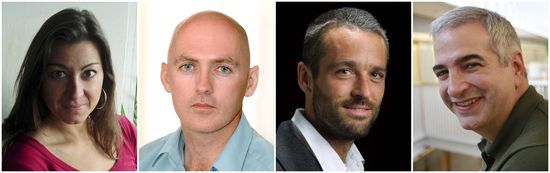
The missing journalists are Anthony Shadid, the Beirut bureau chief and twice winner of the Pulitzer Prize for foreign reporting; Stephen Farrell, a reporter and videographer who was kidnapped by the Taliban in 2009 and rescued by British commandos; and two photographers, Tyler Hicks and Lynsey Addario, who have worked extensively in the Middle East and Africa.

Mr. Keller said there was some speculation that they had been detained at a government checkpoint between Ajdabiya and Benghazi, a rebel stronghold in eastern Libya. If that is the case, he said, they would eventually be taken to Tripoli. “Beyond that, we’re still pretty much in the dark,” he added.

Here is a the last known photo of Addario and Hicks, seen fleeing a battle with a number of other journalists. Holly Pickett, also in the photo, spoke with MSNBC about the dramatic scene:

Pickett said it was the most chaotic, intense situation she has ever been in. “Bullets were whizzing past us. You could see the dust stirring on the ground from bullets zipping past our legs. I’ve never taken this much fire before,” she said. At the end of the day, opposition forces were in a full-scale retreat.

Babak Dehghanpisheh, a friend of the missing journalists, shares his thoughts.

(Image: A combination made from photos provided by the New York Times and an Associated Press file photo shows New York Times journalists, from left, photographer Lynsey Addario, reporter Stephen Farrell, photographer Tyler Hicks, and Beirut bureau chief Anthony Shadid. The four journalists covering the fighting in Libya were reported missing on Wednesday, March 16, 2011, and the newspaper held out hope that they were alive and in the custody of the Libyan government.)

The Daily Wrap

Today on the Dish, US intervention in Libya loomed, and Andrew asked some dire questions about this imminent war, and the other wars we're still engaged in. The ironies mounted, Exum had questions, Dick Lugar brought some sanity to the debate, and then we found out they briefed Congress in secret. Larison demolished David Kopel's paper tiger, Les Gelb explored an Arab League no-fly zone, and Douthat kept his eyes on what would happen after the intervention. Vivienne Walt explained the tribal loyalties keeping Qaddafi in power, and Scoblete looked to Iraq's example for what happens next. Andrew built on Reihan's assessment of America's relative decline and the right's amnesia about the last ten years. Nick Kristof reported on the scary sectarian riffs in Bahrain, Iraq cracked down on free speech, and Jill Goldenziel updated us on Egypt's long constitutional road ahead. Andrew noted the shift in GOP rhetoric on Afghanistan, Palin planned her visit to Israel and Andrew braced himself for a civilizational war against Islam. Greg Ip charted economic upheavals after terrorist attacks and natural disasters, Will Wilkinson looked to Japan's economic recovery, Euan Mearns eulogized nuclear energy, and the body count grew. Readers testified to looting in Japan, Chris Beam explored the crime aspect, Jesse Walker reminded us that solidarity is the norm, and finally we got some good news.

Andrew applauded the NYT's blogger-friendly paywall, Alexis found the cracks, and Felix Salmon scratched his head. Bradley Manning was chained, Scott Morgan analyzed what's at stake in Montana's marijuana raids, and Robert Shrimsley spoofed Obama's foreign policy. We gawked at Rebecca Mansour, Palin's right-hand gal, and stood in awe before the GIF wall of Judge Judy. Palin played the international circuit, Felix Salmon explained why we'll wait to be seated, and Americans wanted more debt. Readers enlightened us on the backwoods of disability pay, and Andrew marveled at a century of taxation that favored the rich. O'Keefe's antics exhausted James Poniewozick, Avent outlined the job of economists, and calling it a drug war actually kills people. Yglesias and Klein debated serious journalism, we celebrated Bayard Rustin's birthday, and Noah Millman reviewed Irving Kristol's writings. Comstock took issue with Andrew's framing of his MPAA project, marriage equality became a wedge issue, and readers mouthed off on Gilbert Gottfried's tasteless jokes.

Charts of the day here and here, quote for the day here, dissent of the day here, VFYW here, MHB here, FOTD here, history of St. Patrick here, basset hounds in flight here, and guilty dog here.

–Z.P.

Qaddafi Relents?

BENGHAZI0317PatrickBaz:AFP:Getty

According to his son, Saif, plans to attack Benghazi have been shelved:

“He said that the army is not going to go into Benghazi. It’s going to take up positions around the stronghold,” said Nic Robertson, a CNN reporter who was telephoned by the son. “The reason is they expect a humanitarian exodus. They expect people will be afraid of what’s going to happen, and he said the army will be there to help them get out.”

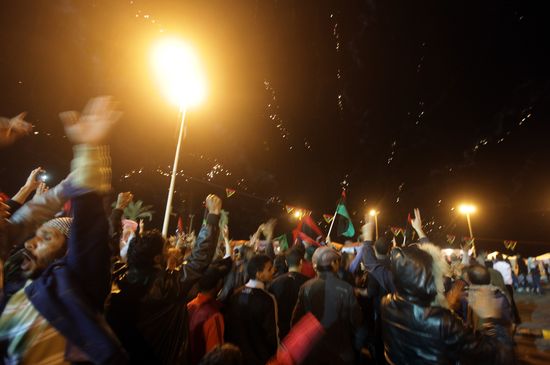
Who knows the truth? His father's latest rant, threatening to go into every closet and murder the inhabitants may have tipped the balance at the UN, and Saif is trying to take that back – too late. Meanwhile, the beleaguered and brave residents of Benghazi are understandably euphoric and ecstatic, as you can see above. We owe them now.

(Photo: Patrick Baz/AFP/Getty.)

Dissent Of The Day

A reader writes:

You should be applauding the way Barack Obama is handling the Libya situation. It is realpolitik in a most self-aware, calculating, interest-driven, human rights driven, cold-blooded form. It's something you claim to want in our foreign policy.

The US is not leading this, and probably won't, ever. That is why Barack Obama is not making a public drive for support. In fact, we were moved toward a no-fly zone by Arab countries largely, and Europe, decisively. When was the last time that happened? Ask yourself why Obama is acting this way.

He does not want to be in front, because he isn't, and he shouldn't be.  That is a lesson America has learned, painfully, and which Obama is heeding.

In addition, this is a fluid situation, not an entrenched stalemate onto which American forces will impose an outcome. Locally, there is no fear of Qaddafi anymore, which cannot be said of either Milosevic in Bosnia or Saddam in Iraq, or the Taliban in Afghanistan.  And think of the positive outcome that is likely – yes likely – another dictator in the Middle East gone, months after the last one, with minor but real US support for the reformers, and another deadly blow to the Al Qaeda narrative that America hates the Arab street. This is a gamble, a long ball, no doubt.  But a smart one, whose payoff could be immediate, and grow more enormous for decades.

My instinct tells me that Obama believes a non-US led (hopefully Arab led) no-fly zone can get rid of another dictator in a region boiling with democratic revolution.  That alone would be incredibly positive.  What comes after, in a region quickly turning a historic page, is probably worth this calculated risk.

From my reader's email to God's ears. But a couple of things: if this is actually going to be led by the Arab states, where are they? Here's what we have so far:

Diplomats said Qatar and the United Arab Emirates were considering taking a leading role, with Jordan, Saudi Arabia and Egypt also considering participating.

Of course, something may be going on behind the headlines. As in:

Egypt's military has begun shipping arms over the border to Libyan rebels with Washington's knowledge, U.S. and Libyan rebel officials said. The shipments—mostly small arms such as assault rifles and ammunition—appear to be the first confirmed case of an outside government arming the rebel fighters.

Alas, this won't be enough. We also know this:

Officials in Britain, France and the United States were all adamant that Arab League forces take part in the military actions and help pay for the operations, and that it not be led by NATO, to avoid the appearance that the West was attacking another Muslim country.

But where are these forces? Who has agreed to pay? And if it's risky for the US or NATO to be seen interfering in Libya, because it looks imperialist, does anyone think the former colonial powers, Britain and France, based in Italy, the country that once controlled Libya, might not be perceived as imperialist before too long?

And one more thing: What if Qaddafi takes Benghazi anyway, despite the intervention? What if we simply create a stalemate which becomes an even deeper and bloodier civil war? Once you start this, it cannot be stopped till either Qaddafi wins in a manner that truly would mean a triumph of despotism against the entire West – or we own the place. But I guess there's no going back now.

Forget History (Or Not)

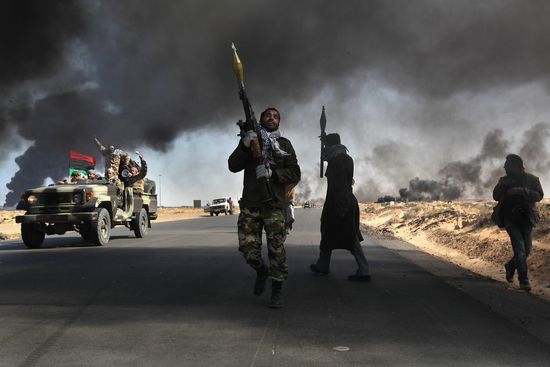
RASLANUFJohnMoore:Getty

Lawrence Kaplan, the co-author with Bill Kristol, of a spectacularly ill-informed book, The War Over Iraq, insists we try not to analogize the imminent war on the Libyan regime with any past precedents of war against a Muslim country. Well, I'm not. I'm analogizing it to present wars which still grind on in both Iraq and Afghanistan and both of which have spectacularly failed by any reasonable cost-benefit analysis and certainly on the grounds that Kaplan made back in 2003.

Then he cites three no-fly zone experiments, two in Iraq and one in Bosnia, two of which he acknowledges failed. So some history is to be forgotten – everything since 2003 and two failed no-fly zones – but some is to be remembered (the one success in Kurdistan). Hence presumably this parenthesis:

(Deceptive as they mean to be, some historical analogies do hold more explanatory power than others.)

Well, yes. Iraq and Libya are very different countries in very different periods. But the fundamental issues for using the US military to launch a war on either country are the same: What is the exit plan? Who are we actually supporting? How does a no-fly zone work without troops on the ground? Who would be involved in the coalition? How much could this cost? What could be the unintended consequences?

None of these questions is answered in the piece. Nor were they answered by Kaplan before the Iraq war (among Kaplan's confident assertions in 2003 was that there was no serious sectarianism in the country any more). In fact, Kaplan/Kristol mocked those asking the salient questions in the 2003 book. Money quote:

Predictions of ethnic turmoil in Iraq are even more questionable than they were in the case of Afghanistan… Unlike the Taliban, Saddam has little support among any ethnic group, Sunnis included, and the Iraqi opposition is itself a multi-ethnic force… [T]he executive director of the Iraq Foundation, Rend Rahim Francke, says, "we will not have a civil war in Iraq. This is contrary to Iraqi history, and Iraq has not had a history of communal conflict as there has been in the Balkans or in Afghanistan…"

A scholar that mis-informed now lectures us on Libya – and the Obama administration (which would not exist if Obama had backed the Iraq war) follows suit.

Kaplan cites widespread European support for intervening, to which the obvious reply is: let the French and British and Italians organize the Arab League to institute a no-fly zone. Let them pay for it themselves, and be prepared to tackle the entire set of consequences. If Sarko wants his Dubya moment, let him have one. And let's see how the Arab world in the long run views such action by colonial powers.

The US is broke, its military over-extended, in two ill-conceived wars that are still being waged at a staggering human and financial cost. Maybe we should ask Lawrence one simple question: what would you cut from the budget to afford such an open-ended military endeavor? If you cannot answer that one, you really have learned nothing from the disasters – fiscal and military – of the last decade.

More on the war we have just been told is happening here, here and here.

(Photo: Libyan rebels battle government troops as smoke from a damaged oil facility darkens the frontline sky on March 11, 2011 in Ras Lanuf, Libya. By John Moore/Getty.)