Don't they realize that to win the GOP nomination you have to at least sound like you're from the South. T-Paw is now competing with Romney in his eagerness to please.
Month: March 2011
They Briefed The Congress – In Secret
This is a more secretive and impulsive war than either of Bush's. Butters is jumping up and down and rubbing his hands together:
"I want to take back criticism I gave to them yesterday and say, ‘you are doing the right thing,'" said Graham. "My money is on the American Air Force, the American Navy, and our allies to contain the Libyans, and anybody on our side that says we can't contain the Libyan air threat — I want them fired."
Let's listen to the Air Force Chief of Staff Norton Schwartz, shall we? Money quote:
He called the plan to impose a no-fly zone in a few days "overly optimistic" and said "it would take upwards of a week." Schwartz was also clear that while the U.S. military can impose a no-fly zone, that's not likely to stop Qaddafi all by itself. He also noted that to do so effectively might require diverting some resources from the missions in Iraq and Afghanistan. "The question is, is a no-fly zone the last step or is it the first step?" Schwartz said. Asked by Sen. John McCain (R-AZ) whether a no-fly zone could turn the momentum, Scwartz replied, "A no-fly zone, sir, would not be sufficient."
So when that is insufficient, what do we do then? Hand Qaddafi a victory not only over the rebels but over the US? Of course not. That means a potentially intractable, expensive war without public support or Congressional debate and authorization.
Remind me again: did McCain or Obama win the last election?
The Egypt Factor

A useful take on what could really make a difference in Libya:
Gaddafi can win without his air force. Tanks and artillery beat courage and small arms every time. What is actually needed is active military intervention on the ground and in the air by disciplined, well-trained Arab forces, sent by a revolutionary Arab government that is in sympathy with the Libyan rebels. So where is the Egyptian army when the Libyans need it?
Egypt has an open border with the rebel-controlled east of Libya, and just one brigade of the Egyptian army would be enough to stop Gaddafi’s ground forces in their tracks. The Egyptian air force could easily shoot down any of Gaddafi’s aircraft that dared to take off, especially if it had early warning from European or American AWACS aircraft. The Egyptian army would probably not need to go all the way to Tripoli, although it could easily do so if necessary. Just the fact of Egyptian military intervention would probably convince most of the Libyan troops still supporting Gaddafi that it is time to change sides.
(Photo: Egyptian army tanks are deployed in front of the monument to the unknown soldier in Cairo on February 17, 2011. By Pedro Ugarte/AFP/Getty Images)
Finally, Sanity
Clearly, the United States should be engaged with allies on how to oppose the Qaddafi regime and support the aspirations of the Libyan people. But given the costs of a no-fly zone, the risks that our involvement would escalate, the uncertain reception in the Arab street of any American intervention in an Arab country, the potential for civilian deaths, the unpredictability of the endgame in a civil war, the strains on our military, and other factors, I am doubtful that U.S. interests would be served by imposing a no-fly zone over Libya … If the Obama administration decides to impose a no-fly zone or take other significant military action in Libya, I believe it should first seek a Congressional debate on a declaration of war under Article I, Section 8 of the Constitution.
That seems to me to be a minimal requirement for such a drastic and risky action. The Congress must have a debate and vote on this. It's hard to express how disappointed I am not just by the administration's decision but by the president's refusal even to explain a third war to the American people. And he's now off to Brazil …? Is he kidding?
What’s The Endgame?
Andrew Exum has questions:
[W]hile there are a lot of questions left to be answered — Who pays for this war? Does the Congress need to authorize anything? What are the vital U.S. interests we are trying to protect? — the question that most concerns me and pertains to readers of this blog is what happens next?
What happens if Gadhafi pulls back? Do we continue to try and press the advantage of the rebels until his government falls? Do we have the authorization to do that? Do we expect a civil war in Libya to drag out, and if so, how will we take sides? If Gadhafi falls, what comes next? What will the new Libyan government look like? Will they be friendly to U.S. interests? Someone please tell me how this ends.
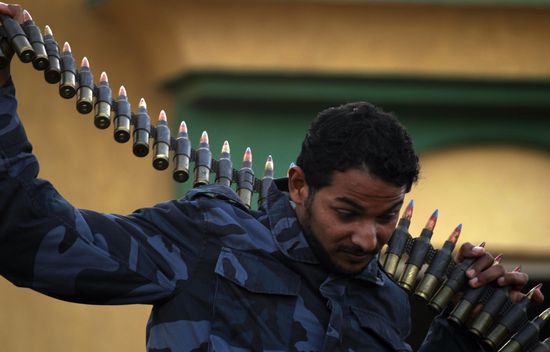
(Photo: A Libyan rebel carries an ammunition belt in the streets of the eastern Libyan coastal town of Tobruk near the border with Egypt on March 16, 2011, as the forces of Libya's strongman Moamer Kadhafi pressed rebels in the west on and threatened their eastern bastion of Benghazi while UN chief Ban Ki-moon called for an immediate ceasefire. By Patrick Baz/AFP/Getty Images)
Why Doesn’t The Arab League Go To War Instead?
One possible answer: total military incompetence.
Who Will Be The First Republican …
… to demand a Congressional vote on this? Or does the Bosnia precedent mean no such authorization is necessary? It sure will be fun to see Democrats backing unilateral executive power to go to war, won't it?
The Ironies Mount
I find it odd that so many interventionists are citing support from the Arab League and the GCC in their arguments for attacking Libya. This would be the same Arab League that includes all of the members of the GCC, which is presently engaged in a crackdown on behalf of Bahrain’s government. The GCC would be doing this whether or not there were a debate about intervening in Libya, but it’s a useful reminder that multilateral intervention doesn’t have to be only on the side of rebels and oppressed groups.
So by going to war against Libya, we are also forced implicitly to back the repressive Sunni autocracy in Bahrain. Morally, snuffing out Bahrainian reform is worth less than standing by as a full-scale massacre occurs in Benghazi. But there are costs and benefits to both over the long run and I suspect the US has sacrificed a huge amount for this denagerous adventure. Real reform in Bahrain could be far more important for US interests than nation-building in Libya.
Some argue that by ceding the leadership to the Europeans, the US has pulled off a serious multilateral trick – advancing collective security by an intervention demanded by Britain and France. But why not then ask the Brits and French and Arabs to go to war by themselves in furtherance of their own interests, and merely offer UN support? I sure hope that this war will be paid for entirely by Britain and France and Saudi Arabia. But somehow, I doubt it, don't you?
Another War, Ctd
A reader writes:
Like you, I've been appalled by the screeching coming from neocons and Hitchenites who have been advocating blindly for the U.S. to intervene with no regard for the past. But you should take note as well that many of the neocons and other have been screaming for not just foreign intervention, but unilateral U.S. intervention if necessary. But Obama is not them, and he has shown time and again that he is smarter and more judicious than they are. Obama has remained collected, reserved, and judicious about this, where other presidents might have felt compelled to look "strong". He did not, as some advocated, rush to give unilateral military aid and arms to the rebels. And he's now put the U.S. in a position, at least conceptually, to potentially lend support to an intervention led by other countries but without the U.S. having to "own" the intervention.
Whether that is possible, we'll just have to see. But notice that unlike Clinton in the case of Bosnia, and unlike Bush in the case of Iraq II, Obama has managed to get something his predecessors could not: UN support for what could be a major multilateral intervention led by states other than the U.S. Doesn't this remind you in some ways of how he handled healthcare, and succeeded where his predecessors had failed, to do something of real significance through patience, reserve, and a commitment to process? Like the health-care bill, this no-fly zone may very well have many things wrong with it. But Obama has proved me wrong so many times before, that I'm going to wait a bit before turning against this too fast, even though I'm skeptical.
I hope to God you're right. But we don't know, do we? We don't even know why the president made this decision – or whether indeed he made it at all. We are at war without the president even informing us of the fact, let alone explaining why, and how we get out, and what our goals are, and how we will pay for it. Whatever else this is, it is antithetical to democratic accountability. Another writes:
Calm down. It is an unfunded, unpopular, undeclared war against a Middle Eastern country that has absolutely no positive effect on our national security. What could possibly go wrong?
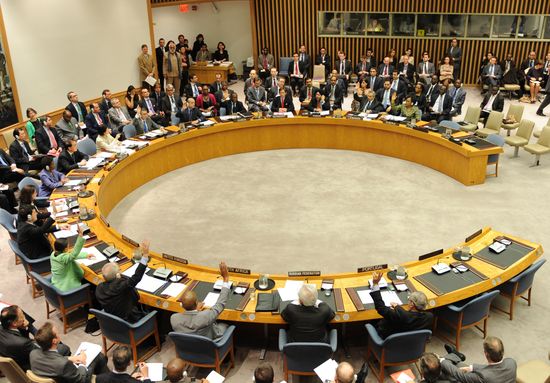
(Photo: The United Nations Security Council votes on a Libya resolution calling for a no-fly zone and "all necessary measures" against forces loyal to Moamer Kadhafi, March 17, 2011 at UN headquarters in New York. The vote was 10-yes and 5 abstained – China, Russia, Germany, Brazil and India. By Stan Honda/AFP/Getty Images)
Quote For The Day
Worth noting from a few days ago:
Senior officials, notably the national security adviser, Thomas E. Donilon, have made it clear that the United States does not view Libya as a vital strategic interest."
This strikes me as the worst decision by Obama since he ramped up forces in Afghanistan. If he thinks it makes him look stronger, he's nuts. He looks weak and led around by Cameron and Sarkozy and Clinton. If he's doing it purely for humanitarian reasons (and since there are no vital interests involved, he must be, right), why have we not stopped the slaughter in the Congo? Why have we not intervened in Zimbabwe? Why are we not instituting no-fly zones in Burma?
None of this makes any sense. And the cost? $300 million a week – or $15 billion a year. Where is that coming from? Or have we really re-elected another Bush? More war paid for by more borrowing – with no leadership on the longterm fiscal crisis.
 The Dish