Some Questions On The Imminent War

SUSANRICEmarioTama:Getty

If the no-fly-no-drive zone fails to protect Benghazi from Qaddafi, are we then obliged to intervene on the ground? What the UN Resolution seems to require is protection of civilians. But if the methods authorized fail to do so, do we then just give up and give Qaddafi not just a victory against his own people but also against the West?

On the other hand, what are the US's obligations if the protection of Benghazi is successful? Are we required to provide food or arms to the rebels? And if the UN Resolution passes, hasn't the US essentially told the rebels to fight on? Having done that, do we not have a moral obligation to support them in an open-ended civil war?

How much is this estimated to cost? What programs are being cut in order to afford this?

It seems to me that this new war ignores every single lesson of the recent past. There is no clear goal. There is no exit plan. The American public opposes it. However tarted-up the coalition is, in the end, we all know that this will become a US responsibility. And we do know that if we break it, we own it, do we not?

If we are prepared to do this in Libya, why not in Congo, where the casualties and brutality have been immensely greater? Or Zimbabwe?

In endorsing the rebels, have we not forgotten the nonviolence that was the core mainspring of the Arab 1848 and legitimized much more divisive means of regime change?

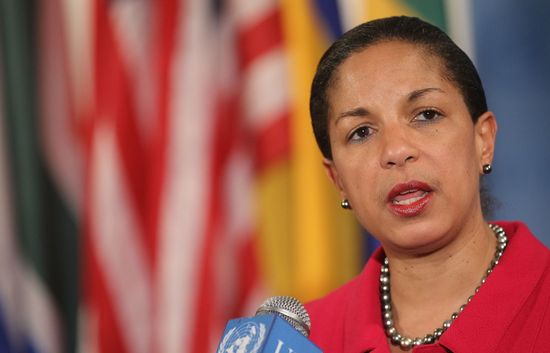
(Photo: Ambassador to the United Nations Susan Rice speaks to the media after a U.N. Security Council meeting on the situation in Libya March 16, 2011 in New York City. By Mario Tama/Getty.)
Another War?

The UN Security Council has apparently got the votes for a resolution for a no-fly no-drive zone to protect Benghazi from Qaddafi's forces and a vote is imminent. Military action could occur immediately after the resolution passes. It is not just a no-fly zone, and will involve bombing roads and military personnel in Qaddafi's mercenary and paramilitary forces. There is apparently language in the resolution that establishes a "responsibility to protect" the civilian population of Benghazi. The coalition will apparently include the British and French and unknown Arab countries. Why unknown?

Several Arab countries have promised to provide planes, but insisted upon their identity being withheld until the resolution was passed. Speculation as to which countries would participate include Saudi Arabia, the United Arab Emirates and Qatar.

Ground troops are ruled out – unless there are downed aircraft or captured airmen (which there well may be). There is no indication of what would happen if the bombing of Libya fails to halt Qaddafi's forces, or if it succeeds in protecting the Benghazi-based revolt. Qaddafi is threatening retaliation across the Mediterranean if the resolution passes and a war begins.

And so the US is at war in a third Muslim country. And yes of course this is a war.

If bombing another country's military in its airspace is not war, then what exactly is? No vote to authorize such a war was taken by the Senate, and no debate was truly aired among the general public, who oppose the action by overwhelming margins. It is very hard to think of another action in direct contravention of Obama's promises as a candidate. So let me ask one simple question at the outset: what is going to be cut to afford this new open-ended conflict? And what will it cost? Or is that as irrelevant now as it was before Iraq?

In all this, Americans may well find themselves at war tomorrow – and their president will not even have explained to them why. This makes the Iraq war look very well considered and deliberated. And one can only hope for the best.

The Body Count

110259399

Will Oremus asks why Japanese fatality numbers were hugely undercounted and reported "with a precision that would later seem absurd":

Vickie Mays, a professor and clinical psychologist at U.C.L.A. who has worked on disaster responses, says survivors are often caught between hope and despair. To the extent that it tips the balance in favor of hope, reporting only the confirmed dead rather than the number presumed dead can save lives. “Why do you want somebody to officially come out and say you’re dead when you’re not, or they don’t know it for a fact?” Mays asks. “You want people to pray, have hope, go out and assist in an orderly way with the rescue. You want the volunteers who are going to try against all odds.”

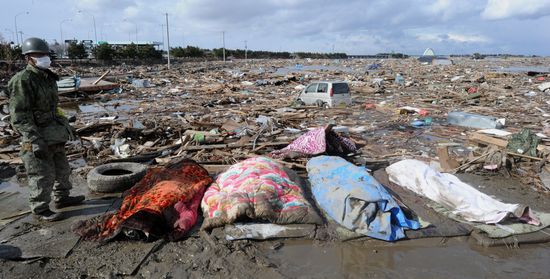
(Photo: A Japanese soldier stands next to a line of wrapped-up bodies recovered from the sea of devastation and debris in Natori, Miyagi prefecture on March 16, 2011 after the March 11 earthquake and tsunami. The official toll of the dead and missing following a devastating earthquake and tsunami that flattened Japan's northeast coast has topped 11,000, with 3,676 confirmed dead, police said on March 16. By Mike Clarke/AFP/Getty Images)

Meanwhile, In Egypt

Jill Goldenziel analyzes Egypt's constitutional reforms:

While the amendments represent a positive start, these rushed, superficial constitutional revisions alone will not lead to substantive democratic change in a deeply flawed system.  Organizing a vote in a country of 83 million is an overwhelming logistical task when previous elections were outright rigged by the Mubarak regime.  Without appropriate time to prepare internal or external monitoring, the referendum process itself is fraught with opportunities for fraud.  Moreover, the SCAF appears to be ramming the amendments through as a package with little opportunity for public debate or dissent on individual provisions.  This does little to promote democratic discourse, and evokes tactics long used by authoritarian regimes to preserve power under democratic guises. 

How O’Keefe Wins

After an effort to explain the misrepresentations in the NPR video, James Poniewozick gets exhausted:

I mean, Jesus, look how long this post is already–and I've only covered a few minutes of a two-hour tape of four people eating lunch. It took me a few hours to watch–transcribing, finding sections, re-watching scenes–analyze and write up. As of this paragraph, I'm at about 1650 words—thank you if you've stuck it out this far!—and I've left plenty out, partly because, frankly, I have other stuff to do. I'm thinking about writing my TIME column about this subject this week. I get about 700 words for that, I can't embed explanatory video, and I'll need to include much more background about NPR, O'Keefe and the week's controversy than I did here. Good luck!

The column is here.

The Unipolar Moment Passes

Reihan makes an important point:

If the strategic footprint of the U.S. shrinks after a decade of expansion — after the 2001 terror attacks, U.S. influence expanded deep into the heart of Central Asia and Sub-Saharan Africa, and elsewhere — other countries, including countries we consider unsavory, will pick up the strategic slack. This was a central part of the Nixon-Kissinger strategy during the détente era: Vietnamization was part of a broader concept of relying on proxy states, like Iran under the Shah, to contain Soviet expansion rather than to rely solely on American power. These archrealists also believed that this was a step on the road to a multipolar world. Basically, I think we’re going to see more interventions like the movement of Saudi troops into Bahrain, and there’s not much we can do about it.

I think the basic underlying division today among foreign policy elites is simply between those who have internalized America's relative decline and the limits of hard power revealed in the last decade … and those who haven't. And what's remarkable to me about those who haven't is that, in inveighing on Libya, they don't even mention the Iraq and Afghanistan precedents, or reduce them to an aside. You can read Leon Wieseltier's screed and find not one mention of the past ten years, as if they had not happened, as if he had not endorsed both, as if we have gone from 1994 to 2011 with nothing in between. And so he can write a sentence like the following:

Why is Obama so disinclined to use the power at his disposal?

Really: is the amnesia and lack of intellectual responsibility that deep? The same could be said for Wolfowitz's 2003 replay. These people have simply wiped the last ten years off the map, or reduced it to this:

After the Iraq War, we are all mindful of the risks inherent in any military action. The caution of a Robert Gates is understandable, although it’s wrong to assume every U.S. operation must go astray. If we can’t establish a no-fly zone over Libya and stop Qaddafi’s drive toward Benghazi, we really are tapped out as a world power. It’s the least we can do to tip the fight against a dictator with American blood on his hands.

Now unpack this for a minute. The point, it seems, of going to war with Libya is to prove that America is still a world-power and to get revenge on Qaddafi. Have they learned nothing?

Why No Looting In Japan? Ctd

Our reader who wrote that “the notion that there is no looting in Japan is a myth” follows up:

Unfortunately, I can’t find any English sources on this, because when I try to search for it I am deluged by a bunch of articles about how there is no looting in Japan. But below I list some Japanese sources and provide brief summaries in English. I also found a YouTube video of a looting in progress (albeit calm looting – the employees just watch as it happens). (1) Looting

As of the 14th of March, Prefectural Police in Miyagi reported 40 known cases of looting. An earlier article (on the 13th – there were 21 cases of known looting by then) quoted a police officer noting that known looting cases were likely only a tiny fraction of the actual looting. He also warned store owners to watch out and protect themselves.

An article from a different source on the 17th reported at least 146(!) cases of looting, including failed attempts that resulted in an arrest. Some of the looting is food, but also people taking cash and brand name clothing. The article also talks about a man at an evacuation center attempting to molest a little girl.

(2) Hoarding/Stocking Up on Supplies

Here is article about how people in Tokyo hoarding food and gas are causing trouble for people in the real disaster areas up north. Here is another article about government efforts to stop people form hoarding:

(3) Fraud

Here is a report about people fraudulently posing as Tokyo Electric Power employees and visiting homes to trick people into paying for “repairs”. Here is more general article about the phenomenon of people doing things like using the earthquake to go to people’s homes to scam, saying it was extremely common in the past after natural disasters.

Iraq Cracks Down On Free Speech

Joel Wing sews together various reports:

Prime Minister Nouri al-Maliki has often been accused of being an autocrat. He has also never been good at taking criticisms. His response to the protests highlights both of those negative traits. The marchers are increasingly focusing their rage against the premier for his inability to improve services, fight corruption, or develop the country. In turn, he has clamped down on the media to limit the spread of the demonstrators’ ideas. He has not only used the security forces to limit the ability of the press to cover the demonstrations, but has subjected them to beatings, arrests, torture, and their offices being raided and vandalized. Journalists are still out in the streets everyday reporting on the marches, but the word has been put out that this could be a dangerous job, which may incur the wrath of the government.